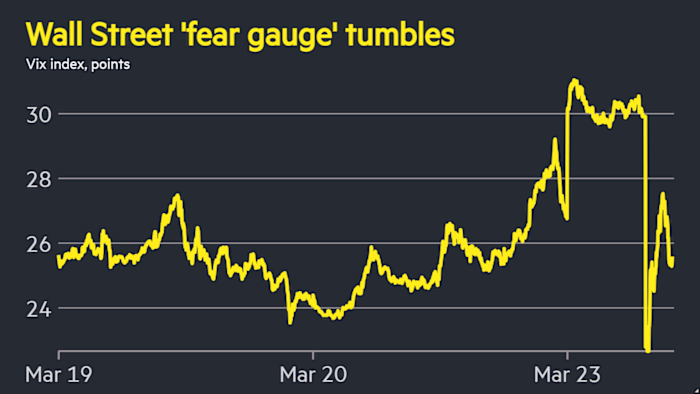

The recent announcement from US President Donald Trump regarding a postponement of attacks on Iranian energy infrastructure following “constructive” talks has triggered a volatile market response, with immediate implications for the MENA region’s financial landscape and broader geopolitical stability. While the immediate market reaction saw a rebound in stock markets and a dip in oil prices, the long-term business impact, particularly on sovereign capital, venture capital, and regional infrastructure, remains highly uncertain and warrants careful scrutiny.
The immediate market reaction underscores the fragility of geopolitical resolutions. The financial markets exhibit a clear sensitivity to perceived de-escalation, evidenced by the surge in equities and the subsequent drop in oil prices. However, the conditional nature of Trump’s statement – a mere postponement contingent on the longevity and outcomes of future negotiations – introduces significant risk. The success of any such “pause” hinges on Iran’s willingness to engage constructively and on the ability of the US to maintain pressure on Iran’s nuclear program. This necessitates a complex interplay of diplomatic, economic, and potentially military strategies. The uncertainty surrounding these factors raises concerns for sovereign capital in the MENA region, particularly those heavily reliant on oil revenues, as continued instability risks impacting investment flows and economic stability.
Furthermore, the potential ripple effects on regional infrastructure are substantial. The Strait of Hormuz, a critical artery for global oil supply, remains a focal point of geopolitical tension. The de-escalation, if sustained, could pave the way for increased investment in infrastructure projects vital for the flow of energy to global markets. However, any further escalation – as suggested by Iran’s immediate rejection of Trump’s announcement – could lead to renewed disruptions, significantly impacting trade, investment, and economic growth across the region and beyond. Venture capital activity in MENA, heavily influenced by global investor sentiment, will be closely watching the development of a more stable regional environment. A sustained period of volatility could severely curtail investment in sectors reliant on energy security and supply chain resilience.
In conclusion, while Trump’s statement presents a fleeting opportunity for de-escalation, the complex geopolitical dynamics and inherent risks associated with the situation call for cautious optimism. The business community in the MENA region must closely monitor the evolving situation and develop contingency plans to mitigate potential disruptions. The long-term impact on sovereign capital, venture capital, and regional infrastructure will depend heavily on the sustained nature of any de-escalation and the willingness of all parties to engage in constructive dialogue. The situation fundamentally underscores the interconnectedness of global politics and finance, a dynamic that will continue to shape investment decisions and economic prospects in the years to come.