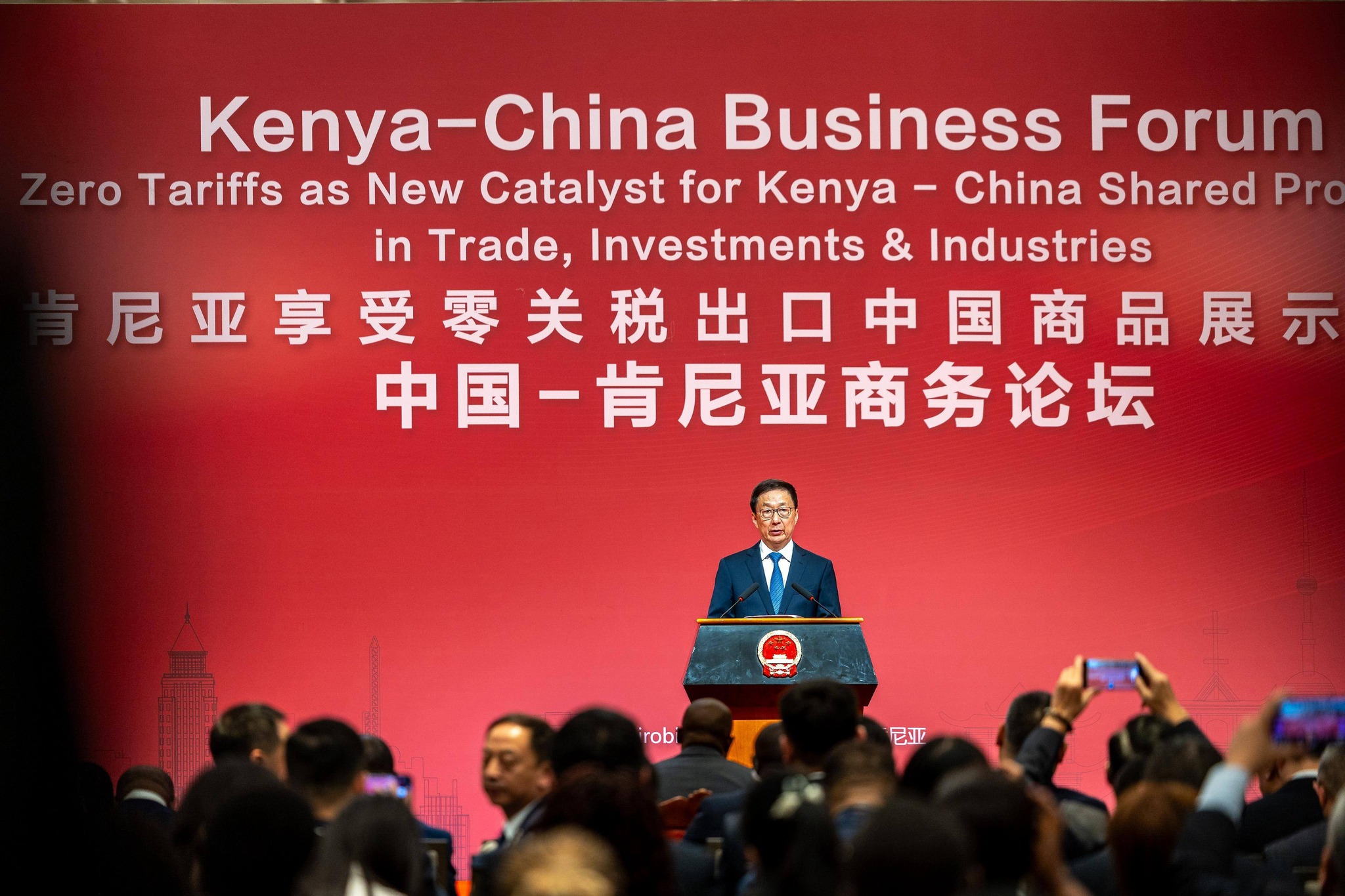

Beijing-KenyaEconomic Partnership: Implications for African Infrastructure and MENA Strategic Alignment
The reaffirmation of China’s commitment to deepening economic ties with Kenya, underscored by Vice President Han Zheng’s comprehensive support framework, represents a significant strategic pivot with profound implications for sub-Saharan Africa and the broader MENA region. China positions this alignment as a catalyst for Kenya’s economic transformation under Vision 2030, emphasizing policy coordination, knowledge exchange, and targeted investment across critical sectors. Beijing’s explicit readiness to facilitate Chinese corporate expansion, particularly through capable enterprises driving competitive industries and new growth drivers, signals a structured approach to leveraging sovereign capital for industrial and digital modernization. The imminent implementation of zero-tariff access for Kenyan exports to China, effective May 1, 2026, and the symbolic flag-off of the first shipment under this new regime, constitutes a concrete demonstration of China’s commitment to Africa. This policy is expected to substantially enhance Kenya’s export competitiveness and market access within one of the world’s largest economies, directly impacting Kenyan sovereign economic strategy and investment flows.
Strategic Infrastructure and Sovereign Capital Flows: A Regional Blueprint?
The China-Kenya partnership, anchored in tangible policy implementation like the zero-tariff initiative and enhanced trade/investment facilitation, serves as a potent model for sovereign capital mobilization and infrastructure development in Africa. Beijing’s emphasis on translating resource endowment into sustainable development gains, coupled with active encouragement of Chinese enterprise deployment, points towards substantial Chinese state-backed financing directed at Kenya’s industrial parks, logistics corridors, and digital infrastructure—key components of both Vision 2030 and China’s Belt and Road Initiative. This influx of sovereign capital, often channeled through policy banks and development finance institutions, directly addresses critical regional infrastructure deficits, potentially lowering transaction costs for Kenyan businesses and attracting parallel private capital flows. The focus on sectors such as agricultural technology, the digital economy, and green energy aligns with Kenya’s industrialization goals and offers a potential template for similar infrastructure-led development strategies pursued by other African nations, including those in strategic MENA proximity.
MENA Strategic Resonance: Leveraging Chinese Economic Engagement for Regional Infrastructure and Diversification
The strategic dynamics unfolding between Beijing and Nairobi resonate strongly within the MENA context, where economies seek to enhance diversification, attract sovereign and private capital, and integrate into global value chains. China’s articulated readiness to align development strategies with partner nations’ priorities, as emphasized by Han Zheng, underscores a model of economic engagement predicated on mutual strategic benefit and long-term partnership frameworks. For MENA nations, particularly those navigating energy transition and seeking to foster non-oil growth, the China-Kenya partnership demonstrates the potential of structured Chinese investment in non-resource sectors (digital economy, renewable energy infrastructure) as a lever for economic modernization. The emphasis on policy coordination, knowledge transfer, and the deployment of established Chinese enterprises offers lessons for MENA policymakers seeking to optimize sovereign capital utilization and attract similar large-scale, strategic foreign direct investment in high-impact infrastructure and industrial zones. This alignment represents not merely bilateral cooperation but a broader geopolitical signal of China’s commitment to Africa and the MENA as critical partners in shaping 21st-century economic architectures.