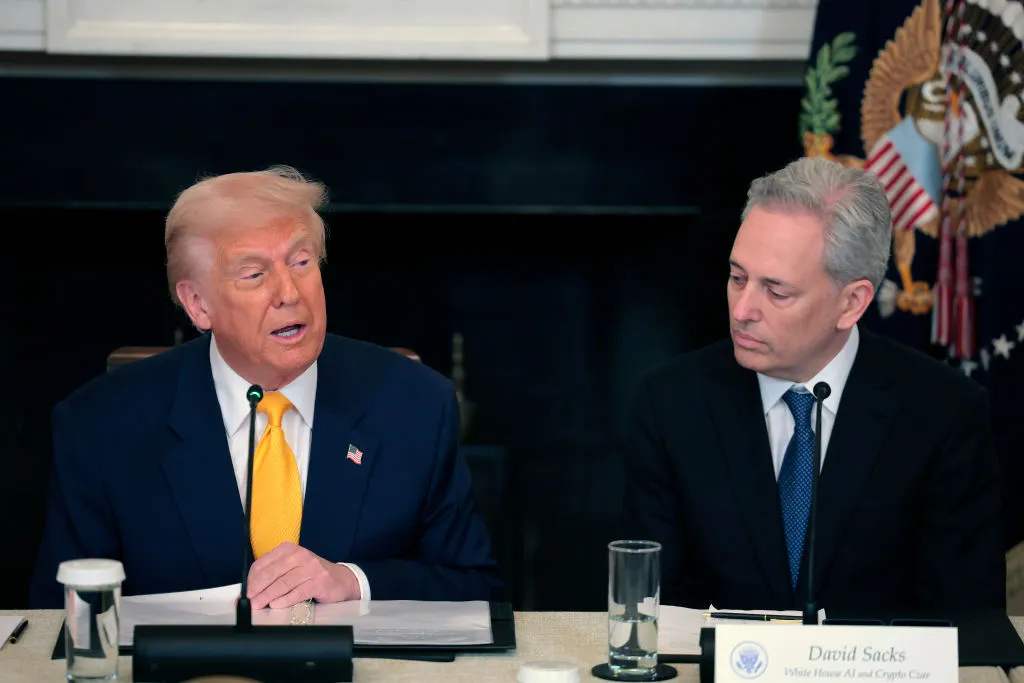

David Sacks’ transition from Trump’s AI and crypto czar to co-chairing the President’s Council of Advisors on Science and Technology (PCAST) underscores significant shifts in Washington’s technological policy architecture, with profound implications for sovereign capital allocation and venture capital dynamics in the Middle East and North Africa (MENA). His departure from the AI czar role signals a recalibration of direct governmental influence over nascent technologies, potentially creating regulatory fragmentation that MENA states and private investors must navigate. The high-profile composition of PCAST, featuring titans like Jensen Huang, Larry Ellison, and Marc Andreessen, amplifies its symbolic weight, yet its advisory nature necessitates examining how its forthcoming reports—particularly on AI standardization, semiconductor supply chains, and quantum computing—will shape global regulatory paradigms and, consequently, MENA’s strategic investments in sovereign technology funds and VC initiatives targeting advanced industries.
The council’s mandate to streamline AI governance through a national framework, aimed at displacing a “patchwork of state-level regulation,” represents a critical intervention in a sector where MENA’s sovereign wealth funds are actively cultivating domestic AI capabilities. This centralization could either mitigate MENA’s challenges in harmonizing cross-border tech investments or, conversely, impose uniformity that stifles regional innovation ecosystems. Furthermore, the inclusion of PCAST members deeply embedded in semiconductor giants (e.g., AMD, Nvidia) and quantum computing firms suggests heightened scrutiny of supply chain resilience and critical mineral dependencies—areas where MENA’s nascent mining and manufacturing initiatives intersect with global industrial strategy, offering both opportunities and risks for VC deployment in strategic infrastructure projects.
Sacks’ move, while personal, reflects a broader trend of technologists transitioning from operational government roles to influential advisory positions, thereby consolidating private sector expertise within policy discourse. This dynamic raises questions about the influence of corporate interests on MENA’s sovereign capital strategies, particularly as PCAST prioritizes nuclear power and semiconductor advancement—sectors where MENA’s sovereign funds have recently expanded. The council’s output, especially its recommendations on AI policy and quantum computing, will likely catalyze further M&A activity and capital allocation in MENA’s tech sector, demanding vigilant oversight by regional policymakers to ensure alignment with long-term infrastructure development and equitable capital distribution across the region.