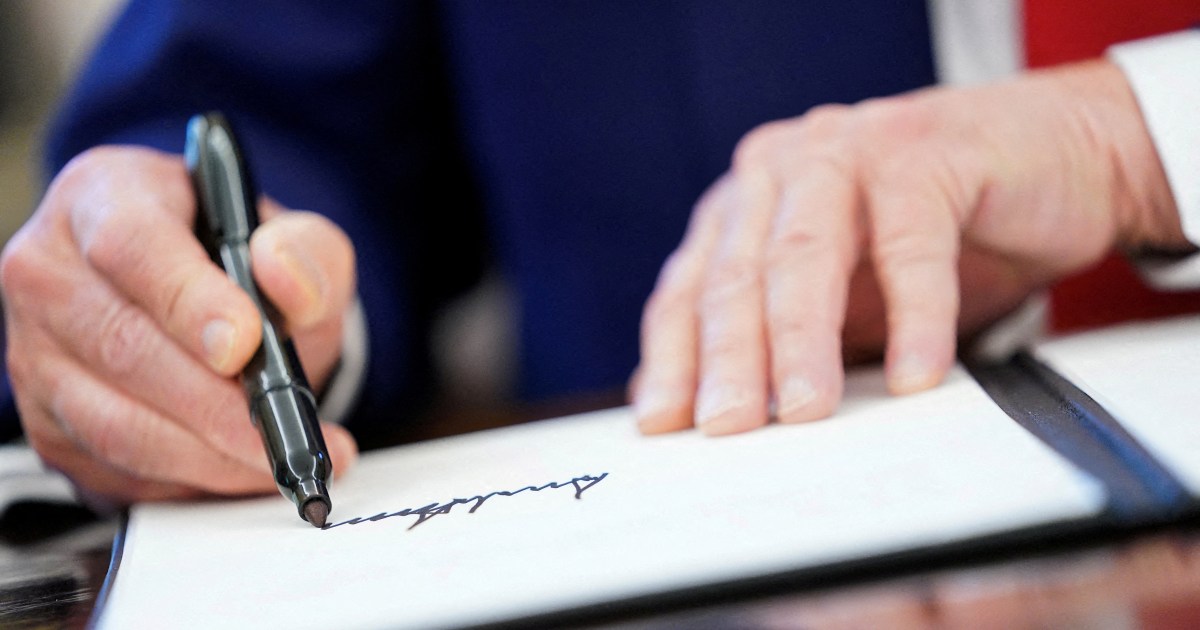

The Trump administration’s decision to emblazon the US president’s signature on all legal tender signals a brazen departure from the institutional norms that have long governed American financial symbolism, an act that itself bears broader ramifications for global capital flows and sovereign branding.
The move — revealed by the US Department of the Treasury — coincides with the commemoration of the country’s 250th Independence Day on July 4 and represents the first instance of a sitting president’s name appearing on circulating US currency beyond signature lines customarily occupied by the Treasury secretary and treasurer. Treasury Secretary Scott Bessent framed the decision as symbolic recognition of “historic achievements” under Trump, touting rhetoric of “unprecedented economic growth” despite GDP figures over the past year (2.2%) trailing the 2.5% average maintained under his predecessor. The divergence between perception and economic data points to a broader question of how symbolic changes at the apex of financial authority intersect with market confidence and the global perception of dollar-backed stability — factors that are acutely important for the MENA region, which remains heavily anchored to petrodollar flows. Feedback from markets in the Gulf and the broader region will likely be muted in public but closely scrutinized for cues on how US political manipulation of financial imagery will impact dollar-denominated derivatives, sovereign bond pricing, and regional reserves storage.
More astoundingly, the decision forms part of a series of brand-centric maneuvers orchestrated since Trump returned to the White House, which saw the minting of a commemorative gold coin with the president’s visage proceed, invoking a legal exception to a long-standing prohibition against featuring living presidents on monetary instruments. This behavior not only challenges long-running American precedents but also borders on the sort of symbolic policies one observes in less institutional market environments or outright autocratic finance. For investors, policymakers, and sovereign wealth fund managers across the Middle East and North Africa, the gesture sets an unsettling precedent by blending personal political branding with immutable fiscal infrastructure — blurring the separation between state authority and personal image. As US institutions undergo overt personalization, the region’s exposure to dollar-based investments and portfolio allocation models inevitably increases the scope for political volatility to permeate market fundamentals, compounding timing difficulties for near-term sovereign debt issuances and pipeline infrastructure projects.
Critics within US policy and Democratic leadership circles — including prominent names such as California Governor Gavin Newsom — have highlighted the disconnect between the administration’s fawning self-portrayal and deteriorating material conditions for American citizens, pointing to rising costs of living and shrinking purchasing power. Market watchers in broader corridors of power have raised concerns as to whether these politically motivated monetary alterations undermine the dollar’s soft credibility as a neutral instrument of exchange. For the Middle East, where substantial local currencies and trade remain dollar-pegged or dollar-tied, the fusion of partisan iconography with currency sends a potentially destabilizing functional signal and raises questions over the United States’ long-term commitment to depoliticized financial stewardship. Investors across Riyadh, Dubai, and Doha will be weighing whether the integrity of the dollar as the global system’s backbone is now a campaign slogan rather than a constitutional principle, recalibrating risk models in the process.