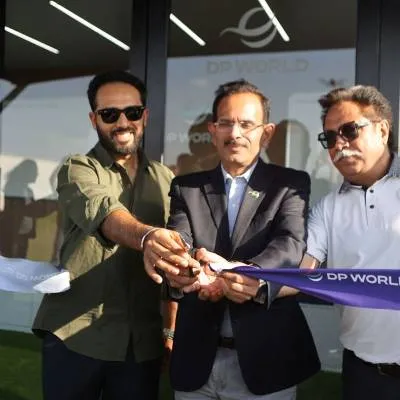

DP World’s strategic expansion into luxury sporting infrastructure through its Golf Clubhouse in Gurugram, India, underscores a bold pivot toward high-margin, tourism-driven ventures that could reverberate across the Middle East and North Africa (MENA). This move aligns with India’s push to diversify its economic base beyond manufacturing and tech, leveraging global capital flows to cultivate aspirational lifestyles and attract affluent demographics. For MENA policymakers, this reflects a broader regional imperative to repurpose sovereign capital—previously concentrated in oil and gas—toward ventures that blend tourism, leisure, and logistics innovation. By integrating premium hospitality with cutting-edge infrastructure, DP World’s model offers MENA states a template to de-risk sovereign portfolios amid volatile hydrocarbon revenues, while positioning logistics hubs as catalysts for luxury economic diversification. The venture’s success hinges on cross-border synergies; MENA nations, including Saudi Arabia and the UAE, could emulate this by repurposing their world-class sports infrastructure (e.g., FIFA World Cup 2022 facilities) into commercial ecosystems that generate sovereign returns through private-sector partnerships and tourism revenue.
The project’s implications for venture capital (VC) in MENA are multifaceted. While Gurugram’s golf clubhouse targets private-sector investors seeking experiential assets, MENA’s burgeoning VC ecosystem faces parallel challenges: sourcing capital for bets outside traditional energy sectors. Investors like Saudi Arabia’s PIF and the UAE’s Mubadala may adopt analogous strategies, channeling sovereign wealth into MENA’s nascent sports-tech ventures or experiential tourism platforms. This mirrors India’s GIFT City model, where VC-backed startups partner with sovereign entities to accelerate regional innovation. For MENA’s VC firms, the Gurugram example highlights the urgency to build niche expertise in RegTech or green logistics, which could unlock capital for climate-resilient infrastructure projects in the region. Cross-regional knowledge transfers may further enable MENA-based startups to scale into India’s booming professional services ecosystem, creating bilateral investment corridors.
Infrastructure-wise, DP World’s Gurugram clubhouse exemplifies the integration of luxury goods with logistics efficiency—a dual focus critical for MENA’s economic vision. The project’s reliance on precision logistics networks, automation, and global supply-chain optimization underscores the region’s need to modernize port terminals, urban transportation systems, and digital infrastructure. For MENA nations, where sovereign capital has historically been siloed, such ventures stress the necessity of unified digital ecosystems (e.g., Saudi Arabia’s NEOM, Morocco’s Tangier-Med port) to compete with Asia’s integrated smart-city blueprints. Additionally, the reliance on ESG-aligned development—evident in Gurugram’s solar-powered clubhouse—pressures MENA states to prioritize renewable energy integration and carbon-neutral urban planning to attract sustainable sovereign and institutional capital.
Ultimately, DP World’s strategic gambit in India serves as a microcosm of MENA’s evolving global role: a region transitioning from resource extraction to asset-backed growth through technology and tourism. Sovereign capital in the GCC and North Africa must now prioritize interoperability between logistics, tourism, and sovereign investment to sustain economic momentum. Cross-regional collaboration—whether via joint ventures with India’s industrial conglomerates or knowledge-sharing partnerships—will determine whether MENA seizes this opportunity to redefine its economic identity. The golf clubhouse case study thus signals not just a business shift, but a geopolitical push for MENA to emerge as a nexus for innovative, high-growth infrastructure in the 21st-century global economy.