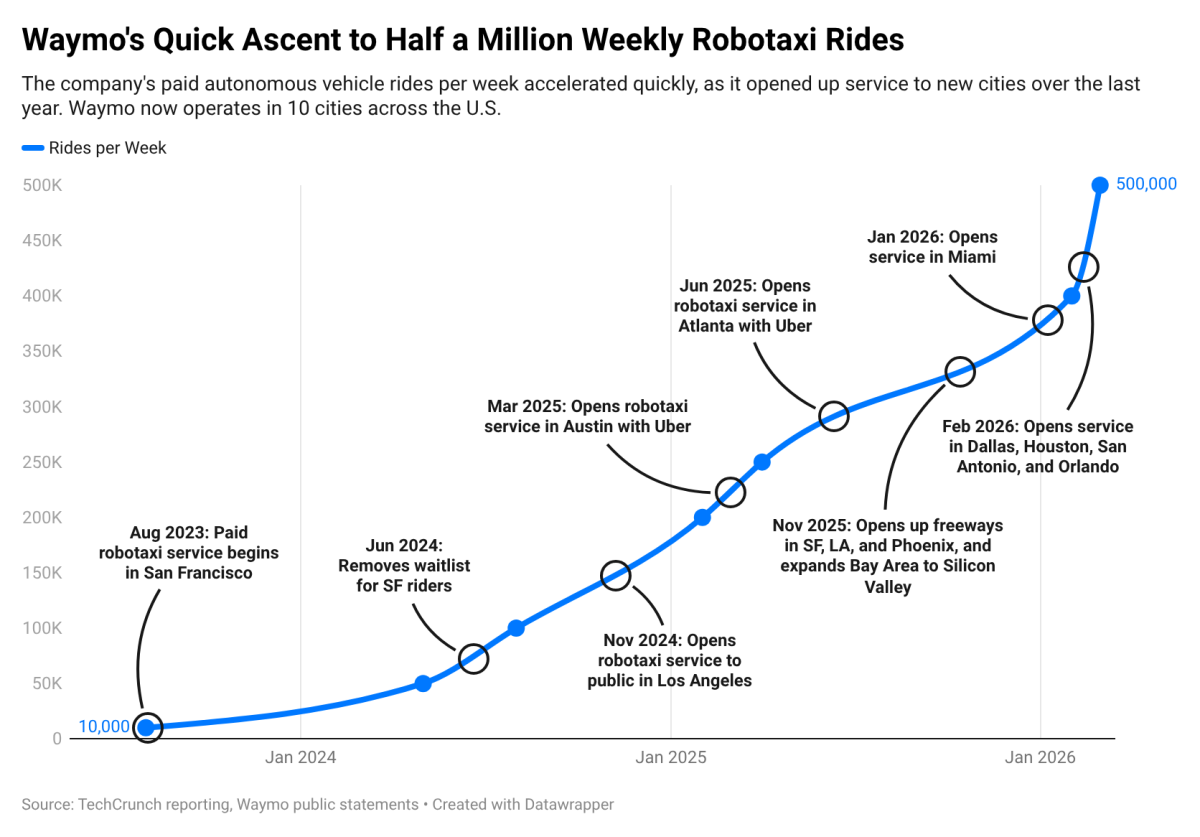

Waymo’s recent announcement of exceeding 500,000 paid robotaxi rides weekly across ten U.S. cities represents a pivotal inflection point in autonomous mobility’s commercial viability. This tenfold growth over 24 months—from 50,000 weekly rides in May 2022—demonstrates not merely technological maturation but the emergence of sustainable unit economics driving system-wide efficiency for Alphabet’s autonomous vehicle division. The company’s operational footprint now spans Phoenix, San Francisco, Los Angeles, Austin, Atlanta, Miami, Dallas, Houston, San Antonio, and Orlando, with Sun Belt expansions executed in rapid succession over the past twelve months.
The scalability metrics reveal critical infrastructure implications. With a largely static fleet count hovering around 3,067 vehicles equipped with Waymo’s fifth-generation self-driving architecture—a figure maintained from December 2024 NHTSA disclosures—the company is achieving superior vehicle utilization ratios fundamental to competitive unit economics. This efficiency becomes increasingly relevant as Waymo prepares to deploy its sixth-generation system across Hyundai Ioniq 5 and Zeekr minivan platforms produced at its expanded Arizona facility. Autonomous sector capital efficiency metrics indicate that utilization optimization rather than pure fleet expansion will dictate market dominance, with each robotaxi generating incrementally higher revenue through sophisticated dispatch algorithms and demand prediction systems increasingly vital as deployment expands regionally.
For MENA sovereign wealth dynamics, Waymo’s trajectory presents compelling franchise opportunities. Gulf Cooperation Council logistics corridors—particularly between emerging NEOM corridors and established Dubai logistic hubs—demonstrate analogous infrastructure characteristics: multimodal transportation networks, elevated digital infrastructure investment, and supportive regulatory frameworks. Regional autonomous mobility adoption hinges on government-backed sovereign capital deployment, either through phased deployment pilots analogous to Dubai’s autonomous mobility initiatives or through sovereign wealth-backed franchise agreements permitting rapid capital-intensive fleet expansion. The autonomous transportation sector’s convergence with smart city infrastructure investments positions it as attractive diversification within sovereign portfolios traditionally dominated by traditional energy and real estate allocations.