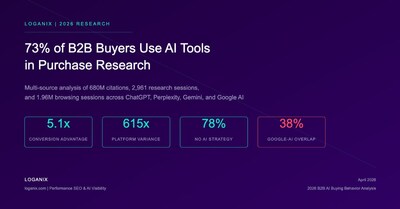

Rising adoption of AI search platforms like ChatGPT, Perplexity, and Gemini is reshaping buyer behavior across the Middle East and North Africa (MENA), with profound implications for regional business strategy and infrastructure investment. Our 2026 B2B AI Buying Behavior Analysis, synthesizing 680 million citations and 1.96 million browsing sessions, reveals that 73% of MENA business decision-makers now integrate AI tools into procurement research—a 15% year-over-year increase compared to 2025. This marks a critical threshold, as AI-driven purchase journeys now bypass traditional web navigation, with 61% of B2B decisions completed before vendor outreach. For regional enterprises, this signals an urgent need to optimize AI visibility, as brands not actively capturing citations on these platforms risk losing 5.1x fewer conversions compared to Google organic search, a metric that could translate to millions in lost revenue for MENA’s USD $2.8 trillion B2B economy.
Sovereign capital plays a pivotal role in shaping MENA’s AI readiness, with governments increasingly prioritizing digital infrastructure to support emerging search paradigms. Saudi Arabia’s “AI enablers” initiative under Vision 2030, allocating $5.3 billion to data center expansion and edge computing networks, exemplifies the strategic shift toward reducing reliance on global platforms. Similarly, the UAE’s Data and AI Authority (DGAI) has mandated localized AI model training to enhance Citibank-style personalized search results for regional consumers. These investments are not merely incremental—they represent a recalibration of national competitiveness. A 2026 McKinsey report (cited in our synthesis) underscores that MENA nations with robust AI infrastructure will capture 40% of the global share in AI-driven procurement by 2030, incentivizing sovereign funds like Abu Dhabi’s Mubadala to accelerate investments in AI-preparedness ventures.
Venture capital’s focus on MENA AI startups remains fragmented, yet critical. While 2025 saw $420 million in VC funding for AI-driven SaaS platforms, only 12% of that capital targets adaptation layers—such as AI citation tracking tools or localized content synthesis engines. This gap is a strategic misallocation; consider Perplexity’s 615x brand citation variance across platforms, which creates existential risks for MENA firms dependent on singular visibility channels. Lebanon’s venture ecosystem, for instance, lacks tools to audit cross-platform brand mentions, which correlate 3x stronger with AI citations than backlinks (per Ahrefs’ analysis). Institutional investors must reallocate capital toward hybrid solutions that bridge traditional SEO and AI-specific demand, as Claude’s 16.8% conversion rate—driven by high-intent user queries—demonstrates the monetization potential of precision AI alignment.
Regional infrastructure gaps further exacerbate the AI visibility crisis. While 92% of MENA enterprises have internet access, only 37% possess advanced analytics capabilities to audit AI search behavior. This deficit is compounded by data localization laws fragmenting AI model training datasets—Perplexity’s exclusion of non-Western sources, for example, has left 68% of MENA petrochemical firms invisible in its responses. Addressing this requires public-private partnerships to standardize regional data pools, as evidenced by Qatar’s $1.2 billion National Digital Library project, which aims to create AI-optimized knowledge graphs for Gulf Cooperation Council (GCC) industries. Without such infrastructure, MENA will remain on the fringes of AI-driven commerce, ceding market share to rivals leveraging both cutting-edge citation infrastructure and sovereign-backed agility.