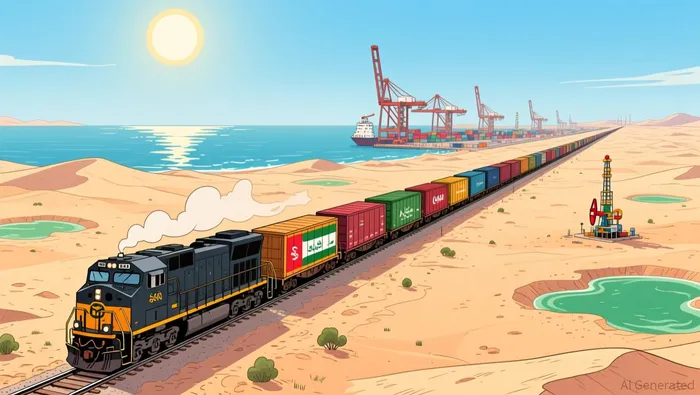

Saudi Arabia’s logistics sector surge represents more than a national strategy—it signals a transformative realignment of business fundamentals across the MENA region. The expansion of logistics capabilities, underpinned by Vision 2030 and infrastructure mega-projects like the $7 billion Landbridge, is catalyzing a shift in how sovereign capital is allocated and leveraged to secure macroeconomic resilience. For Gulf states and regional enterprises, this represents an opportunity to recalibrate investment portfolios toward critical infrastructure and logistics tech, capturing value from enhanced trade efficiency. The sector’s projected 5.5% CAGR, driven by industrialization and e-commerce, reflects a broader MENA trend where sovereign entities are prioritizing logistics as a linchpin for diversified economies. However, the success of these initiatives hinges on synchronized regional adoption, as fragmented infrastructure and capital flows could undermine the sector’s potential to become a unifying trade driver.
The infusion of sovereign capital into logistics is accelerating, with strategic reserves being directed toward assets that yield strategic volatility reduction and trade cost arbitrage. The landbridge’s prioritization of rail over maritime routes exemplifies how sovereign investment is not merely economic but geopolitical, aiming to reduce reliance on volatile shipping lanes while anchoring regional supply chains. Concurrently, venture capital is beginning to show qualitative interest in logistics-enabled technologies—such as AI-driven customs automation and blockchain for cross-border trade transparency—though early-stage funding remains concentrated in Gulf-centric ecosystems. For MENA startups, accessing sovereign-backed financing pipelines or green venture funds could unlock scalable solutions that bridge infrastructure gaps. Nevertheless, the sector’s capital trajectory remains asymmetric, as non-Gulf states lack the fiscal depth or institutional frameworks to replicate Saudi-style investments, creating a bifurcated regional opportunity landscape.
Regional infrastructure developments, if strategically networked, could transform MENA’s logistical influence into a sovereign advantage. The Landbridge’s projected capacity to handle 50 million tons annually is not an isolated effort but a blueprint for cross-border corridors that integrate with existing projects like Egypt’s Halembat Industrial Zone or Jordan’s Southern Corridor. Such interconnections would enable sovereign states to pool capital toward shared infrastructure, mitigating individual risks while amplifying comparative advantages. For venture capital, this environment offers fertile ground for syndicated investments targeting logistics tech platforms that optimize multi-country supply chains. However, the sector’s long-term viability depends on aligning sovereign capital allocation with private-sector innovation. Delays in project execution or misallocation of resources could stifle VC confidence, particularly in regions where political or economic instability persists. Investors must thus prioritize ventures that demonstrably enhance regional trade resilience, ensuring that infrastructure and capital flows are not siloed but synergistic.