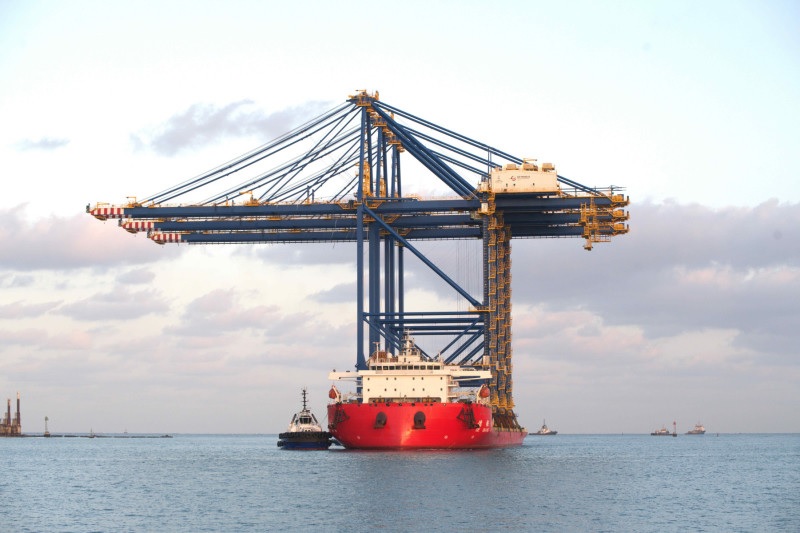

DP World’s commissioning of three new semi-automated quay cranes at Jeddah Islamic Port marks a strategic escalation in Saudi Arabia’s logistics capabilities, directly executing Vision 2030’s mandate to transform the Kingdom into a global trade nexus. The $800 million modernization—escalating terminal capacity from 1.8 million to 4 million TEUs with a trajectory toward 5 million—is a sovereign-capital-intensive endeavor, likely underpinned by Public Investment Fund alignment, that amplifies Jeddah’s resilience as a Red Sea transshipment hub. This infrastructure upgrade is not merely operational but geopolitical, enabling the port to handle the world’s largest container vessels amid persistent maritime security disruptions that have rerouted global shipping away from the Suez Canal. The immediate business impact is quantifiable: 2025 volumes surged to 1.3 million TEUs, doubling prior-year throughput as shipping lines returned to the corridor, thereby cementing the terminal’s role in absorbing diverted Euro-Asia trade flows and generating tariff-based revenue for both DP World and Saudi economic diversification goals.
The technological infusion—expanding ship-to-shore cranes from 14 to 17, with plans for 22—signals a regional shift toward automated, high-productivity port ecosystems that attract venture capital into adjacent supply-chain innovation. This automation paradigm, coupled with a 2,150-metre deep-water quay capable of berthing five ultra-large vessels simultaneously, sets a new operational benchmark for the MENA region, potentially stimulating VC allocations toward Saudi and UAE-based logistics tech startups specializing in AI-driven vessel scheduling, IoT cargo monitoring, and digital freight forwarding. DP World’s investment functions as a catalyst, de-risking private-sector innovation by providing a high-capacity terminal interface that can scale integrated solutions. Consequently, sovereign wealth funds are increasingly likely to co-invest in such tech-adjacent infrastructure, creating a feedback loop where public capital de-risks private venture deployments, thereby accelerating the region’s transition from traditional transshipment to value-added logistics services.
Regionally, this capacity expansion recalibrates competitive dynamics across the Red Sea corridor, positioning Jeddah against emerging ports like King Abdullah Economic City and Egypt’s Ain Sokhna in a race for sovereign-capital-fueled dominance. The terminal’s enhanced throughput capacity—supporting 38 weekly shipping calls—integrates with broader infrastructure initiatives such as NEOM and the Gulf Railway, weaving a networked logistics spine that could capture a significant share of China’s Belt and Road Initiative traffic. However, the business case remains tethered to Red Sea security; ongoing Houthi threats sustain elevated insurance premiums and routing volatility, which could erode the cost efficiencies of this infrastructure upgrade. Sovereign investors must therefore balance capital deployment with security partnerships, as the terminal’s long-term viability hinges on sustained naval escorts and regional stability frameworks that are currently ad hoc.
Ultimately, DP World’s Jeddah deployment transcends local terminal operations, embodying the MENA playbook for leveraging sovereign capital and automation to capture structural shifts in global supply chains. It demonstrates how state-backed entities can de-risk critical infrastructure while creating ecosystems for venture capital in logistics technology—a model that other Gulf Cooperation Council nations are emulating. For financial markets, the project underscores a calculated bet on Red Sea corridor resilience, with implications for port operator equities and regional GDP growth. Yet, investors must remain vigilant to geopolitical headwinds; the terminal’s projected 5 million TEU capacity is contingent on a stable security environment, making this a high-stakes wager where sovereign balance sheets absorb short-term volatility in pursuit of long-term strategic positioning.