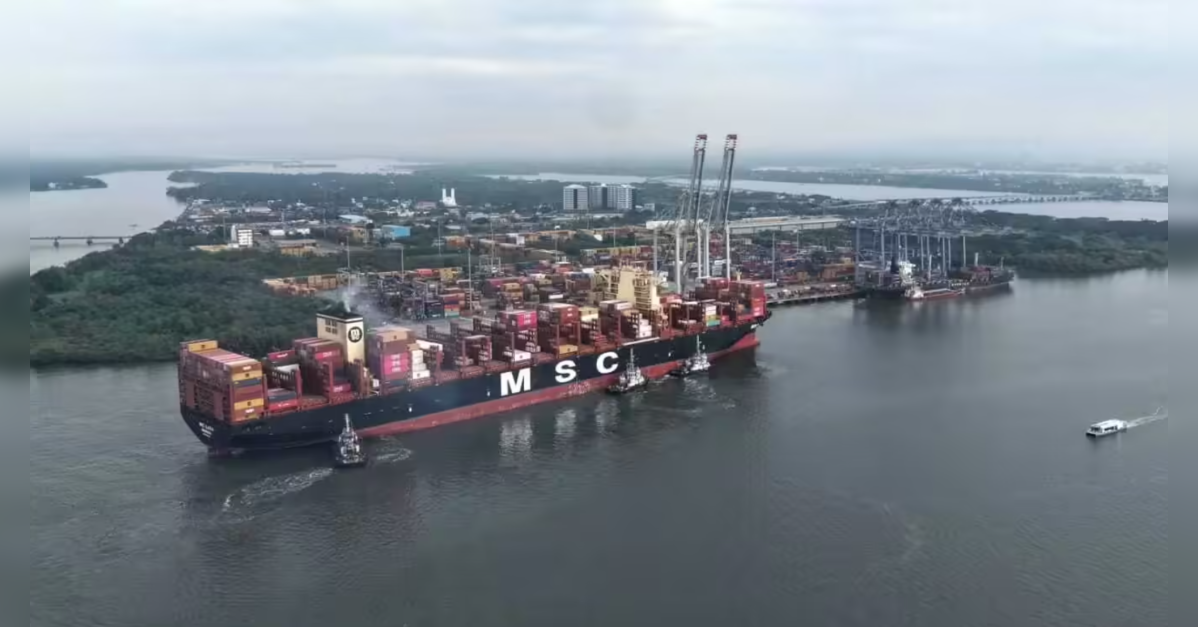

The Vallarpadam container terminal in Cochin, a DP World-operated project launched under a state-backed infrastructure push, has recorded a sharp 8% decline in annual throughput, with transhipment volumes collapsing by nearly half to just 85,912 TEUs in fiscal year 2026. The broader decline comes as Adani Ports’ newer Vizhinjam facility, just a handful of nautical miles down the Kerala coastline, surged to 1.3 million TEUs in its first full year—operating above nameplate capacity—drawing in a majority of regional transhipment flows and challenging Cochin’s long-held ambitions to be India’s primary southern transhipment pivot.
While Cochin’s international transhipment fell to 53,294 TEUs in FY26, its domestic coastal transhipment hovered around a third of that level, reinforcing a trend where the terminal’s function has realigned from global cargo pivot to regional gateway. With natural constraints such as a 14.5-metre depth limiting its ability to host ultra-large container vessels—compared to Vizhinjam’s 20-metre deep approach—the facility has struggled to capture deep-sea routes that are vital to transhipment economics. Government-backed incentives, including steep rebates on vessel-related charges and partial relaxation of cabotage rules, have done little to reverse the strategic resurgence of Colombo, which continues to handle over 2.5 million TEUs of India-bound transhipments.
Despite falling transhipment, the terminal’s pivot to higher-margin export-import and coastal flows is not critically undermining Cochin Port Authority’s revenue base, since such cargo attracts double the handling rates of transhipment. Sovereign capital’s shift in focus toward Vizhinjam’s deep-water capabilities, coupled with international shipping alliances backed by MSC’s dominant presence, has effectively redrawn the commercial balance in the region. This leaves Vallarpadam at a disadvantage not only in terms of physical infrastructure, but also in strategic alignment with the sovereign maritime development agenda, which is increasingly prioritising ports able to anchor large-scale international logistics chains.
For regional infrastructure investors, the divergence between the two Kerala terminals signals a recalibration: where Vallarpadam was conceived as a transhipment fulcrum under state-backed development imperatives, Vizhinjam’s viability hinges on deep-water access, aggressive marine-linked policy incentives, and backing from Adani’s integrated logistics ecosystem. As sovereign capital deepens commitments to Vizhinjam, the commercial case for anchoring future container volumes at Cochin weakens, with implications for venture capital flows into complementary logistics infrastructure in the broader Malabar coast.