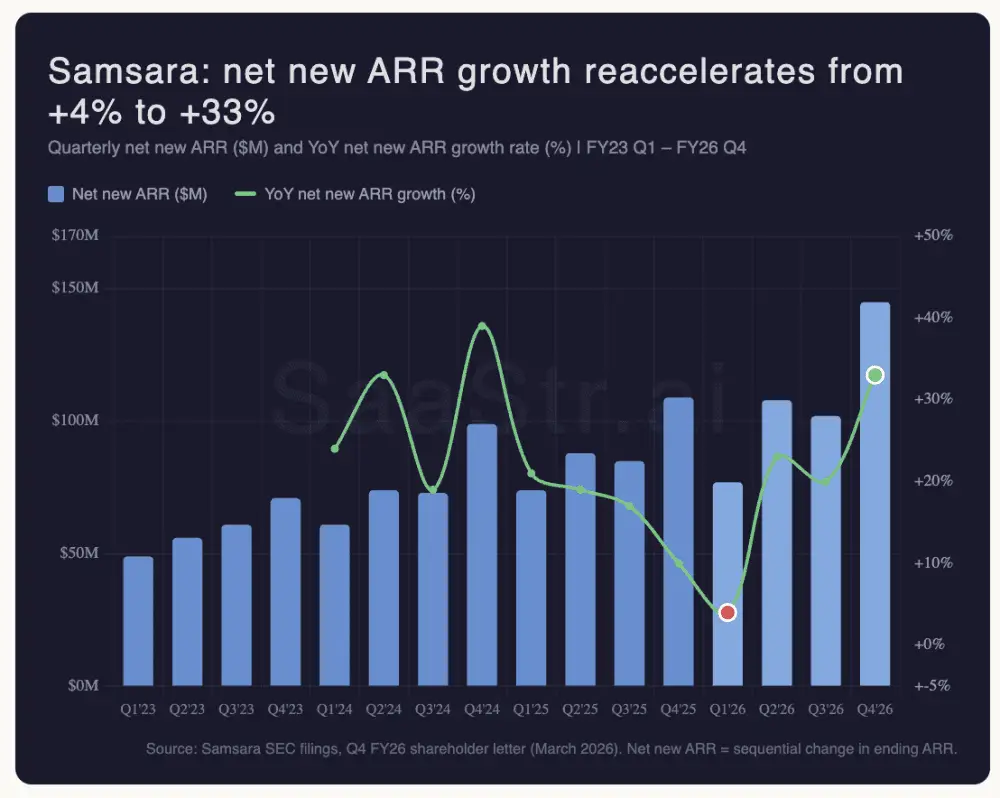

Samsara’s financial dynamism exemplifies the transformative potential of vertical SaaS in MENA’s evolving economic landscape. With ARR acceleration to 30% at $1.9 billion and a 10x ARR valuation, the company’s success in monetizing IoT, AI, and fleet management solutions underscores a strategic opportunity for MENA policymakers and investors. The region’s nascent digital infrastructure and sovereign wealth funds—now pivotal in driving industrial modernization—must prioritize investments in vertically oriented SaaS platforms that address physical operations, logistics, and energy. By mirroring Samsara’s multi-product scalability and enterprise retention rates, MENA states could unlock productivity gains across construction, transportation, and utilities, sectors contributing >40% of global GDP. Sovereign capital, often siloed in broad economic diversification, should shift toward targeted investments in tech infrastructure and entrepreneurial ecosystems capable of producing regional SaaS leaders.
The venture capital landscape in Middle East and North Africa, long skewed toward fintech, e-commerce, and healthtech, must pivot toward industrial tech—a space where Samsara’s 56% YoY growth in $1M+ ARR customers signals robust demand. The company’s guidance of sustained net-new ARR growth, even in macroeconomic headwinds, mirrors Riyadh’s and Abu Dhabi’s playbooks for de-risking pre-IPO valuations through operational excellence and geographic diversification. MENA VCs should emulate this approach: prioritize growth-stage bets in enterprise software with embedded physical ecosystems, where asset intensity and regulatory complexity create sticky customer contracts. Samsara’s $100M+ ARR from emerging products like AI-driven analytics and asset tags foreshadow trends applicable to MENA’s nascent smart-city and renewable energy deployments. Early-stage funding should focus on startups bridging IoT hardware, AI automation, and vertical-specific data analytics, mirroring Samsara’s playbook but scaled for regional supply chains and labor markets.
Regional infrastructure debates in MENA often center on megaprojects—ports, desalination plants, and solar farms—but digital scaffolding for physical operations is equally critical. Samsara’s $145 million Q4 net-new ARR in Europe, paired with expansion into Gulf-based logistics hubs, highlights the need for cross-border data interoperability and cloud infrastructure tailored to industrial use cases. Waterloo Square-backed AI agents, Tesla’s Cybertruck integration, and Saudi Aramco’s Orion AI reliably demonstrate how heavy industry investors are valuing real-time asset intelligence. For MENA, this implies sovereign-backed investments in semiconductor fabrication (via UAE Industrial Strategy 2030) and AI compute hubs could unlock regional SaaS playbooks. Simultaneously, infrastructure-as-a-service (IaaS) providers must prioritize cybersecurity and low-latency networks to support Samsara-like deployments in remote oilfields, mining operations, and agricultural zones, where connectivity gaps persist despite physical infrastructure investments.