
Saudi Arabia’s smart conveyor systems sector is poised to become a linchpin of the kingdom’s Vision 2030 agenda, with the market projected to grow from USD 17.8 million in 2025 to nearly USD 34 million by 2034 at a CAGR of 7.4 %. This expansion is driven by the state‑backed logistics boom, which is channeling an estimated USD 267 billion into new distribution centres, industrial cities and free‑zone hubs. The National Industrial Development and Logistics Programme (NIDLP) is earmarking up to USD 85 billion for advanced manufacturing clusters, while MODON’s expansion to over 4.8 million m² of logistics real estate signals an ongoing institutional commitment to high‑capacity, precision intralogistics infrastructure. In effect, the government is transforming the logistics landscape into a value‑add, autonomous ecosystem that will underpin the kingdom’s aspiration to become a global trade artery between Asia, Europe and Africa.
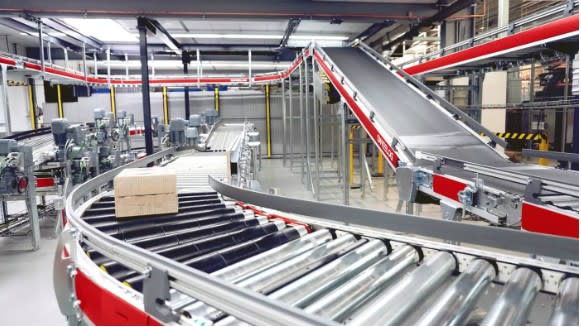
The acceleration of e‑commerce, which saw Saudi Arabia’s online retail spend rise 25.8 % YoY to SR 197 billion in 2024, has amplified the demand for fully automated fulfillment pipelines. Newly launched facilities such as the Agility Logistics Park in Jeddah—spanning 338,000 m² at a SAR 611 million cost—are being designed from the ground up around smart conveyor networks, sortation gates and Warehouse Management Systems (WMS). These systems, coupled with real‑time IoT sensors and AI‑driven predictive maintenance, are redefining operational benchmarks, reducing cycle times, and delivering the bill‑of‑materials accuracy required by high‑volume sectors like pharmaceuticals, food‑and‑beverage and automotive. The integration of digital twins further enhances design fidelity, enabling operators to simulate, optimise and commission conveyors before installation, thereby slashing both downtime and capital outlays.
From a sovereign capital perspective, the shift toward smart conveyors aligns with Saudi Arabia’s broader industrial diversification strategy, which seeks to raise non‑oil GDP from roughly 6 % to 10 % by 2030. The associated capital outlay—publicly funded through sovereign wealth programmes and privately sourced venture capital—positions the kingdom as a magnet for foreign direct investment in advanced logistics technology. Venture firms are increasingly channeling funds into start‑ups offering modular conveyor solutions, AI‑powered routing algorithms and integrated digital twin platforms, anticipating a robust middle‑market pipeline. The confluence of state‑led infrastructure spending, e‑commerce momentum and venture capital enthusiasm is creating a virtuous cycle that will cement Saudi Arabia’s status as a logistics and intralogistics powerhouse across the MENA region.
In summation, the smart conveyor market in Saudi Arabia is not merely a support function; it is becoming a strategic asset that underpins sovereign economic objectives, fuels venture‑backed innovation, and lays the groundwork for future regional infrastructure excellence. Stakeholders across the supply chain—government agencies, industrial developers, logistics operators and technology investors—must recognise that the next wave of competitiveness in the MENA region hinges on the deployment of intelligent, IoT‑enabled conveyor systems that can scale with the kingdom’s ambitious growth trajectory.