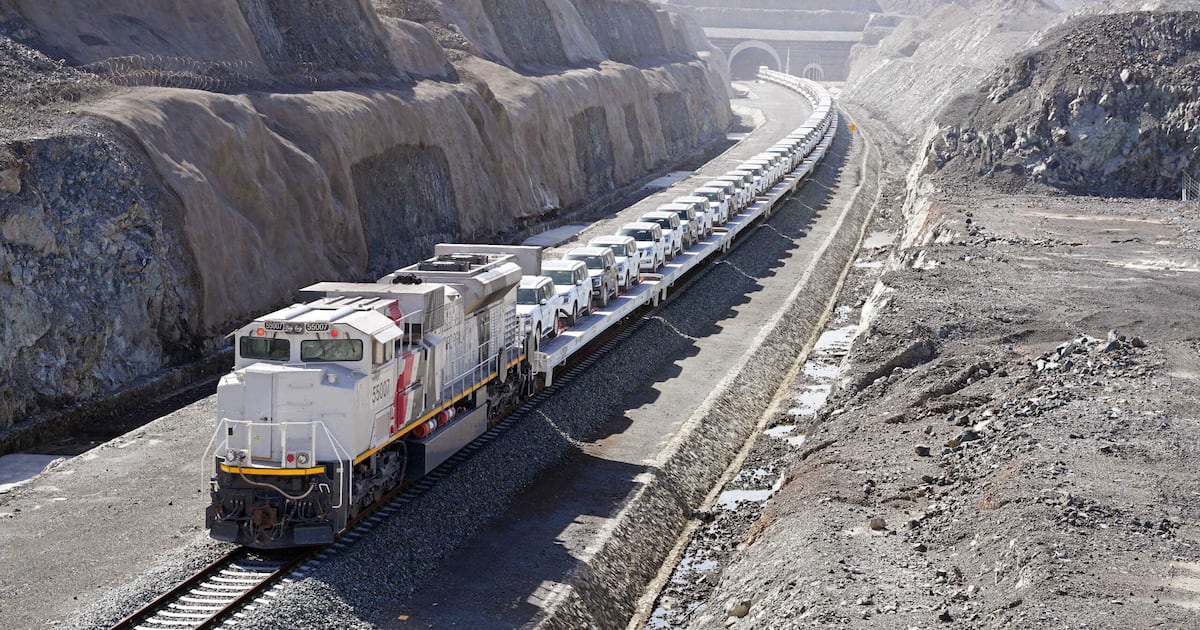

Etihad Rail’s completion of the UAE’s first commercial finished-vehicle rail shipment, moving Nissan inventory from Fujairah to Abu Dhabi in partnership with Al Masaood Automobiles, marks a critical inflection point for the monetization of the federation’s $11bn+ sovereign-funded national rail network. The move expands the operator’s freight remit beyond bulk aggregates, petrochemicals and polymers into high-value, time-sensitive automotive logistics, a sector with higher service-level expectations than traditional bulk cargo. This shift validates the original sovereign capital thesis behind the network: building a resilient, cost-competitive alternative to road freight that can anchor the UAE’s position as a regional logistics hub amid rising global supply chain fragmentation.
The public-private partnership with Al Masaood, the authorized distributor for Nissan, Infiniti and Renault across Abu Dhabi, Al Ain and Al Dhafra, underscores a broader MENA trend of sovereign infrastructure owners opening high-value verticals to private capital to accelerate return on investment. For venture and private equity investors with exposure to regional logistics, automotive retail and supply chain technology, this milestone signals a maturation of rail-linked infrastructure-as-a-service models that can lower customer acquisition costs and reduce burn for early-stage mobility and logistics startups. Sovereign wealth funds including Mubadala and ADIA, which have allocated record capital to domestic infrastructure in recent years, stand to benefit from expanded revenue streams that reduce reliance on bulk commodity traffic, a critical hedge against hydrocarbon price volatility.
Beyond UAE borders, the success of this pilot reinforces the commercial case for the pan-GCC rail network, a $200bn+ regional sovereign capital initiative designed to integrate Saudi Arabia, the UAE, Oman and Kuwait via standardized freight corridors. Etihad Rail’s existing link to the Saudi border positions the UAE to capture transit freight for automotive imports destined for the broader Gulf market, a revenue stream that could add $1.2bn annually to the network’s top line by 2030 per pre-2026 fiscal projections. The network’s target of reducing road transport CO2 emissions by 21% annually by 2050 aligns with ESG mandates for regional sovereign funds, which are increasingly directing capital into low-carbon infrastructure to meet net-zero commitments and attract institutional green finance.