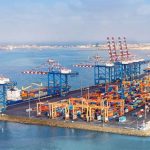
The escalating conflict in the Red Sea has exposed critical vulnerabilities in global maritime logistics, with Dubai’s Jebel Ali port serving as both a bellwether and a strategic linchpin for regional stability. Despite the closure of the Strait of Hormuz and mounting security risks, DP World’s Jebel Ali terminal remains operational, yet inbound vessel arrivals have plummeted as oil and commodity shipments reroute through safer corridors. The CEO, Yuvraj Narayan, emphasized the terminal’s resilience, but the firm’s decision to highlight throughput growth of 5.8% to 93.4 million TEUs in 2025—even amid disruptions—underscores its strategic pivot toward Red Sea alternatives like Jeddah and Sokhna. This shift, coupled with a 32.2% profit surge to $1.96bn, reflects DP World’s ability to monetize geopolitical anxiety through optimized rerouting fees and asset redeployment, reinforcing its investment-grade profile that attracts sovereign and institutional capital seeking “safe haven” infrastructure plays in volatile regions.
The limited redundancy capacity at UAE ports outside Hormuz—Khorfakkan’s 5 million TEU maximum and Fujairah’s 1 million TEU ceiling—exposes systemic fragility in regional supply chain architecture. Policymakers in Abu Dhabi, Dubai, and Cairo face mounting pressure to expand hinterland infrastructure, with Jebel Ali’s reliance on Hormuz-bound traffic highlighting the existential risks of single-chokepoint dependencies. Sovereign wealth funds and multilateral institutions are likely to allocate capital toward rail corridors, inland waterways, and diversified port networks to rebuild resilience, mirroring Singapore’s post-Malacca Dependency Syndrome reforms. DP World’s 18% Ebitda margin expansion to $6.4bn suggests current”), yet the resolution of the Red Sea crisis could catalyze a surge in sovereign-backed investments in “last-mile” logistics and green energy hubs to align with ESG mandates driving global capital flows.
Venture capital activity in maritime tech has surged in response to the crisis, as firms seek solutions for real-time rerouting, regulatory compliance, and cyber-physical security. DP World’s deployment of AI-driven rerouting systems and blockchain-enabled supply chain tracking exemplifies the sector’s shift toward “smart logistics” platforms that mitigate fragmentation risks. Emerging platforms in the MENA region are leveraging AI to predict oil spill drills, route optimization for embargo-evasive tankers, and predictive maintenance models for aging harbor infrastructure. While VC inflows into Red Sea-based logistics startups remain modest compared to the Gulf Cooperation Council economies, the conflict has accelerated a $2.3bn funding wave in 2025 across MENA-focused logistics tech ventures, prioritizing firms with cross-border interoperability frameworks that align with the UAE’s Corridor 6.3 and Saudi Arabia’s Red Sea Development Project.
The interplay between business resilience, sovereign investment priorities, and venture-backed innovation will define MENA’s capacity to navigate protracted geopolitical disruptions. While DP World’s 2025 performance signals sectoral strength, the long-term imperative to decouple from Hormuz-dependent trade corridors will reshape regional capital allocation. Institutional investors are likely to favor mixed-use port developments integrating sustainably powered terminals with AI-enhanced cargo handling, while sovereign states may adopt basing agreements with DP World to secure choke point independence. The crisis has rechristened the region as a laboratory for hybrid public-private models that balance capital intensity with de-risking strategies tailored to an era of aquis route unpredictability.