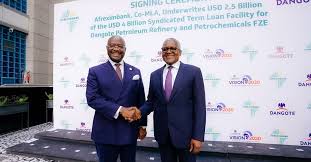

African Export-Import Bank’s (Afreximbank) strategic partnership to underwrite a $2.5 billion facility for Dangote Group’s refinery expansion marks a pivotal moment in African industrial sovereignty. This collaboration, underpinned by a $40 billion projected investment requirement for Vision 2030, exemplifies sovereign capital mobilization to reduce critical import dependencies. Dangote’s ambitious growth plan, targeting a $100 billion turnover by 2030, pivots on scaling existing operations and forging new ventures across energy, agriculture, and infrastructure—sectors vital to MENA’s strategic interests in energy security and commodity trade. The partnership signals Afreximbank’s commitment to executing its core mandate, moving beyond rhetoric to tangible infrastructure development, a model potentially replicated across the MENA region where similar challenges of import reliance and industrial capacity exist.
Dangote Group’s expansion blueprint, encompassing a near-tripling of its petroleum refinery capacity and a quadrupling of urea fertilizer production, fundamentally reshapes the African commodity landscape. This scale-up necessitates substantial venture capital mobilization beyond the sovereign-backed Afreximbank facility, attracting global and regional investors seeking high-impact opportunities in Africa’s industrial transformation. The diversification into ports, pipelines, data centers, and power generation underscores a holistic approach to building resilient, self-sufficient supply chains—directly addressing the infrastructural bottlenecks constraining MENA’s own regional trade and energy integration efforts. The emphasis on “semi-processed and value-added mineral exports” positions this partnership as a catalyst for transforming raw resource exports into competitive manufactured goods, a strategic pivot critical for both African and MENA economic diversification.
The synergy between Afreximbank and Dangote Group transcends financial support, embodying a shared vision to dismantle dependency and anchor industrial growth on indigenous capacity. Dangote’s assertion of being “joined at the hip” with Afreximbank, leveraging the Bank’s historical faith in ventures others doubted, highlights the institutional confidence essential for large-scale development. For MENA, this partnership offers a case study in sovereign-backed infrastructure development and value-addition, potentially informing future initiatives to leverage regional development finance institutions in reducing dependency on external supply chains for energy and key commodities. The urgency underscored by global fragmentation and protectionism further amplifies the significance of this model for regional economic resilience.