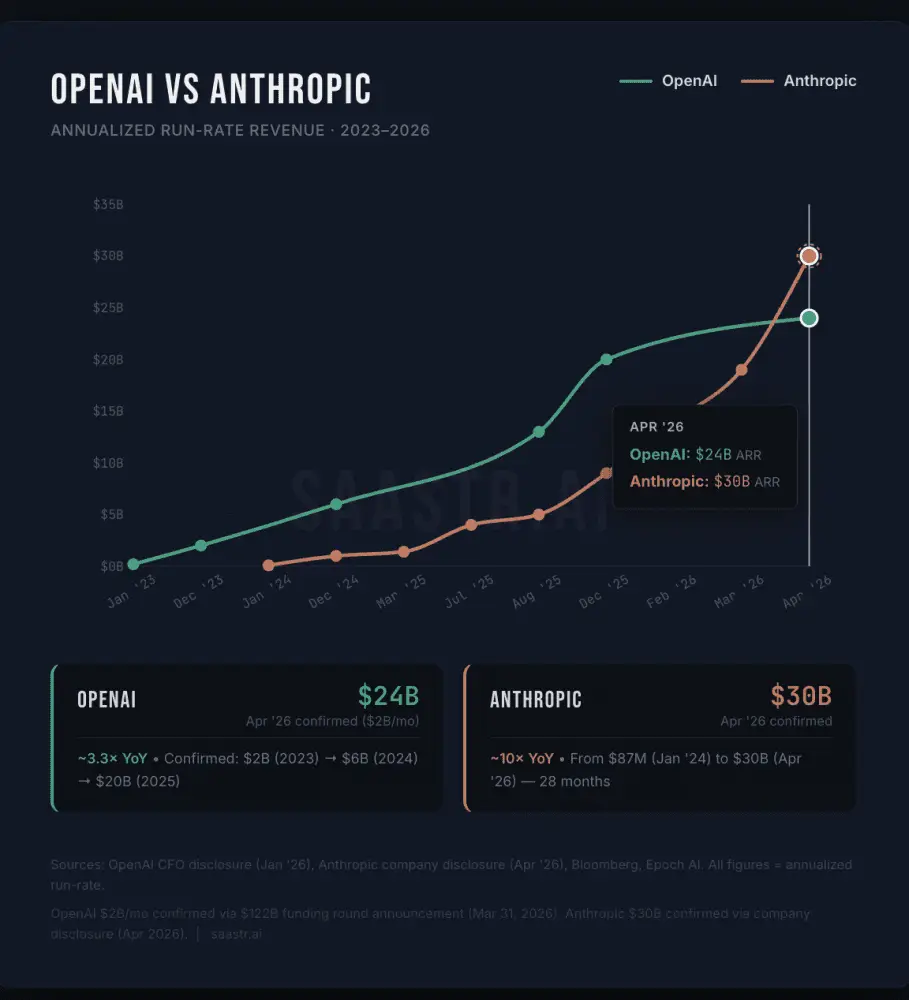

The rapid scalingof AI-driven revenue by OpenAI and Anthropic signals a tectonic shift in global enterprise technology investment, with profound implications for the Middle East and North Africa (MENA). Sovereign capital markets in the region are increasingly treating AI infrastructure as a strategic national asset, mirroring the aggressive bets made by global investors. Countries such as Saudi Arabia and the UAE have committed hundreds of billions to AI and tech-enabled industrialization, creating a unique ecosystem where local enterprises are pressured to align with global AI adoption curves. For B2B firms in MENA, this could mean accelerated demand for AI-powered solutions—whether in energy optimization, logistics, or fintech—driven by both domestic policy mandates and the need to compete in a tech-accelerated global market. However, the challenge lies in domesticizing these tools, as sovereign investment often prioritizes foundational infrastructure (data centers, cloud partnerships) over application-layer innovation. This creates a bifurcation: MENA’s venture capital community must balance frontier bets on AI-native startups with the necessity of building sovereign-backed ecosystems capable of scaling through regulated, regionally optimized infrastructure.
The enterprise-centric model championed by Anthropic and replicated by OpenAI offers a blueprint for MENA’s venture capital strategy. Regional VC funds are increasingly shunning consumer-facing AI ventures in favor of embedded, B2B-focused solutions—particularly in sectors like government digital transformation, manufacturing, and cross-border trade. This mirrors Anthropic’s success with Fortune 100 clients, where enterprise API contracts and cloud provider deals (e.g., AWS, Google Cloud) dominate revenue. Sovereign capital in MENA is likely to accelerate this trend, with governments incentivizing local startups to pursue deep, contractual relationships rather than viral user growth. However, the region’s VC landscape faces a critical juncture: the influx of global capital into AI infrastructure (notably from Gulf sovereign funds and tech giants like SoftBank or NVIDIA) could drive a “winner-takes-most” dynamic, where only a handful of firms capture the lion’s share of AI-driven revenue. This risks leaving many regional startups constrained by a lack of scalable infrastructure or regulatory clarity around data sovereignty, forcing them into suboptimal partnership models with global AI providers.
The infrastructure implications for MENA are both a strategic opportunity and a precarious dependency. As OpenAI’s $121 billion projected 2028 compute spend and Anthropic’s $30 billion training costs dominate headlines, MENA’s sovereign entities face a crossroads: invest in homegrown AI infrastructure to reduce reliance on foreign compute power or replicate the global model of outsourcing to hyperscalers. Countries like Singapore and UAE have already begun building sovereign AI hubs, but this requires balancing cost efficiency with technological sovereignty—a tension amplified by the asymmetric cost structures of global AI firms. For instance, Anthropic’s capital efficiency, enabled by lower training costs relative to OpenAI, could make it an attractive partner for MENA’s sovereign investors seeking cost-effective AI adoption. However, this also risks entrenching global tech monopolies in regional markets. Regional infrastructure development, particularly in data center networks and local cloud ecosystems, becomes critical. Without sovereign-backed infrastructure, MENA firms may face prohibitive costs or data governance risks when scaling AI solutions, undermining both B2B growth and national tech ambitions. The choice will shape not just economic outcomes but the geopolitical alignment of the region’s digital future.