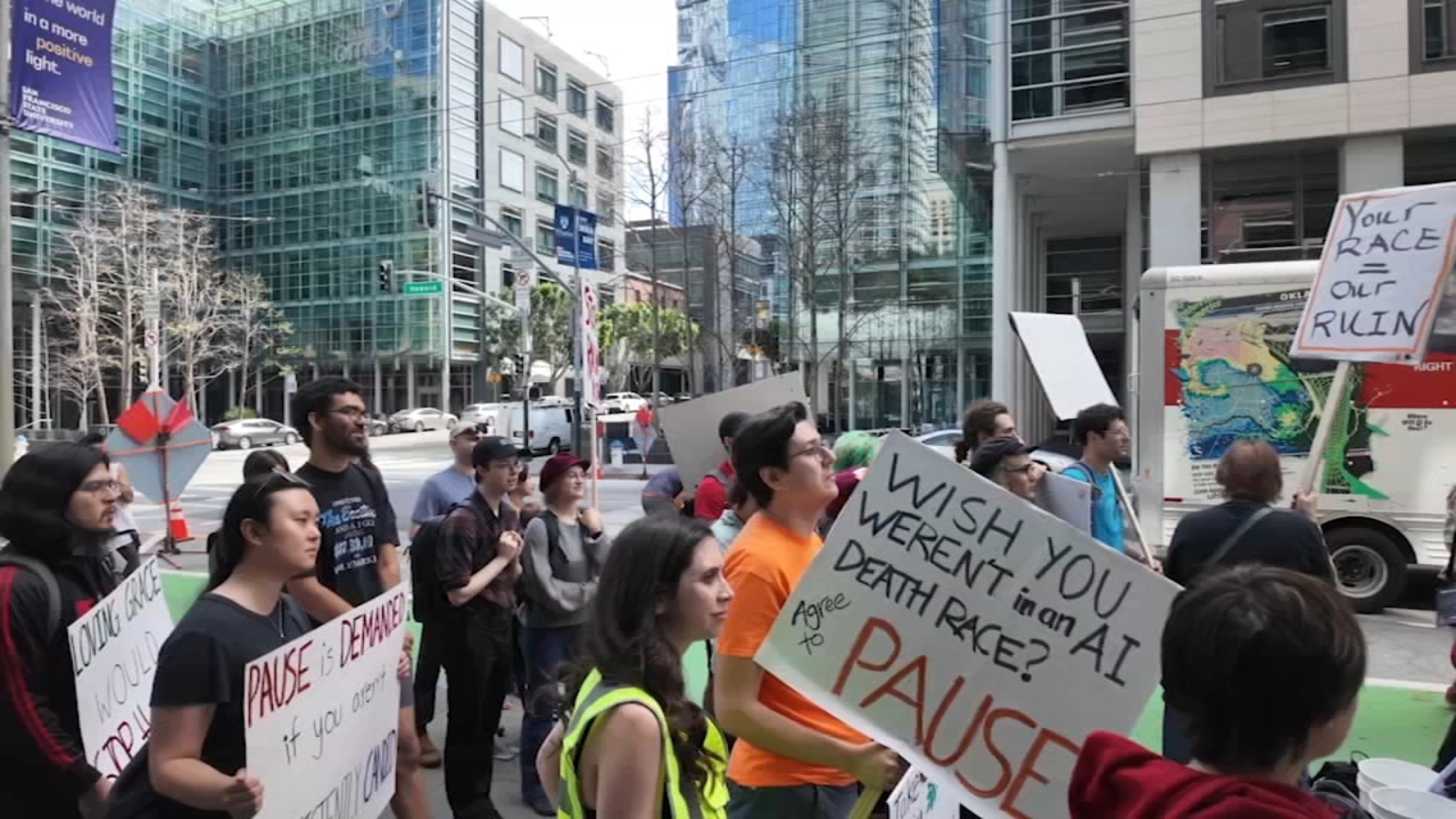

The coordinated protests outside leading AI laboratories in San Francisco, demanding a conditional pause on frontier systems development, signal a critical inflection point for global technology capital allocation. For the MENA region, whose sovereign wealth funds and state-backed investment vehicles have deployed tens of billions into the AI ecosystem—from minority stakes in foundation model companies to infrastructure plays—this escalation in the safety debate introduces a material regulatory and reputational risk calculus. The discourse framing advanced AI as an existential threat directly challenges the core investment thesis of entities like Saudi Arabia’s Public Investment Fund (PIF) and Abu Dhabi’s Mubadala, which are betting on AI as a cornerstone of post-oil economic transformation. A de facto moratorium or stringent new liability regimes in key Western markets could trigger valuation resets, constrain exit windows via IPO or strategic sale, and force a re-evaluation of capital deployment strategies toward more utilitarian, less contested applied AI sectors.
Sovereign capital from the Gulf, in particular, has pursued a dual-track strategy: securing financial returns while embedding national technology champions within the global AI supply chain. The protest movement’s allegations ofreckless development, juxtaposed with reports of Pentagon deals and litigation, underscore the geopolitical and compliance complexities these investors now face. Their significant minority positions in entities such as OpenAI, Anthropic, and xAI—often channeled through hybrid VC-sovereign vehicles—are no longer purely financial assets but potential points of diplomatic and legal contention. This necessitates a sharper focus on governance rights and safety protocol alignment within portfolio companies. The region’s capital may increasingly pivot toward domestic and regional AI infrastructure projects—such as national data sovereignty clouds and specialized AI research institutes—to insulate investments from transatlantic policy volatility while still capturing strategic value.
For the region’s nascent but rapidly growing venture capital ecosystem, the protest tide and accompanying policy friction in the United States present a paradoxical opportunity. As U.S. innovation faces potential headwinds from safety-driven regulation, MENA-based VCs may attract talent and early-stage projects seeking a more facilitative regulatory environment, provided they can navigate their own governments’ sovereignty-first digital policies. However, the heightened scrutiny on AI safety also raises the bar for due diligence. Regional VCs and corporate venture arms, such as those linked to telcos and conglomerates, must now rigorously assess the safety frameworks and ethical compliance of prospective portfolio companies, or risk becoming embroiled in the same reputational crossfire. The pathway to building globally competitive AI startups in MENA may now require a demonstrable, auditable commitment to responsible development from inception.
The long-term infrastructure implications for the MENA region are profound. Megaprojects like Saudi Arabia’s NEOM and the UAE’s G42-led AI initiatives depend on a stable pipeline of advanced AI capabilities forsmart city operations, healthcare, and logistics. Disruptions to the global development cadence of frontier models could delay the integration of next-generation autonomous systems, impacting project timelines and ROI. Conversely, this moment of crisis in the West could accelerate the region’s push for technological self-reliance, channeling sovereign capital into domestic compute infrastructure, model fine-tuning, and sector-specific applications less prone to existential risk arguments. The strategic imperative is no longer merely to adopt foreign AI, but to build a locally-controlled, safety-prioritized stack that serves national development goals while mitigating exposure to foreign regulatory shocks. The business impact will be measured in both deferred project milestones and the accelerated reallocation of capital toward a more regionally-anchored, and possibly more cautious, AI paradigm.