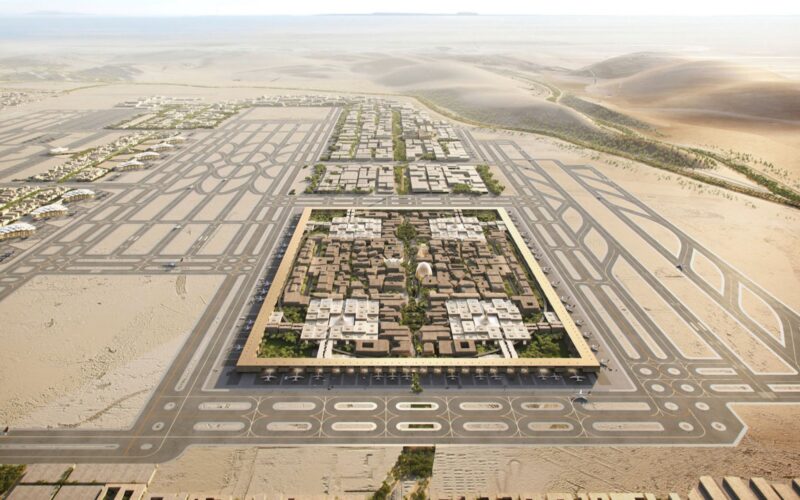

Saudi Arabia’s sovereign wealth engine, the Public Investment Fund (PIF), has moved the King Salman International Airport (KSIA) into full‑scale construction, signalling the Kingdom’s most ambitious push to capture a share of global aviation capacity. The $30 billion megaproject, set on the King Khalid site, will eventually accommodate 120 million passengers a year by 2030 and scale to 185 million by 2050, dwarfing the current Riyadh throughput of 42 million. By delivering six parallel runways and a 57 km² aerotropolis that blends logistics, retail and residential zones, KSIA is engineered to become a decisive node in the Middle‑East’s freight‑and‑tourism corridor, attracting airline alliances, cargo forwarders and high‑value service providers that have hitherto relied on European or Asian hubs.
The financing structure underscores a new paradigm for regional infrastructure financing. In addition to the PIF’s direct capital injection, the project has opened a pipeline for private‑equity and venture‑capital participation through co‑investment vehicles targeting airport‑related technology, smart‑city services and sustainable‑fuel supply chains. Early‑stage funds are already courting the consortium of international designers—Foster + Partners, Mace Group and Jacobs—whose involvement brings global best‑practice procurement standards and positions the development as a test‑bed for aerospace innovation, from AI‑driven passenger flow optimisation to green‑energy retrofits. This hybrid funding model is likely to catalyse a broader wave of private capital into Saudi logistics and mobility projects, reducing sovereign exposure while leveraging the Kingdom’s credit rating.
From a macro‑economic perspective, KSIA is a cornerstone of Vision 2030’s diversification agenda. The airport’s capacity surge is expected to generate upwards of 200,000 direct jobs and multiply ancillary employment across hospitality, customs, ground handling and e‑commerce logistics. Its cargo handling ambition—3.5 million tonnes annually—will dovetail with the Red Sea’s emerging free‑trade zones, offering a seamless air‑sea interface that can reroute freight away from congested European gateways. The ripple effect on regional connectivity is profound: Riyadh will rival Dubai and Doha as a trans‑continental hub, prompting airlines to re‑balance route networks and sparking competitive fare structures that benefit both business and leisure travelers across the MENA basin.
Strategically, the KSIA project dovetails with concurrent upgrades at Jeddah, Mecca and secondary domestic airports, forming an integrated national aviation blueprint that amplifies Saudi Arabia’s bargaining power in global air‑service negotiations. By aligning sovereign capital, private‑sector expertise and venture‑driven innovation, the Kingdom is not merely building an airport but constructing a catalyst for a new logistics ecosystem—one that promises to reshape trade flows, attract foreign direct investment and solidify the Gulf’s position at the forefront of 21st‑century mobility.