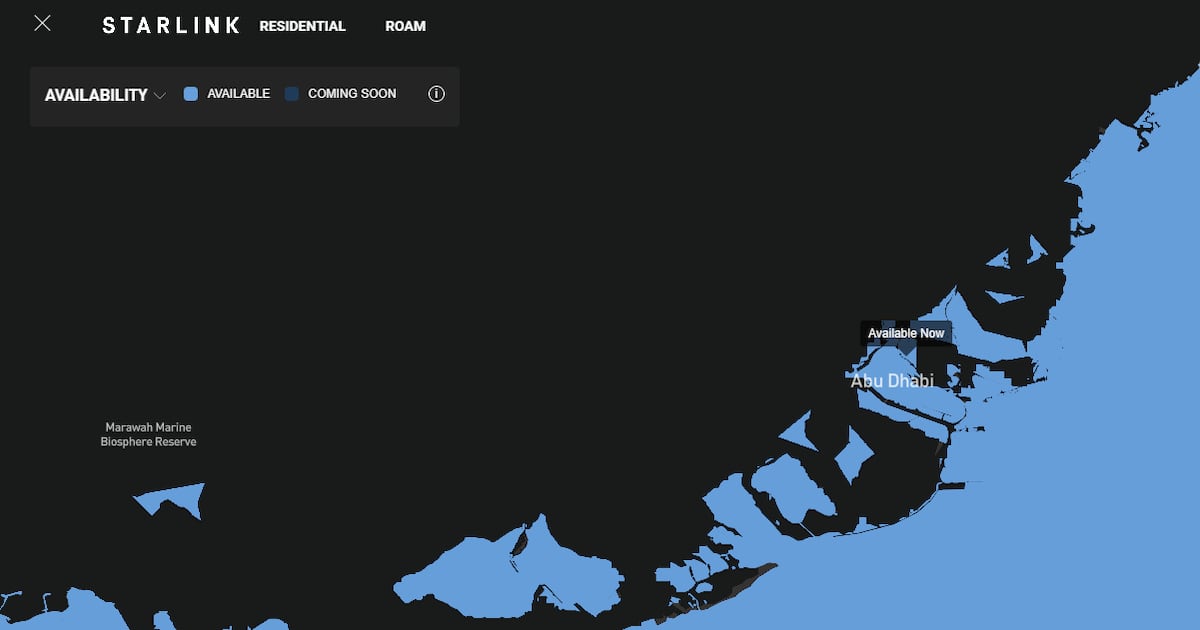

The commercial rollout of Starlink in the United Arab Emirates transcends a simple consumer broadband launch; it represents a strategic inflection point for the region’s digital infrastructure sovereignty and a direct challenge to traditional telecom paradigms. The regulatory licence granted by the Telecommunications and Digital Government Regulatory Authority (TDRA) for a decade-long “maritime satellite internet services” mandate, coupled with the immediate partnership to equip Emirates Airline’s entire fleet, signals a state-backed embrace of non-terrestrial networks as critical national infrastructure. This moves Starlink from a niche product to a potential backbone for the UAE’s logistics, tourism, and remote operations nexus, directly impacting the business models of du and Etisalat by forcing a rapid evolution from connectivity providers to integrated digital service platforms.
For sovereign wealth and strategic capital, the development validates the GCC’s long-term bets on diversifying into the space economy and digital superhighways. The UAE’s proactive regulatory framework contrasts with more cautious approaches elsewhere in MENA, positioning the country as a prime testbed for global satellite operators seeking high-value commercial and governmental contracts. This creates a blueprint for Public-Private Partnerships (PPPs) where sovereign capital, such as the Abu Dhabi Investment Authority or Mubadala, could co-invest in ground station infrastructure or data sovereignty initiatives, turning Starlink’s commercial network into a secured strategic asset. The venture capital implication is clear: this operational success de-risks the MENA space tech sector, likely accelerating investment in local upstream and downstream applications, from precision agriculture to IoT, that can leverage this new low-latency layer.
Regionally, the UAE’s entry completes a high-stakes connectivity race within the Gulf Cooperation Council, where Qatar, Bahrain, Oman, and Saudi Arabia have already sanctioned Starlink operations. This creates a de facto integrated GCC satellite coverage corridor, enhancing the region’s appeal as a unified logistics and business hub with redundant, resilient connectivity. However, it starkly highlights the inflection gap with North Africa, where regulatory fragmentation and incumbent operator resistance have slowed adoption. The business impact here is bifurcated: while the GCC leverages Starlink for economic diversification, markets like Egypt and Morocco risk being left behind in the next wave of digital transformation unless they enact similar agile, infrastructure-first regulatory frameworks.
The ultimate business impact lies in the redefinition of ‘connectivity’ as a commodity utility. Starlink’s entry, anchored by a flag-carrier partnership, forces a regional recalculation of total cost of ownership for enterprises operating across remote or maritime zones. It erodes the geographic monopoly of terrestrial fibre and microwave links, introducing price elasticity and service-level competition. For sovereigns, it is no longer merely about telecom revenue but about securing a sovereign digital backbone that guarantees operational continuity for critical national sectors—from oil and gas field communications to emergency response—independent of traditional network vulnerabilities. This is the quiet infrastructure war being waged in MENA, and Starlink has just officially joined the battle on the UAE’s terms.