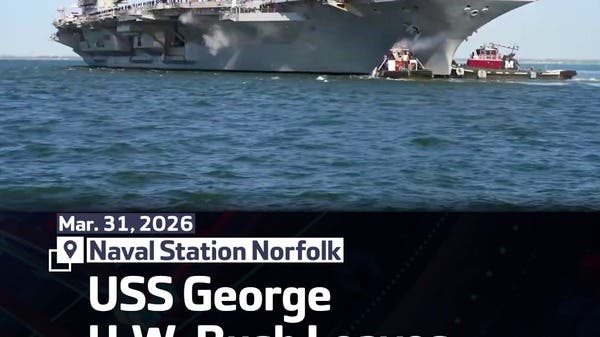

The deployment of a U.S. carrier strike group to the Middle East functions less as a transient security posturing and more as a structural pricing signal for regional capital markets. Institutional allocators and sovereign wealth funds across the Gulf and North Africa are immediately recalibrating risk-adjusted return thresholds, accelerating capital rotation away from highly duration-sensitive exposures toward domestically anchored, strategic asset classes. Sovereign balance sheets, particularly in the UAE, Saudi Arabia, and Qatar, are leveraging this geopolitical inflection to front-load long-horizon mandates in hard infrastructure, dual-use industrial capabilities, and localized supply chain resilience. The implicit security guarantee provided by external military assets reduces near-term tail risk, allowing state-backed capital vehicles to deploy liquidity at scale with renewed confidence in trade corridor stability, energy transit continuity, and sovereign credit fundamentals.
Venture capital deployment across the region is undergoing a parallel structural realignment, with institutional LPs and family offices systematically reweighting term sheets toward cybersecurity, sovereign-grade cloud infrastructure, advanced logistics platforms, and B2B enterprise automation. Elevated security dynamics act as a valuation filter: consumer-facing tech models facing longer monetization runways are experiencing compressed funding windows, while ventures addressing import substitution, data localization mandates, and critical infrastructure digitization are absorbing accelerated co-investment mandates from sovereign tech funds. Gulf-based VC syndicates are now embedding real-time geopolitical stress testing into their investment committees, prioritizing startups that demonstrate clear alignment with national security, financial interoperability, and regulatory compliance frameworks. The ecosystem’s capital formation is therefore shifting from speculative growth metrics toward measurable utility, tightly coupling private innovation velocity with state modernization roadmaps.
At the infrastructure stratum, the operational reality of enhanced naval presence reinforces the strategic premium assigned to redundant logistics nodes, subsea cable networks, and next-generation port modernization initiatives across the Red Sea, Eastern Mediterranean, and Persian Gulf basins. Regional sovereign planners are treating physical transit corridors and digital infrastructure as integrated macroeconomic assets, channeling multi-billion-dollar allocations toward route diversification, grid interconnectivity, and energy storage resilience. This capital-intensive pivot directly de-risks foreign direct investment by signaling an uncompromising commitment to uninterrupted trade velocity and institutional-grade supply chain integrity. For global allocators tracking the MENA structural transition, the convergence of security architecture and capital formation will determine whether regional pricing gaps converge with advanced market baselines or remain tethered to legacy geopolitical risk premiums. The trajectory of sovereign liquidity, venture deployment, and critical infrastructure financing is now explicitly tied to how efficiently regional stakeholders translate strategic signaling into durable economic architecture.