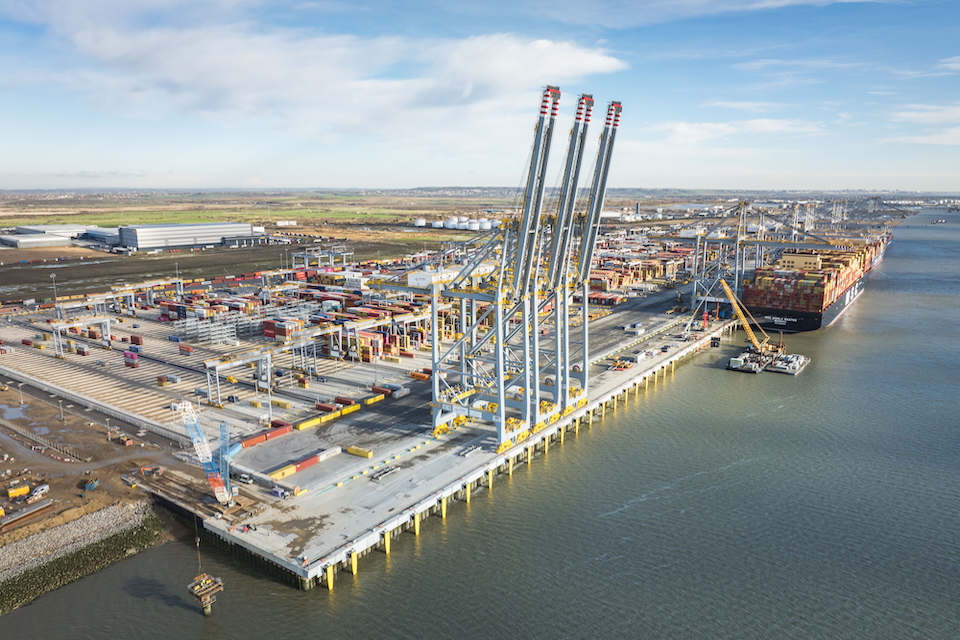

DP World’s expansion at London Gateway underscores a pivotal shift in global logistics infrastructure, with significant ramifications for the Middle East and North Africa (MENA) region’s trade dynamics and investment strategies. The £15–18 million tender for Phase 2 of the rail terminal, emphasizing robotic-ready infrastructure, signals a strategic alignment with automation trends that will redefine port efficiency benchmarks. For MENA sovereign investors, this development highlights the necessity of comparable infrastructure modernization to maintain competitiveness in global maritime corridors. As containerized trade volumes grow, the ability to rapidly decongest quaysides through intermodal integration—exemplified by London Gateway’s enhanced rail capacity—will become a critical determinant of port performance, directly influencing regional logistics hubs in Egypt, the Gulf, and North Africa.
The project’s focus on rail-mounted gantry (RMG) cranes and intelligent guided vehicle (IGV) readiness reflects a broader MENA trend of leapfrogging legacy systems in favor of scalable, tech-driven solutions. Sovereign capital in the region, particularly from entities like Saudi Aramco or the UAE’s Mubadala, is increasingly prioritizing projects that combine physical infrastructure with digital resilience. London Gateway’s phased approach—coupling immediate sidings expansion with future automation—mirrors the phased investment strategies gaining traction in the MENA, where capital allocation often balances immediate ROI with long-term technological readiness. This duality is critical as ports in the region, such as Jebel Ali or Suez, seek to replicate such integrated models to handle larger vessels and meet ESG-driven efficiency mandates.
Venture capital dynamics in the MENA will also refract London Gateway’s automation ambitions, as private tech firms accelerate deployments of autonomous terminal tractors (ATTs) and AI-driven yard management systems. The port operator’s emphasis on unified control systems and signaling upgrades foreshadows a regional opportunity for fintechs and PropTech firms to innovate in logistics analytics and real-time asset optimization. Moreover, the tender’s 21 new switches and crossings, which reduce operational bottlenecks, parallel the MENA’s urgent need to modernize rail networks that lag behind ports in efficiency. Countries like Qatar and Morocco, investing heavily in rail-to-port connectivity, will closely monitor these developments as they design their own intermodal hubs.
Ultimately, London Gateway’s expansion exemplifies the nexus of sovereign capital, private innovation, and infrastructure modernization that MENA port authorities must emulate. As vessel sizes swell and liner competition intensifies, the ability to pivot toward automation-ready infrastructure will define the region’s participation in mega-port projects like Dubai’s Port Jebel Ali or Saudi Arabia’s Seascape initiative. By embedding automation from inception—even if delayed—DP World’s initiative sets a blueprint for how MENA nations can future-proof their ports, transforming sovereign investment into strategic advantages in an increasingly automated global supply chain.