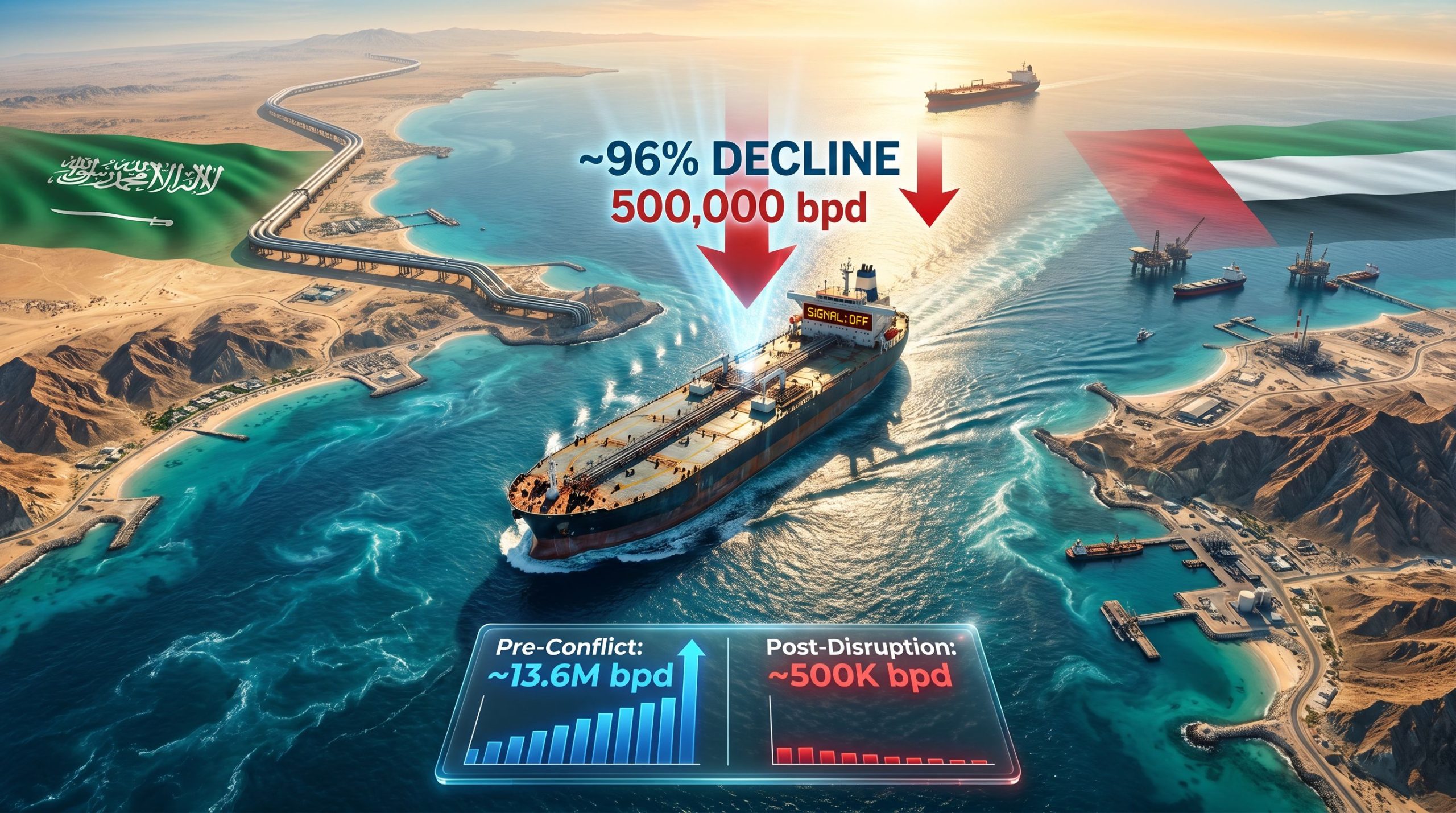

The collapse in throughput through the Strait of Hormuz represents an unprecedented structural failure in global energy infrastructure, forcing Saudi Aramco and ADNOC into operational rationing that fundamentally reshapes MENA sovereign capital flows and regional energy economics. With exports plummeting from 13.6 MMbpd to an estimated 500,000 bpd—a 96% collapse—Gulf producers face a systemic supply gap exceeding 10 MMbpd. Aramco’s pivot to Yanbu elevates Red Sea throughput to 4 MMbpd, yet this merely exposes the mathematical impossibility of replacing Hormuz’s capacity given existing infrastructure ceilings. The resulting production curtailments, particularly for offshore UAE assets lacking alternative routing, directly correlate with reduced national hydrocarbon revenues, compelling sovereign wealth funds to recalibrate expenditure trajectories and diversification strategies amid compressed fiscal horizons.
Regional infrastructure inadequacies are laid bare, as decades of bypass investments—designed for contingency, not replacement—prove structurally insufficient. ADNOC’s offshore production paralysis underscores the terminal geographic constraint where sovereign capital cannot engineer alternative export routes. Meanwhile, the deliberate suppression of AIS transponders creates opaque market conditions, distorting price signals and complicating strategic reserve management. These dual challenges—physical infrastructure gaps and data opacity—simultaneously elevate insurance premiums for commodity traders and create bifurcated tanker markets, where premium chartered vessels commanded by firms like Mercuria and Dynacom operate alongside those entirely evacuated from Gulf waters, fracturing traditional freight benchmarks.
The enduring 6-7 MMbpd deficit unaddressable by current infrastructure catalyses profound shifts in venture capital allocations toward resilient energy logistics and sovereign-backed regional transit development. MENA nations face dual imperatives: immediate market stabilization through coordinated SPR release mechanisms, and accelerated investment in cross-border hydrocarbon corridors. The disruption’s global reverberations threaten Asian energy security at a time of strained LNG markets, elevating MENA’s strategic position as prospective infrastructure investors pivot toward long-term transit redundancy. This chokepoint crisis, while catastrophic in scale, paradoxically positions Gulf sovereign capital to spearhead next-generation energy routing networks—provided regional political dynamics permit the capital expenditures required to reconfigure the region’s export architecture.