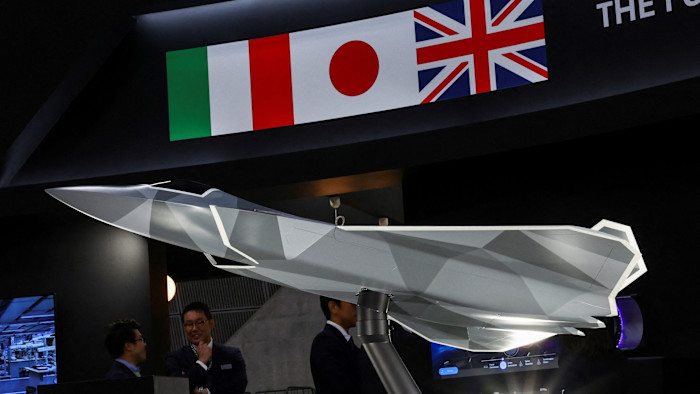

The expanding ambitions to redefine global defense architectures through multilateral collaboration directly reverberate in the Middle East and North Africa (MENA), where sovereign capital flows and strategic technological investments are reshaping regional military-industrial ecosystems. Canada’s bid to join the Global Combat Air Programme (GCAP), a counterweight to U.S.-centric defense systems, underscores a broader geopolitical realignment that could accelerate MENA nations’ efforts to diversify procurement sources and bolster indigenous defense capabilities. For the region, already grappling with geopolitical fragmentation and modernization demands, the GCAP expansion offers a dual opportunity: leveraging its growing sovereign wealth funds to access cutting-edge aerospace technology while positioning itself as a critical supplier of niche components or logistics infrastructure. Japan’s tentative openness to broadening GCAP partnerships—a response to delayed funding in the U.K. and Japan’s own capacity constraints—aligns with MENA’s push to integrate into high-tech defense value chains beyond the Gulf’s traditional reliance on U.S. F-35s or European legacy platforms. Countries like Saudi Arabia, the UAE, and Egypt are already redirecting sovereign capital toward domestic defense production, and a broader GCAP would provide a neutral platform to negotiate joint ventures or co-development agreements that circumvent U.S. influence.
The program’s financial and venture capital dynamics also cast light on MENA’s evolving private-sector defense ecosystem. While GCAP’s multilateral model emphasizes state-led acquisition and shared R&D, private companies in the region are increasingly positioned to capitalize on new markets. For instance, Saudi Arabia’s ambitious $10 billion Royal Air Force modernization plan and the UAE’s procurement of Saab JAS 39 Gripen fighters demonstrate a shift toward customizing acquisitions through partnerships with non-U.S. vendors—mirroring GCAP’s intent to reduce dependency on a single power. Venture capital inflows into MENA’s defense tech startups, from drone systems to cybersecurity, could gain momentum if expanded multilateral programs like GCAP prioritize modular, scalable solutions ideal for low-intensity conflicts and asymmetric warfare typical in the region. States such as Qatar and the UAE are already fostering public-private partnerships to commercialize defense innovations, a trend likely to intensify as MENA nations seek to monetize IP and reduce defense budget dependency.
Regional infrastructure implications of GCAP’s evolution are twofold: they compel MENA states to invest in ancillary logistical networks and manufacturing hubs capable of supporting advanced aviation projects. For example, Israel’s dominance in unmanned aerial systems (UAS) and artificial intelligence-driven defense capabilities positions it as a potential partner for GCAP-affiliated nations seeking lightweight, cost-effective solutions for surveillance and strike missions. Similarly, Egypt’s strategic locations along the Suez Canal and Red Sea could emerge as critical nodes for maintenance hubs or refueling stations if GCAP prioritizes long-range platforms suited to complex, multi-front operations. However, the region must also navigate capacity gaps in R&D and skilled labor—a stark contrast to Europe’s institutionalized defense industrial base. Sovereign wealth funds, such as Saudi Arabia’s Strategic Industries Fund, may need to reinvest hundreds of billions in education, vocational training, and cross-border technology parks to close these gaps, aligning with Global South aspirations for self-reliance.
Geopolitical recalibrations underpinning GCAP’s expansion reflect a broader MENA paradigm shift toward multipolarity, where defense sovereignty increasingly overrides transatlantic loyalties. Canada’s move mirrors Saudi Arabia’s 2023 acquisition of French Rafale jets—a signal that even U.S.-aligned regimes now view diversification as existential. For MENA, this trend introduces risks and incentives: on one hand, closer collaboration with Japan or Europe could unlock technology transfer deals and access to sovereign-backed credit lines; on the other, regional arms races—or more likely, fragmented alliances—may stoke security dilemmas. The program’s 2035 delivery deadline further exacerbates timing challenges, with Turkey and South Korea already exploring their own UCAV and stealth fighter initiatives. In sum, GCAP’s trajectory will test the MENA region’s ability to balance sovereign capital deployment with multipolar strategic ambiguity, ensuring its military-industrial rise does not replicate the resource dependency traps of prior decades but instead fuels a durable, self-sustaining defense ecosystem.