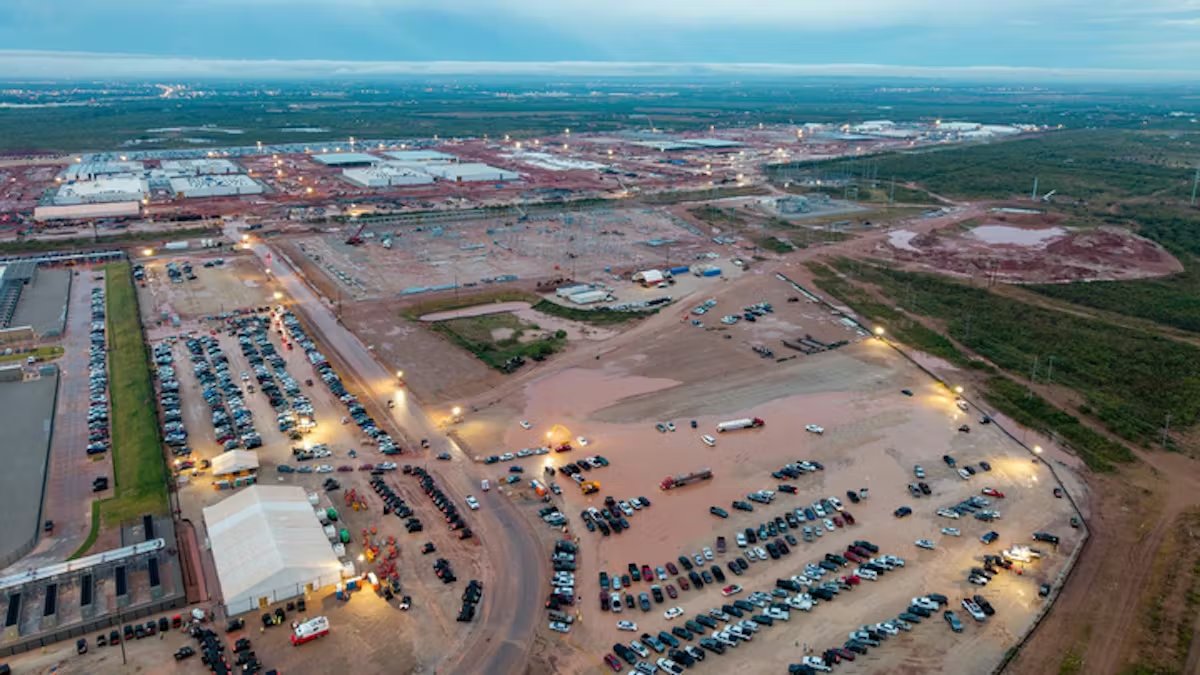

OpenAI’s abrupt reshuffle – the exit of three senior executives who built the company’s “Stargate” data‑center programme – has sent reverberations across the global AI supply chain, and the Middle East‑North Africa (MENA) region is poised to feel the strategic fallout. The departing cadre, including Peter Hoeschele who oversaw the early‑stage construction of purpose‑built AI clusters, leaves a vacuum in OpenAI’s capital‑intensive infrastructure rollout at a time when sovereign wealth funds in Saudi Arabia, the United Arab Emirates and Qatar are lining up billions of dollars to secure “trusted” AI compute capacity within their borders. The loss of institutional memory on site selection, power‑grid integration and cooling‑technology partnerships may delay the timelines that Gulf ministries have built into their national AI strategies.
For regional venture capital firms, the leadership churn introduces both risk and opportunity. Funds that have been co‑investing with OpenAI‑backed start‑ups on edge‑compute solutions now face uncertainty over the continuity of OpenAI’s on‑premise service commitments, potentially curbing follow‑on financing rounds. At the same time, the shake‑up opens a window for MENA‑based data‑centre operators – such as Saudi’s NEOM and Abu Dhabi’s ADQ‑backed e& – to pitch themselves as alternative hosts for OpenAI’s next‑generation GPUs, leveraging deep‑pocketed sovereign capital to negotiate preferential terms. Early‑stage AI hardware startups could capture a larger share of the integration market if they can demonstrate compatibility with OpenAI’s evolving architecture.
From a sovereign‑budget perspective, the disruption underscores the urgency for Gulf states to diversify their AI compute sourcing away from a single vendor. The United Arab Emirates’ “AI First” initiative, which earmarks AED 10 billion for domestic cloud infrastructure, may accelerate the procurement of locally owned compute farms, thus reducing exposure to OpenAI’s internal governance turbulence. Saudi Arabia’s Vision 2030, already channeling $40 billion into digital transformation, is likely to prioritize partnerships that embed regional energy‑grid resiliency and the nascent green‑hydrogen power projects that are critical for sustainable AI workloads.
In the broader context of regional infrastructure, the OpenAI departures could catalyze a re‑assessment of data‑center policy frameworks across MENA. Regulators may tighten requirements for foreign AI operators to partner with local entities, mirroring the EU’s forthcoming digital‑services act, to safeguard strategic data sovereignty and ensure that the massive electricity demand of AI training is met by locally sourced renewable energy. The net effect will be a more fragmented but potentially more resilient AI ecosystem, where sovereign capital, venture funding and home‑grown infrastructure converge to fill the gap left by OpenAI’s internal upheaval.