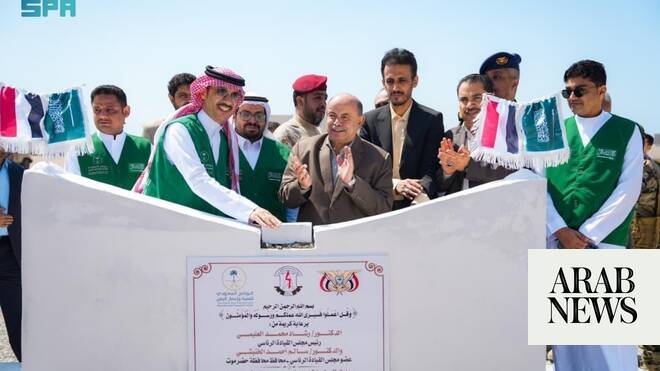

The recent groundbreaking ceremony for a 100-megawatt power generation initiative along Yemen’s Hadramout coast, spearheaded by the Saudi Program for the Development and Reconstruction of Yemen (SPDRY), represents a strategically significant investment with far-reaching implications for both Yemen and the broader MENA region. Beyond the immediate provision of electricity, this project, involving tripartite cooperation between SPDRY, Yemen’s Ministry of Electricity and Energy, and Gulf Power International, underscores the Kingdom of Saudi Arabia’s continued commitment to stabilizing Yemen and fostering economic recovery through targeted infrastructure development. The phased rollout, beginning with the 40 MW Jawl Masah and 60 MW Ambikha stations, culminating in a planned 100 MW facility within the Hadramout wadi and desert, signals a deliberate approach to addressing critical energy deficits and bolstering essential public services.
The scale of Saudi investment – a previously announced SR1.9 billion ($506 million) pledge encompassing electricity, transport, healthcare, education, and water – highlights the increasing role of sovereign wealth funds and state-backed entities in driving regional development. This initiative is not merely humanitarian aid; it’s a calculated investment designed to mitigate instability and create a more conducive environment for future private sector engagement. The provision of SR1.3 billion in operational support and salary payments further demonstrates a focus on immediate economic stabilization, directly impacting local employment and stimulating nascent economic activity. The success of this power infrastructure project will be a key indicator of the efficacy of Saudi Arabia’s broader Yemen stabilization strategy and could serve as a model for similar interventions in other fragile states within the region.
From a venture capital perspective, while direct VC investment in Yemen remains limited due to the ongoing security situation, the improved energy infrastructure created by SPDRY will indirectly stimulate opportunities for businesses reliant on reliable power. This includes sectors such as telecommunications, light manufacturing, and potentially, renewable energy solutions leveraging the region’s solar potential. Furthermore, the involvement of Gulf Power International suggests a potential pathway for attracting further private investment in Yemen’s energy sector, contingent on sustained stability and transparent governance. The project’s reliance on international contractors also necessitates careful consideration of supply chain dynamics and potential geopolitical risks, particularly given the current global energy landscape.
Ultimately, the Hadramout power plant initiative exemplifies the interconnectedness of regional security, economic development, and infrastructure investment. The project’s success will depend not only on efficient execution and technological integration but also on fostering local capacity building and ensuring long-term sustainability. The broader implications extend to the wider MENA region, demonstrating the potential for sovereign capital to play a pivotal role in addressing critical infrastructure gaps and promoting stability in conflict-affected areas, while simultaneously creating opportunities for private sector participation and fostering a more resilient regional economy. Continued monitoring of this project’s progress will be crucial for assessing the effectiveness of Saudi Arabia’s development strategy and its impact on Yemen’s long-term prospects.