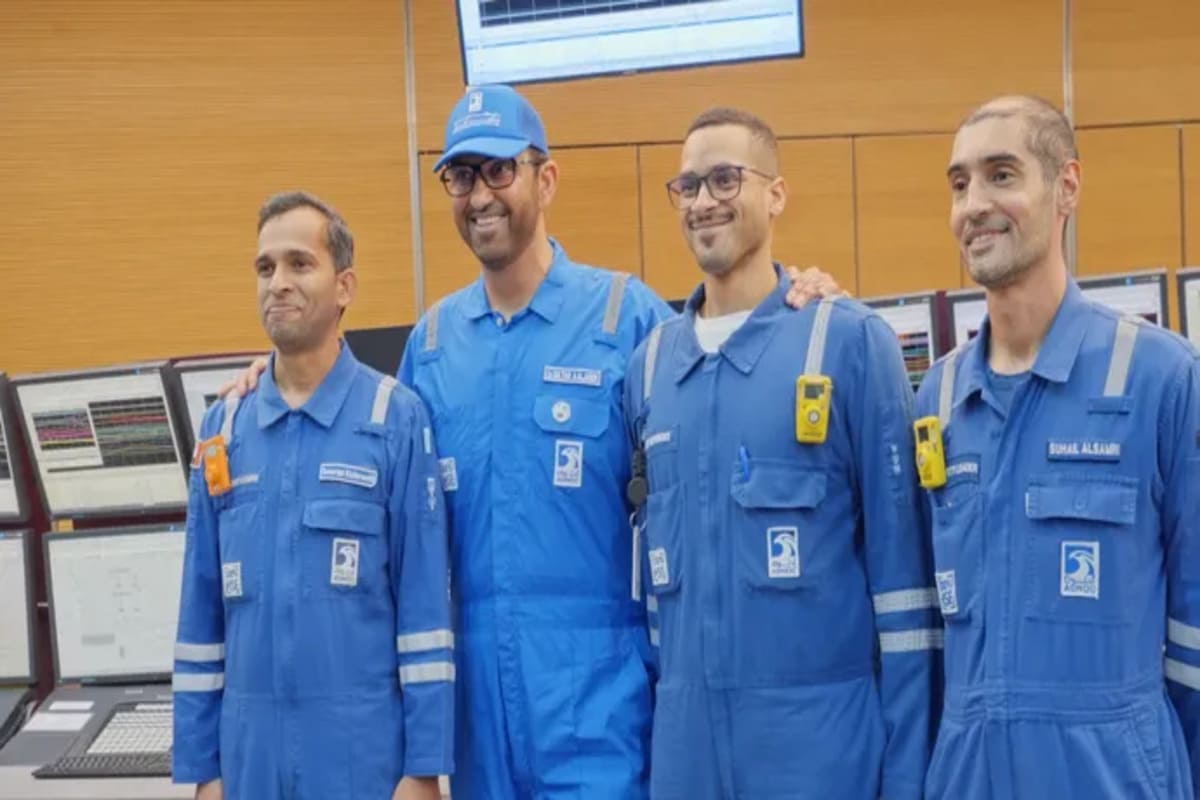

Dr.Sultan Al Jaber’s hands-on engagement with ADNOC’s operational resilience underscores the strategic imperative for energy and technology firms in the Middle East and North Africa (MENA) to align industrial discipline with digital innovation. ADNOC’s ability to maintain operational readiness amidst sustained attacks on its infrastructure—evidenced by incidents in Fujairah, Ruwais, and Habshan—highlights a critical juncture for MENA’s sovereign and venture capital ecosystems. The UAE’s leadership, through ADNOC’s institutional maturity, is setting a precedent for sovereign capital inflows into energy-security-focused ventures. With global energy transition dynamics accelerating, entities leveraging advanced technologies like AI-driven grid management or carbon capture could attract comparable investment flows, positioning ADNOC as a bellwether for regional capital allocation. This aligns with the UAE’s broader strategy to consolidate sovereign wealth fund assets—nearly $700 billion—into high-impact, tech-enabled sectors, where ADNOC’s performance metrics offer a credible risk-return benchmark.
The convergence of ADNOC’s security posture and technological roadmap signals a transformative opportunity for venture capital in MENA. As ADNOC integrates cutting-edge solutions—from digital twinning in production to blockchain-enabled supply chain transparency—it signals a blueprint for enterprise-scale innovation that venture firms may emulate. Regional venture capital has historically been fragmented, with energy-focused investments dominating. However, ADNOC’s proven capacity to sustain operations in high-risk environments could catalyze a shift toward diversified tech-enabled energy plays. Sovereign entities, including Abu Dhabi’s Mubadala, are increasingly prioritizing mergers with tech-savvy startups to future-proof energy infrastructure. This trend may redirect VC capital toward hybrid ventures that combine ADNOC’s operational expertise with disruptive technologies, accelerating MENA’s emergence as a hub for energy-tech startups.
Regionally, ADNOC’s infrastructure investments—spanning pipeline modernization to cybersecurity infrastructure—exemplify how sovereign capital can drive large-scale, integrated asset development. MENA’s fragmented energy infrastructure often hampers cross-border technological collaboration, but ADNOC’s centralized approach demonstrates scalability. This could inspire other Gulf states to accelerate public-private partnerships for critical infrastructure, fostering regional interoperability. However, the vulnerability demonstrated by recent attacks underscores a systemic risk: inadequate cybersecurity investments in public-sector energy assets. To mitigate this, sovereign and venture-backed funding may prioritize hybrid models, where state-led infrastructure projects are underpinned by private-sector tech innovation. Such a paradigm shift would not only enhance energy security but also signal to global investors that MENA’s infrastructure is viable as a nexus for Energy Transition 2.0 initiatives, extending beyond conventional fossil fuel dependencies.