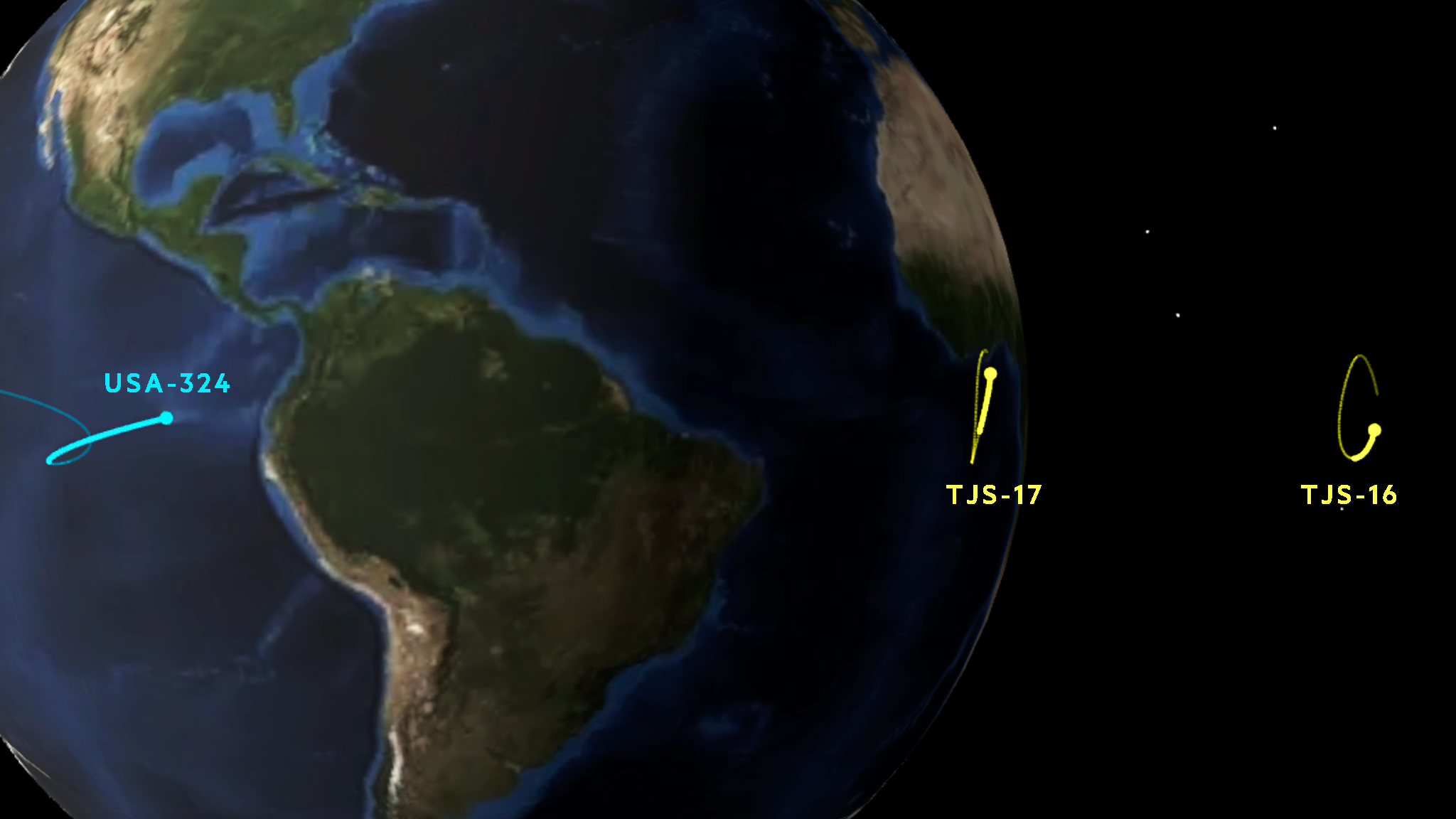

While Beijing’s 2022 official space white paper touts a peaceful, civilian-led orbital program, and its 2021 UN submission accused the US of accelerating space combat system development, declassified PLA-affiliated research and military textbooks confirm a deliberate, large-scale R&D push for counterspace capabilities aligned with explicit orbital warfighting doctrine, including plans to paralyze adversary decision-making chains by striking critical satellite nodes—a capability validated by the 2022 Shijian-21 mission, which used a robotic arm to secretly tow a defunct Beidou navigation satellite to graveyard orbit, and 2024 close-range satellite maneuvers in geostationary orbit, including a June rendezvous operation flagged by analytics firm Comspoc as a first-of-its-kind test, that US intelligence likened to orbital dogfighting, with the 2023 US Office of the Director of National Intelligence warning such tests prove China’s capacity to deploy future space-based counterspace weapons. For MENA sovereign wealth funds managing a combined $4.3tn in assets, including Saudi Arabia’s Public Investment Fund, UAE’s Mubadala, and Qatar Investment Authority, this great-power space race carries outsized exposure to regional infrastructure and balance sheet risks, as the GCC and wider MENA have committed more than $110bn in sovereign capital to satellite constellations, 5G backhaul, and space-adjacent digital infrastructure since 2018.
MENA-based space tech startups secured a record $1.9bn in venture capital funding in 2024, per regional data provider MAGNiTT, with 45% of that capital directed to satellite-enabled financial services, smart agriculture, and Red Sea logistics optimization tools, while regional SWFs have allocated $16bn to direct stakes in US and Chinese commercial space firms since 2020. The US-China race to harden orbital assets against counterspace attacks is already diverting 28% of global institutional space investment to defensive technologies, compressing returns for MENA limited partners and forcing sovereign allocators to navigate competing IP and launch-access restrictions from Washington and Beijing, both of which are increasingly conditioning partnership terms on formal non-alignment pledges. Howard Wang, a Rand researcher, notes the PLA’s core strategy of targeting network central nodes to paralyze data collection and command systems—a doctrine that directly threatens the satellite-dependent digital ecosystems MENA is building to diversify away from hydrocarbons.
MENA financial markets processed $4.6tn in cross-border transactions in 2024, all reliant on satellite timing and navigation signals for trade settlement and central bank operations, while GCC smart city projects, offshore oil and gas production, and Suez Canal logistics hubs depend on uninterrupted satellite communications for operational continuity. US Joint All-Domain Command and Control doctrine, which integrates space-based surveillance and reconnaissance into a single cross-domain command network, creates a single point of failure that PLA counterspace capabilities are explicitly designed to exploit, with IMF stress tests indicating a successful orbital strike would collapse power grids, halt port operations, and freeze settlement systems across the region within 72 hours, erasing up to 11% of annual GDP for oil-importing MENA states and 6% for GCC economies. Regional sovereigns are now earmarking 15% of new space allocations to redundant, sovereign-controlled orbital assets to mitigate exposure, though escalating US-China orbital provocations continue to raise risk premiums for all MENA infrastructure and tech investments.