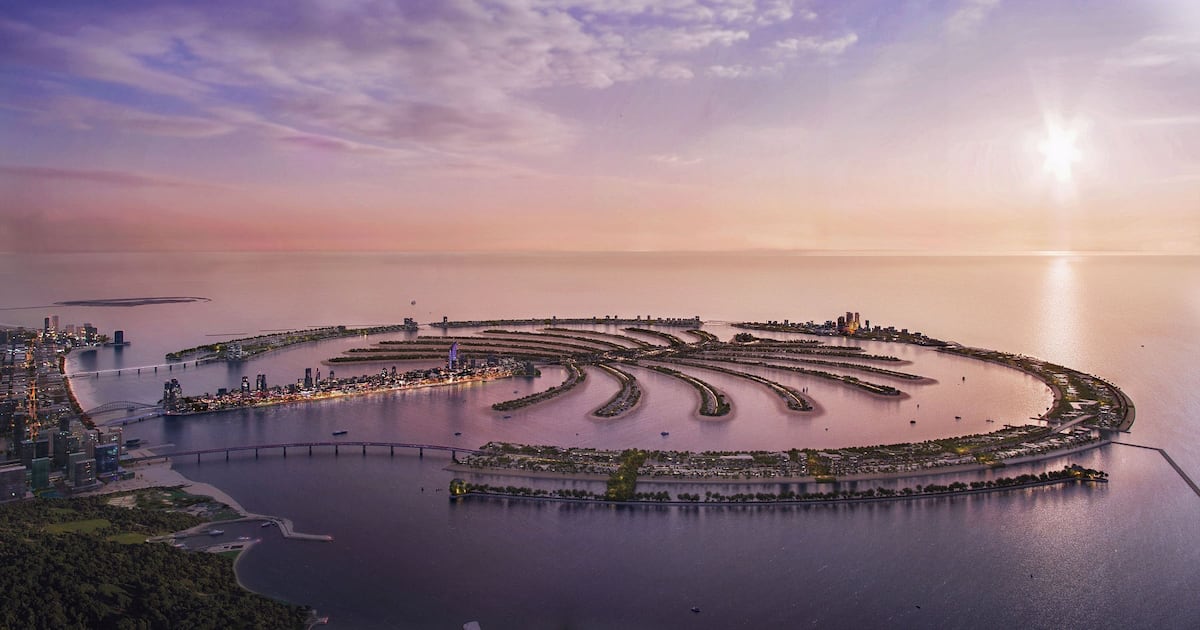

Nakheel’s Dh3.5 billion investment in Palm Jebel Ali underscores a strategic imperative for businesses operating in the Middle East Peninsula, reflecting both sovereign fiscal strategy and regional economic diversification goals. The scale of this infrastructure project—位于Emirates’ burgeoning coastal real estate market—signals a calculated effort to consolidate Dubai’s position as a global hub for luxury assets. By prioritizing large-scale developments like Palm Jebel Ali, which will accommodate 35,000 families and integrate 80 hotels, Dubai is leveraging sovereign capital to drive vertical integration in its real estate sector. This aligns with the UAE’s broader D33 economic agenda, which aims to double the emirate’s economy to Dh32 trillion by 2040. Such projects not only inject sovereign funds into high-yield private infrastructure but also create a multiplier effect, attracting foreign institutional investment and fostering ancillary industries such as logistics, hospitality, and construction technology. The project’s alignment with urban planning frameworks establishes a blueprint for sovereign-backed infrastructure in the region, signaling a shift toward capital-intensive, long-term growth models that transcend traditional real estate monocultures.
The Palm Jebel Ali development also presents compelling implications for venture capital in the MENA region, particularly in sectors intersecting with smart infrastructure and luxury real estate tech. With demand for premium residences surging—as evidenced by a 28% year-on-year increase in high-value home sales—the ecosystem is ripe for innovation in construction methodologies, digital twins for property management, and sustainable materials. Venture capital firms are likely to target niche players enabling scalable solutions for ultra-luxury housing, such as AI-driven design platforms or modular prefabrication technologies. Furthermore, the project’s emphasis on green spaces and recreational areas could spur interest in ESG-focused ventures, aligning with global sustainability trends. For regional VCs, this represents an opportunity to position the Gulf as a testing ground for high-margin, technology-driven investment models, leveraging the region’s connectivity and regulatory clarity to attract cross-border innovation capital. The Palm Jebel Ali initiative, therefore, acts as both a market validator and a catalyst for VC activity in adjacent domains.
Regionally, the Palm Jebel Ali project redefines infrastructure investment paradigms in the Middle East, blending sovereign ambition with commercial pragmatism. Its status as a twice-the-scale_of_Palm_Jumeirah development, featuring 16 fronds and 90km of beachfront, positions it as a landmark for coastal urbanization in arid regions. This model could influence neighboring MENA states to adopt similar mega-projects, prioritizing waterfront development to mitigate climate risks and attract tourism-driven economies. Sovereign entities in the region may follow suit, channeling public funds into strategically located infrastructure to enhance economic resilience. Moreover, the project’s integration into Dubai’s 2040 Urban Master Plan—aimed at doubling population and green areas—sets a template for urban planning that balances growth with ecological sustainability. For regional infrastructure, this signals a convergence of power, connectivity, and lifestyle assets, enhancing Dubai’s role as a linchpin in Gulf economic cooperation. The long-term success of Palm Jebel Ali could thus catalyze a regional trend where infrastructure projects are not merely development tools but instruments of soft power and economic sovereignty.