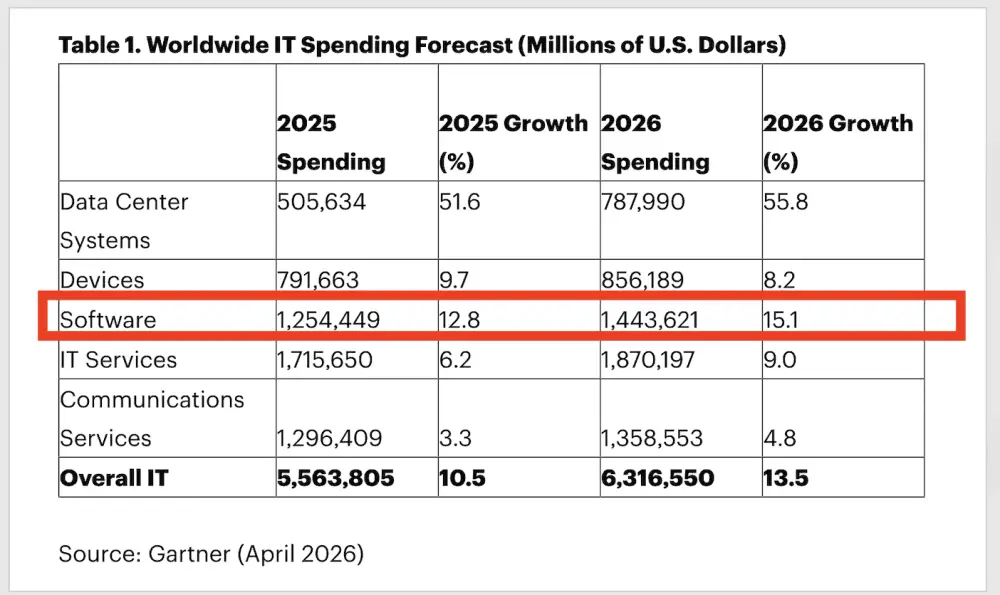

Gartner’s latest revision upward for global IT spending to $6.31 trillion in 2026, with software growth accelerating to 15.1%, carries significant implications for Middle East and North Africa sovereign wealth portfolios and regional investment strategies. As governments across the Gulf Cooperation Council and Maghreb nations continue their diversification away from hydrocarbon dependencies, this sustained spending growth validates their strategic pivot toward digital economies and technological sovereignty. Saudi Vision 2030, UAE Centennial 2071, and similar regional blueprints now face recalibrated investment horizons, with sovereign capital increasingly flowing toward software innovation rather than traditional infrastructure, positioning MENA as a critical hub for the next wave of technological advancement.
The projected $190 billion in net new software spending creates unprecedented opportunities for MENA-based venture capital and emerging tech ecosystems. Regional VC funds are recalibrating their strategies to capture enterprise software growth, with particular emphasis on AI infrastructure and vertical SaaS solutions targeting regional pain points. The expanding capital runway supports nascent fintech, edtech, and healthtech startups while attracting international VC interest into MENA’s emerging innovation clusters including Dubai, Riyadh, Cairo, and Amman. This software spending acceleration further validates MENA’s diversification efforts and provides ample runway for regional founders to capture market share against global competitors.
Regional infrastructure implications remain profound as MENA nations align public sector investment with this global software spending trajectory. Countries like the UAE and Saudi Arabia are positioning themselves as regional cloud and data hubs, leveraging sovereign-backed infrastructure to capture enterprise data center demand that now grows at 55.8%. The GCC’s strategic location between major markets facilitates digital infrastructure development, with governments actively incentivizing hyperscale data center deployment, submarine cable expansion, and next-generation network capabilities to serve as conduits for this swelling software investment. This infrastructure shift positions MENA as not just a consumer of technology but increasingly a provider, particularly in specialized verticals addressing unique regional market dynamics.
For MENA-based businesses and institutional investors, the current market trajectory necessitates urgent recalibration. Regional enterprises must benchmark themselves against accelerating growth rates as software becomes a competitive imperative rather than an optional investment. Sovereign and institutional capital should increasingly allocate toward AI-driven software solutions that address regional market needs, while creating sovereign-backed VC vehicles to leverage this expanding global software opportunity. The region’s strategic demographic advantages, coupled with expanding digital infrastructure, provide the foundation for MENA to transition from technology adoption to innovation leadership, with significant wealth creation potential for those positioned to capture this accelerating software growth trajectory.