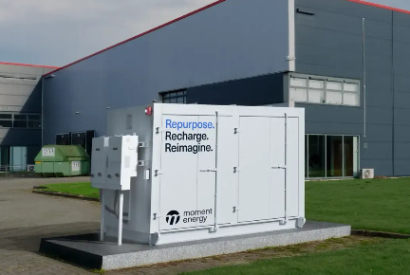

The global convergence of artificial intelligence expansion and rapid electrification has fundamentally recalibrated the risk profile of energy infrastructure. As hyperscale data centers and industrial hubs face critical power availability constraints, the reliance on legacy grid architectures and volatile, geopolitically sensitive supply chains has become a systemic vulnerability. The emergence of enterprise-grade second-life battery storage—exemplified by Moment Energy’s deployment of repurposed EV batteries—represents a structural shift toward decentralized, independent energy ecosystems. For the MENA region, where sovereign wealth funds are aggressively pivoting toward “Physical AI” and energy transition technologies, this paradigm shift offers a blueprint for decoupling industrial growth from grid instability and raw material dependency.
From a capital allocation perspective, the economics of energy storage are being redefined by technological maturity and circularity. Moment Energy’s proprietary architecture, which extends system lifespans to 30 years and achieves cycling costs as low as 3 cents per kWh, fundamentally alters the Net Present Value (NPV) calculations for large-scale energy projects. This level of cost-efficiency, coupled with high-density storage capabilities—reaching up to 164 MWh per acre—addresses the spatial and economic constraints inherent in high-value industrial zones. For institutional investors and regional sovereign capital, such advancements mitigate the traditional capex-heavy risks associated with primary battery manufacturing and long-lead-time utility upgrades.
The geopolitical implications of this technology cannot be overstated. As nations move to secure “friend-shoring” and FEOC-compliant supply chains, the ability to repurpose existing domestic battery stocks provides a strategic hedge against the concentration of mineral processing power. In the Middle East, where the ambition to become a global hub for AI and green hydrogen is paramount, integrating second-life storage into the regional infrastructure can accelerate the deployment of renewable energy without the prohibitive costs of new extraction and refining. This transition from centralized, vulnerable grids to scalable, data-driven, and circular energy models is no longer a sustainability goal, but a prerequisite for maintaining regional industrial competitiveness in the age of AI.