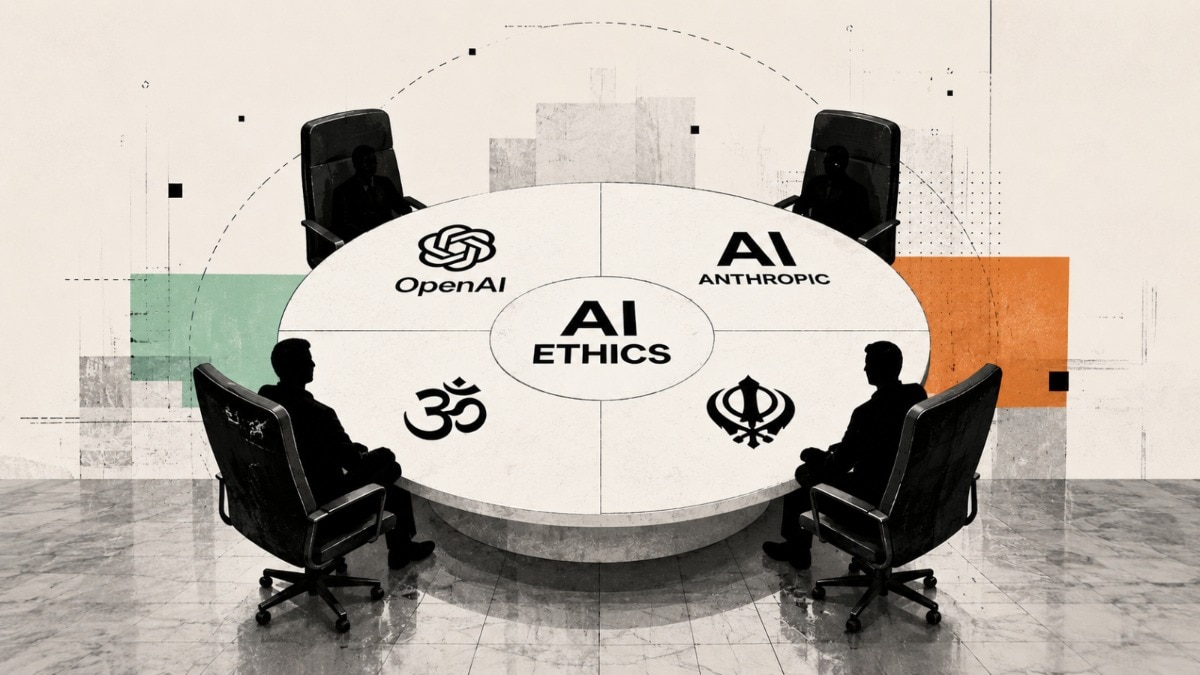

The convergence ofAI ethics and interfaith dialogue underscores a strategic shift with profound implications for sovereign capital and regional economic diversification in the Middle East and North Africa (MENA). As tech giants like Anthropic and OpenAI seek to embed moral frameworks into their models through collaboration with religious institutions, sovereign entities in MENA could leverage this trend to position themselves as ethical AI hubs. Countries such as UAE, with its Agenda 2071 prioritizing tech sovereignty, may accelerate investments in AI startups that align with religiously informed ethical standards, thereby enhancing their sovereign capital attractiveness. This approach could differentiate MENA in global VC landscapes, where ethical AI is increasingly a compliance and reputational differentiator. Moreover, regional infrastructure projects aimed at AI development might integrate these ethical principles, reducing regulatory friction and fostering cross-border partnerships. The长期 impact hinges on MENA’s ability to standardize these norms across diverse religious demographics, turning ethical alignment into a competitive advantage for sovereign wealth funds and tech-heavy governments.
The venture capital ecosystem in MENA stands to benefit from this ethico-technological synergy, particularly as global investors prioritize ESG-compliant initiatives. by framing AI ethics through the lens of religious values—a facet often overlooked in Silicon Valley—the region could tap into underserved niches where faith-based investors or halal-compliant AI applications hold sway. For instance, AI-driven fintech platforms adhering to Islamic finance principles could flourish, attracting specialized VC funding. Additionally, MENA’s strategic location as a bridge between East and West may enable regional infrastructure providers to develop decoupled, ethically certified AI infrastructure parks. These hubs could serve dual purposes: reducing reliance on Western tech monopolies and embedding region-specific ethical guardrails, thereby mitigating geopolitical risks associated with data sovereignty. The success of such models would hinge on sovereign capitals aligning with local religious institutions to co-design compliant frameworks, a move that could solidify MENA’s role as a nexus for values-aligned tech innovation.
The long-term viability of this ethico-technological convergence in MENA depends on addressing inherent challenges in harmonizing diverse religious value systems into coherent AI principles. While the UAE’s centralized governance model may ease the integration of faith-based ethics into sovereign strategies, more decentralized regions like North Africa could face bureaucratic inertia. Critical to this process is the role of venture capital in scaling pilot projects into wide adoption—VCs must balance profit motives with ethical imperatives to fund initiatives that resonate across religious fault lines. Furthermore, regional infrastructure investments must prioritize AI ethics as a core component of digital public goods, ensuring that sovereign-backed projects do not inadvertently amplify biases or exclusion. The coming years will determine whether MENA can transform ethical AI from a niche academic exercise into a scalable economic engine, one that leverages both sovereign capital and strategic partnerships with religious stakeholders to redefine global AI governance norms.