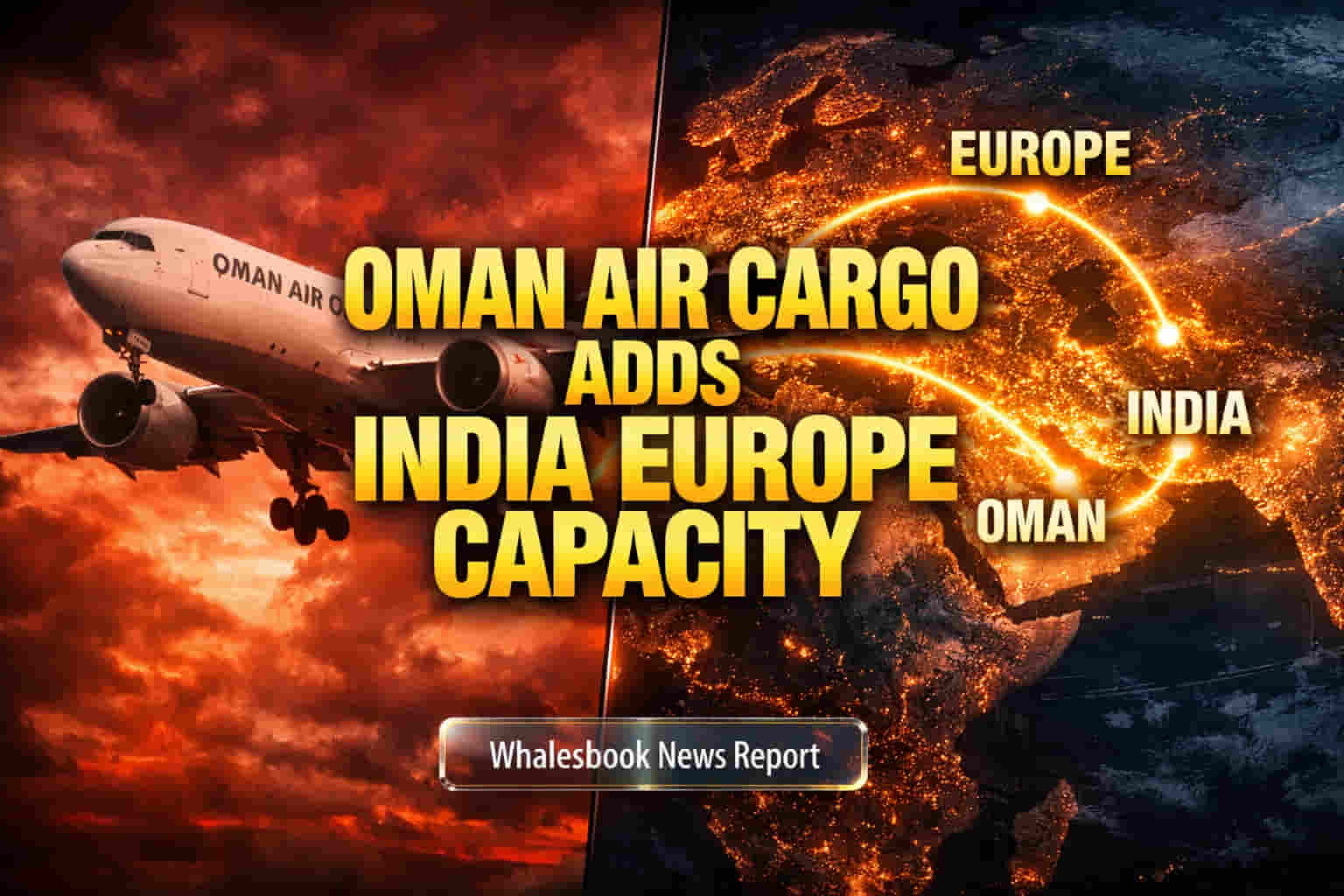

The strategic recalibration of air cargo networks in response to regional airspace closures presents a significant market capture opportunity for Oman Air Cargo. By aggressively augmenting belly-hold capacity on Europe-Asia and India-Europe corridors, the carrier is leveraging Muscat’s geographic position to absorb rerouted traffic from constrained Gulf hubs. This move targets a segment of the estimated $1 billion Omani air cargo market, directly competing with entrenched giants. The carrier’s 42% volume growth in H1 2023 demonstrates existing operational traction, and its 2026 strategy reflects a calculated bet on sustained disruption. The business impact is twofold: immediate gain in transit market share and a longer-term repositioning of Oman as a critical logistics node, potentially attracting sovereign wealth fund attention and venture capital into ancillary ground handling and digital freight platforms to support this scaled ambition.
DP World exemplifies the stabilizing force of institutionally-backed infrastructure operators during periods of volatility. The company’s record $20 billion revenue and robust H1 2025 growth, coupled with a $2.5 billion capex budget, underscore its financial resilience and strategic intent. Its operations at Jebel Ali Port continuing unabated, despite regional tensions, provides essential continuity for global supply chains. Critically, DP World’s actions—such as the acquisition of the ‘DP World Chennai’ vessel and its $5 billion India investment pledge—signal a deliberate pivot to de-risk trade corridors by bolstering the India-Middle East connection. This strategy, supported by its sovereign ownership structure, directly addresses shipper demand for reliability and mitigates some transit risk. The firm’s market capitalization and strong EBITDA margins afford it the liquidity to double down on infrastructure precisely when uncertainty peaks, converting geopolitical stress into a competitive moat.
The systemic shock to global air cargo, with Asia-Middle East-Europe capacity contracting by 26%, exposes profound vulnerabilities in just-in-time supply chains reliant on Gulf hub-and-spoke models. The immediate business impact includes sharp increases in war-risk insurance, fuel costs, and ultimately, freight rates, alongside inevitable 7-10 day backlogs. This environment accelerates two divergent trends: a flight to quality and reliability, benefiting operators like DP World with diversified port assets, and a scramble for alternative routing, which Oman Air Cargo is strategically targeting. The prolonged disruption, however, highlights a critical infrastructure deficit across the MENA region—a gap that will likely draw heightened interest from sovereign capital (via entities like the Public Investment Fund or Mubadala) for large-scale port and airport expansions, as well as from venture capital focused on logistics technology, supply chain finance, and trade digitization solutions designed to navigate such fragilities. The ultimate test for the region’s logistics architecture will be its ability to attract this capital to build redundant, resilient capacity that outlasts the current crisis.