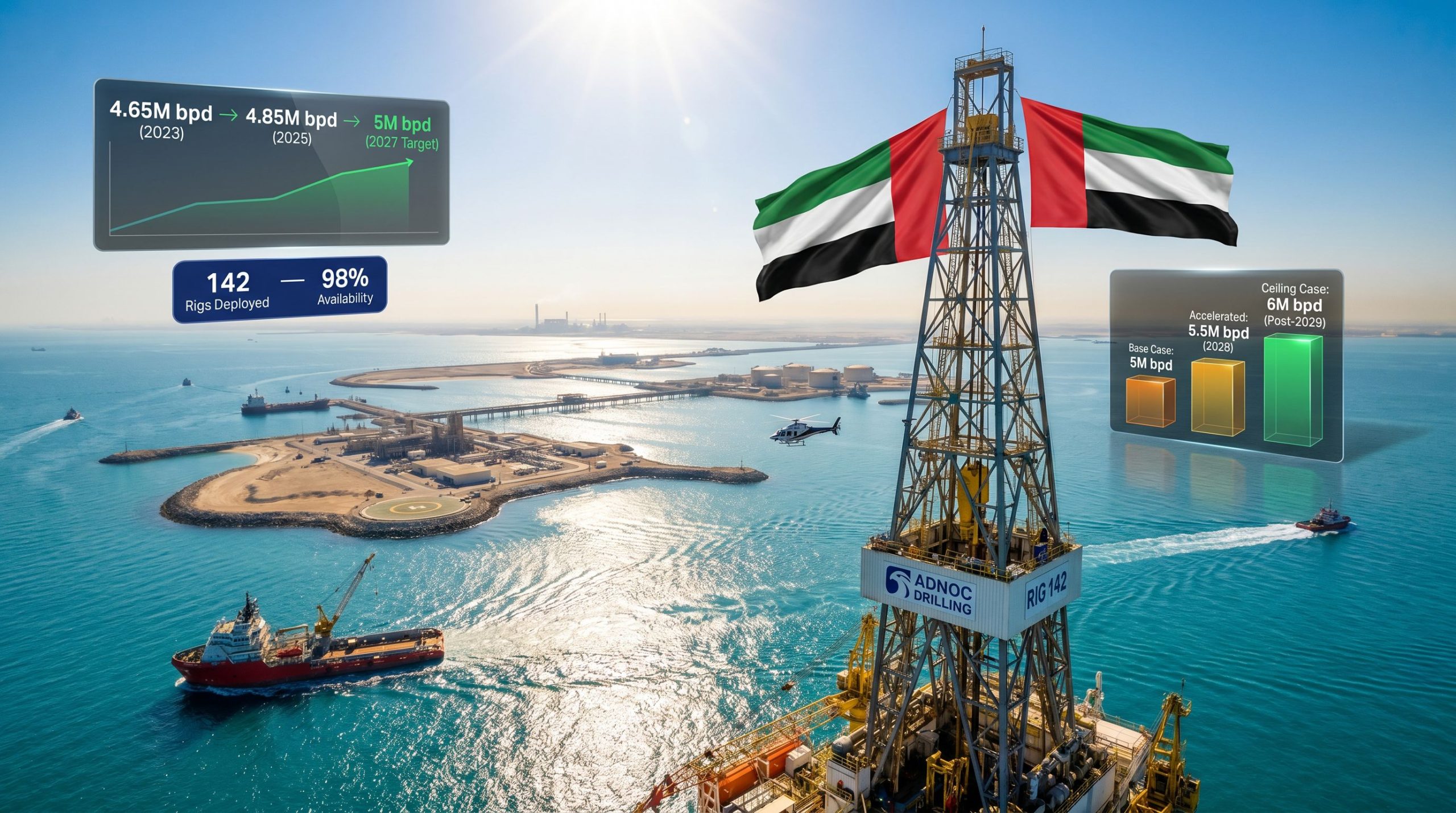

The UAE’s formal departure from OPEC on May 1, 2026 represents far more than a quota management adjustment — it is a structural repricing of sovereign economic agency in the Persian Gulf. By severing itself from cartel-imposed production ceilings, Abu Dhabi has unlocked the ability to monetize an installed crude capacity that had already reached approximately 4.85 million barrels per day by mid-2025, well above the roughly 3.5 million bpd constrained by OPEC+ allocations. For investors and sovereign capital allocators across the MENA region, the critical signal is this: ADNOC Drilling’s fleet now stands at 142 deployed rigs — 15 ahead of a 2030 target originally set at 127 — with a 98% availability rate recorded in Q1 2026, confirming that the ramp is infrastructure-bound, not aspiration-bound. The 5 million bpd sustainable capacity target, once anchored to a 2027 horizon, is now the floor rather than the ceiling, with Energy Minister Suhail al-Mazrouei publicly validating a trajectory toward 6 million bpd conditional on market economics and successful unconventional commercialization.
The capital architecture underpinning this expansion merits close scrutiny from institutional and venture capital perspectives. ADNOC’s unconventional programs — a gas venture with TotalEnergies and an unconventional oil partnership with EOG Resources and Petronas — represent a deliberate diversification of technology risk through multi-jurisdictional partnerships rather than single-source dependency. EOG’s entry, following a review of early-phase results, constitutes a meaningful third-party technical validation that de-risks the unconventional thesis for co-investors. With approximately 100 first-phase wells completed and over 60 hydraulically fractured, these programs are advancing toward Final Investment Decisions expected within 2026, establishing a commercially scalable growth vector beyond conventional brownfield optimization. Critically, the UAE’s pre-existing pipeline, processing, and export infrastructure compresses the capital intensity of unconventional scale-up relative to the U.S. shale model, where parallel gathering and terminal investment historically inflated development timelines and cost structures. For regional infrastructure planners and Gulf sovereign wealth funds evaluating energy transition exposure, this existing asset base is a material competitive advantage that lowers the threshold for project bankability.
From a supply-chain resilience standpoint, ADNOC Drilling’s three-layer logistics model — land-based routing bypassing maritime chokepoints, utilization of the east-coast Port of Fujairah as a strategic alternative to Strait of Hormuz transit, and a pre-positioned two-to-three-month inventory buffer — effectively neutralizes the geopolitical risk premium that has historically suppressed valuation multiples on Gulf-origin production. The fact that 98% fleet availability was maintained throughout Q1 2026 amid active regional tensions is not a fortuity; it reflects years of deliberate redundancy investment that now converts supply reliability into a commercial differentiator for offtake partners and downstream contract negotiations. The incremental 1.5 to 2.5 million bpd of supply that the UAE’s post-OPEC trajectory introduces to global markets over the medium term will not materialize instantaneously, but the directionality is now unambiguous: production policy is oriented toward capacity maximization, and the competitive implications for OPEC+ peers operating within remaining quota frameworks are material. For MENA-focused capital allocators, the UAE’s production logic has shifted from quota compliance to sovereign monetization — and the infrastructure, partnership, and logistics frameworks now in place suggest that the capital deployment cycle supporting this transition has already advanced well beyond the announcement stage.