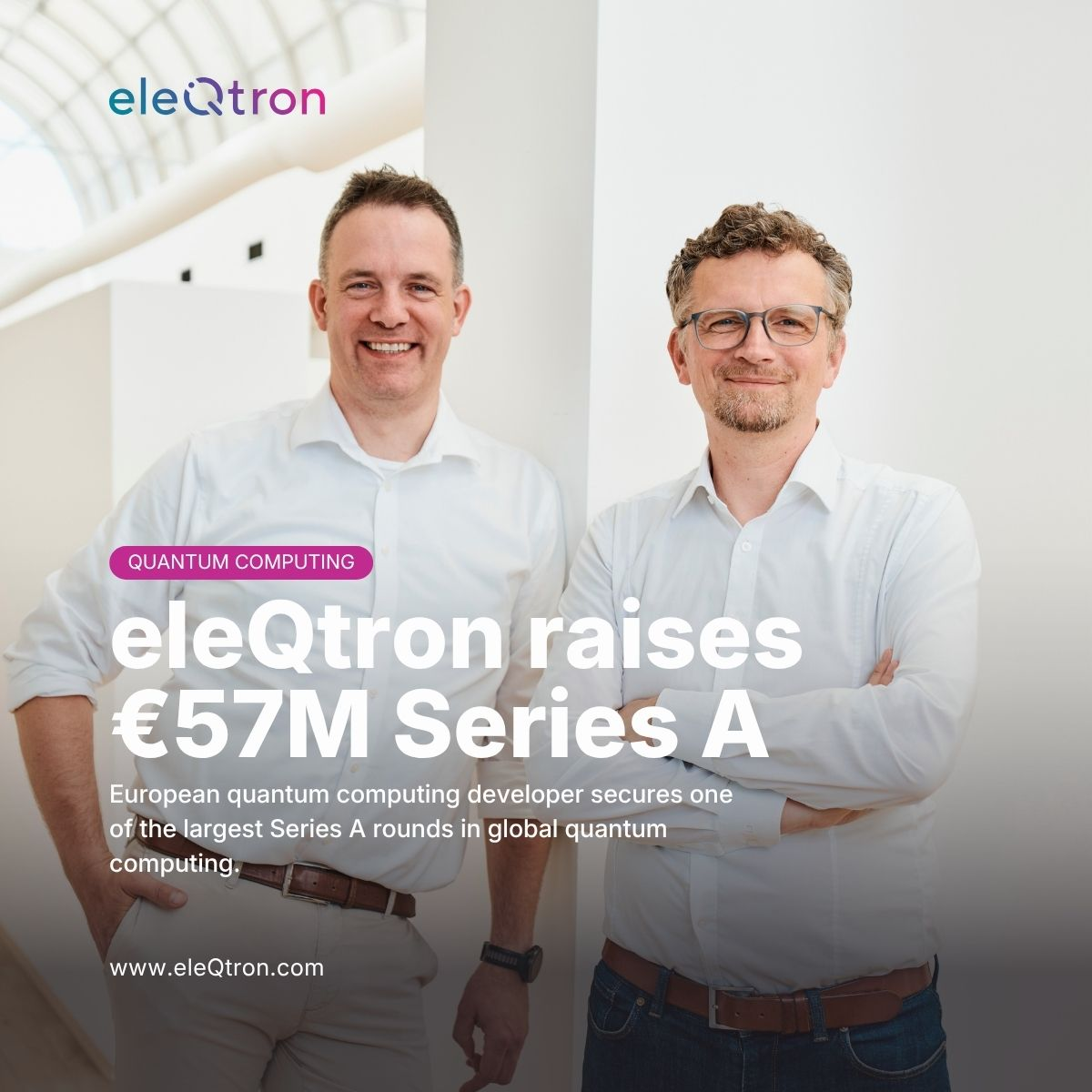

elemQtron’s €57 million Series A funding underscores the accelerating convergence of sovereign capital and quantum technology investment, signaling a strategic imperative for MENA nations to engage in this nascent field. The lead role of Schwarz Digits—a European institutions-driven entity—reflects a broader regional trend where public-private partnerships leverage sovereign resources to dominate high-growth sectors. For MENA, this funding round illustrates the template for sovereign-backed innovation hubs, where state-backed entities like the European Innovation Council (EIC) Fund catalyze technological sovereignty. Such capital injections are not merely financial; they represent a recalibration of industrial policy toward securing quantum supremacy, a domain with profound implications for economic competitiveness. The funds earmarked for industrializing eleQtron’s MAGIC technology could serve as a blueprint for MENA countries aiming to integrate quantum computing into national infrastructure, particularly in defense, energy optimization, and financial services sectors where data sovereignty is paramount.
The venture capital component of this round, with participation from Earlybird, Ankaa Ventures, and others, highlights a maturing quantum startup ecosystem that transcends geographical boundaries. While the investors are predominantly European, the deal’s magnitude and strategic focus may incentivize MENA-based VCs to pivot toward quantum tech as a critical vertical. However, the region’s participation remains limited compared to Silicon Valley or Europe. This gap poses a systemic risk: without localized VC networks capable of funding quantum_), sovereign capital alone cannot bridge the talent or infrastructure divide. For MENA firms eyeing quantum innovation, the challenge lies in aligning sovereign capital with agile private-sector execution. Additionally, eleQtron’s plan to scale cloud-based access to quantum hardware necessitates robust regional data infrastructure. MENA’s uneven digital connectivity and lack of sovereign cloud providers create bottlenecks, urging governments to prioritize quantum-resistant frameworks alongside quantum infrastructure development.
At the heart of eleQtron’s success is its MAGIC technology—a technical leap with outsized business and strategic value. For MENA, the adoption of such scalable quantum solutions could disrupt traditional industries, particularly logistics and manufacturing, where quantum algorithms promise exponential efficiency gains. However, replicating this model requires infrastructure tailored to regional challenges: MENA’s extreme environmental conditions, for instance, demand specialized quantum Leasing or modular facility designs. Moreover, the push for MENA’s sovereign digital frameworks must address regulatory harmonization; disparate data localization laws across the region could stifle cross-border quantum collaboration. The funds allocated by eleQtron to transition from lab to production should prompt MENA policymakers to earmark similar resources for local quantum startups, ensuring homegrown expertise rather than overreliance on foreign providers. In this context, the global quantum race transcends technology—it is a proxy for economic sovereignty, a domain where MENA’s delayed entry risks marginalization in the next industrial revolution.