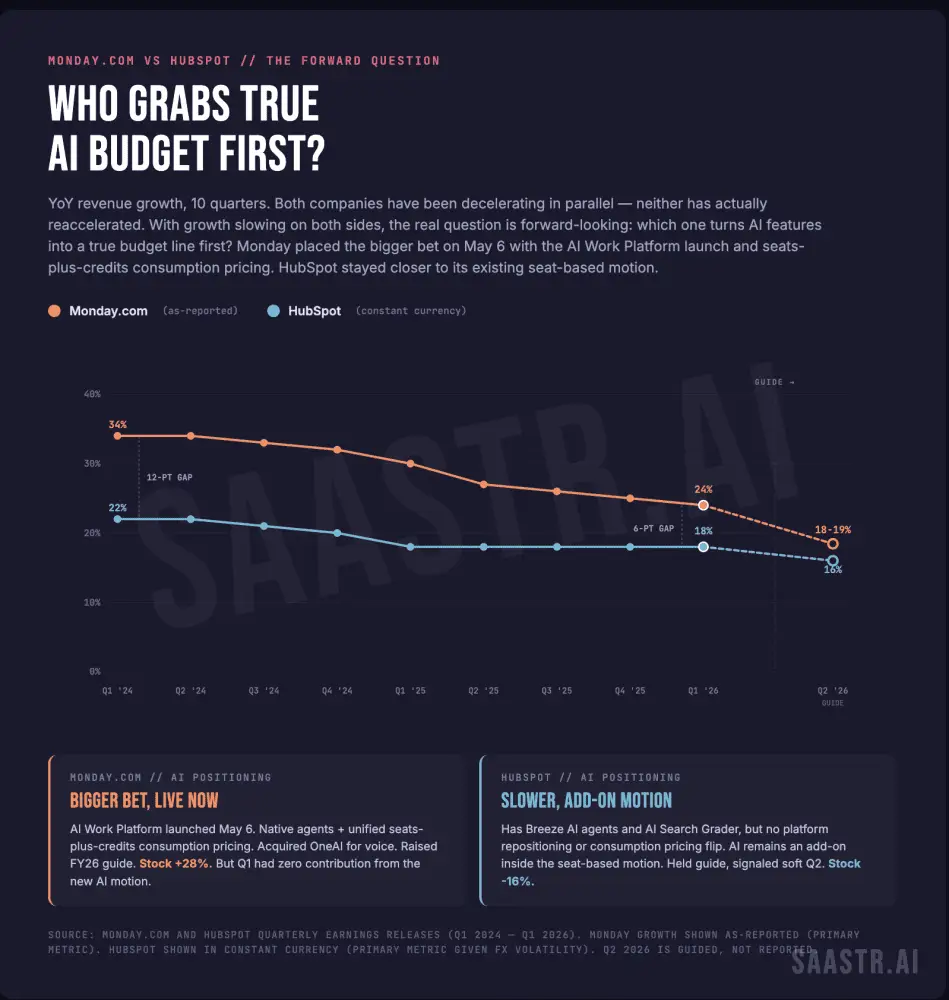

Monday.com’s Q1 2026 results, which include a 24% revenue beat and a guidance raise to $1.47B, underscore a critical shift in the B2B software landscape: enterprise adoption of AI-driven growth models is no longer a speculative bet but a measurable, scalable engine. For the Middle East and North Africa (MENA), this signals both opportunity and urgency. Sovereign capital, which has long prioritized infrastructure-heavy investments, now faces pressure to reallocate resources toward tech-enabled enterprise solutions. Countries with nascent digital ecosystems—such as the UAE, Saudi Arabia, and Egypt—must recognize that regional competitiveness hinges on fostering B2B SaaS and AI startups that mirror Monday.com’s trajectory: scaling through multi-product attach, upmarket migration, and consumption-based pricing. The market’s reward for Monday’s strategy—crushing HubSpot’s decelerating model—reflects a broader investor preference for ventures that demonstrate AI’s tangible impact on operating leverage and customer retention, particularly in high-value enterprise segments.
Venture capital dynamics in MENA are also evolving in response to these trends. The region’s VC community, historically focused on fintech and e-commerce, must pivot toward enterprise software and AI infrastructure as the next growth frontier. Monday’s success highlights the importance of RPO (Remaining Performance Obligations) as a leading indicator of future revenue, a metric that could redefine deal evaluation criteria. Sovereign-backed funds and regional VCs with a mandate to support digital transformation should prioritize investments in AI workflow platforms, agent-based pricing models, and tools that enable net expansion in enterprise cohorts. Furthermore, the acquisition of OneAI for voice agent capabilities underscores the strategic value of domain-specific AI solutions—an area where MENA’s tech stack remains fragmented. By aligning with these models, regional investors can accelerate the development of a homegrown ecosystem capable of competing globally.
Regional infrastructure implications are equally profound. Monday’s shift to a “seats plus credits” pricing model, which decouples user costs from AI consumption, aligns with MENA’s push for cloud-first, API-driven architectures. This model reduces friction for enterprises managing hybrid teams and could catalyze the adoption of multi-cloud strategies, a critical step for countries aiming to diversify their digital infrastructure portfolios. Moreover, the emphasis on internal AI ROI—explicitly cited in Monday’s CFO remarks—resonates with sovereign efforts to justify public sector digital investments through cost savings and productivity gains. Governments in the region should leverage these outcomes to advocate for policies that incentivize AI adoption in enterprise workflows, from logistics to regulatory compliance. Ultimately, Monday.com’s Q1 print serves as a blueprint: to thrive in a post-2025 B2B landscape, MENA must embed AI into its capital allocation frameworks, venture strategies, and digital infrastructure roadmaps.