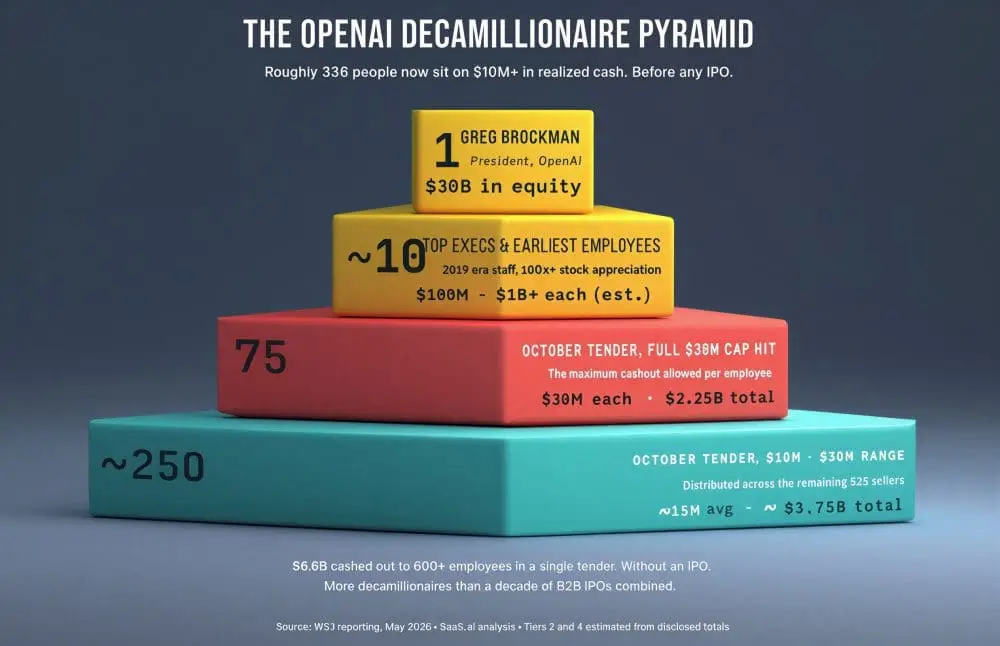

The unprecedented secondary sale by OpenAI represents a seismic shift in global technology capital allocation that carries profound implications for MENA’s sovereign wealth architecture and emerging technology infrastructure. With over 600 employees realizing $6.6 billion in liquidity at an $852 billion valuation—75 individuals receiving maximum $30 million payouts—the transaction signals the arrival of artificial intelligence as a primary wealth creation vehicle rivaling traditional energy sectors. Regional sovereign investors including Saudi Arabia’s Public Investment Fund, Abu Dhabi’s Mubadala, and Qatar Investment Authority have been positioned directly in the AI value chain through strategic partnerships and direct investments, with these secondary events providing crucial validation of long-term infrastructure bets in semiconductor capabilities, cloud computing capacity, and data center construction across the Gulf.
For MENA’s venture capital ecosystem, the OpenAI liquidity event establishes a new benchmark for portfolio construction and exit expectations that challenges conventional regional investment horizons. The concentration of wealth among technical talent—with cumulative employee populations holding $10 million-plus positions reaching 300-500 individuals across multiple tenders—creates an emerging class of tech-savvy investors who will increasingly compete for early-stage deals across Dubai, Riyadh, and Cairo. This capital migration from traditional real estate and energy allocations toward technology opportunities accelerates the region’s digital transformation agenda, while creating pressure on local fund managers to demonstrate comparable returns in shorter timeframes to justify continued institutional support for regional venture ecosystems.
The infrastructure implications extend beyond pure capital flows to encompass fundamental restructuring of MENA’s technology talent competitive positioning. As base salaries for AI engineers crest $500,000 annually with equity packages rivaling founding stakes at successful startups, regional hubs face intensified competition for scarce machine learning expertise necessary to support sovereign cloud initiatives, smart city deployments, and industrial AI applications. The liquidity-driven retention model pioneered by OpenAI—wherein two-year cliffs serve as de facto lockup periods—requires careful consideration by regional policymakers seeking to develop indigenous AI capabilities rather than remaining dependent on imported talent or service partnerships with Western technology leaders.
Looking toward eventual public offerings by both OpenAI and Anthropic, the prospect of thousands of decamillionaires emerging from single transactions presents both opportunity and disruption for MENA’s financial markets. Sovereign pension funds and family offices that participated early in AI venture rounds now face the challenge of deploying massive distributions into subsequent technology cycles while competing against a newly-minted class of millennial investors whose formative wealth experiences occurred entirely within artificial intelligence’s current boom cycle. This generational wealth transfer, concentrated geographically in San Francisco but financially connected to global capital networks, will drive increased cross-border investment activity and potentially hasten the development of secondary market capabilities within regional exchanges seeking to capture spillover effects from what may prove the largest B2B wealth creation event in technology history.