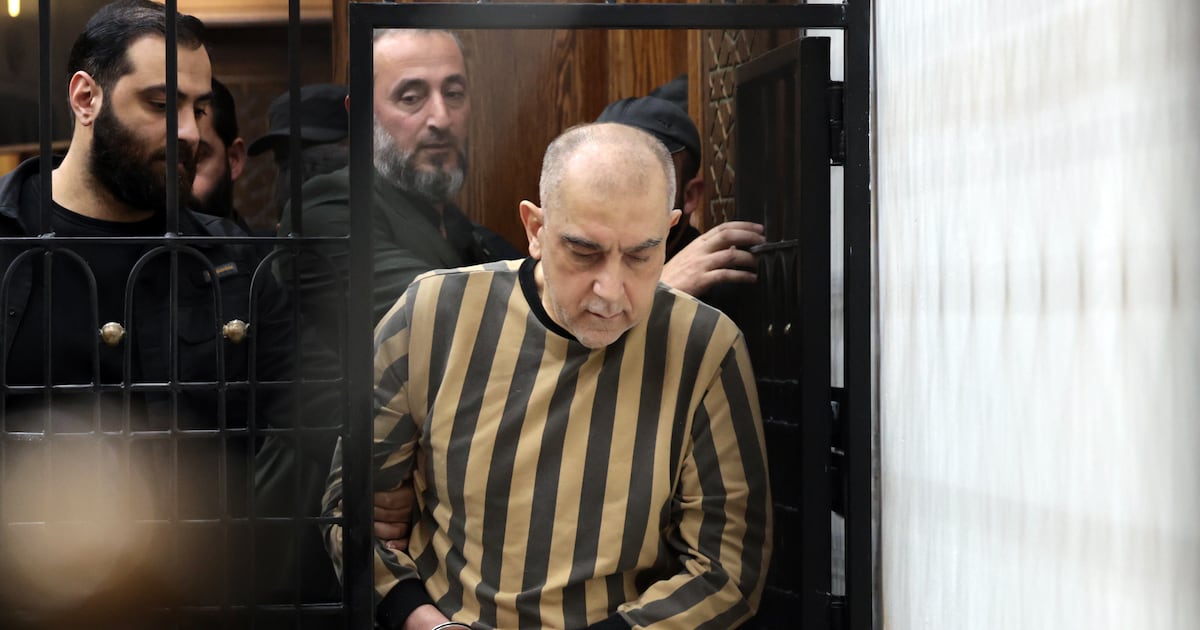

The commencement of public trials for senior officials of the ousted Bashar Al Assad regime in Damascus this week marks a pivotal, if tentative, signal to global sovereign capital allocators and multilateral lenders evaluating post-conflict reconstruction exposure in Syria. Justice Minister Mazhar Al Wais confirmed proceedings opened Sunday with Atif Najib, former Deraa political security chief and a US Treasury-sanctioned cousin of the ex-president, as the first defendant, with additional hearings planned for figures implicated in the 2013 Tadamon massacre and the regime’s $5bn+ annual Captagon trafficking network. For Gulf sovereign wealth funds, including Saudi Arabia’s Public Investment Fund and the UAE’s Mubadala, which have held $200bn+ in unallocated Levant reconstruction capital since the Assad regime’s collapse in December 2024 following the ex-president’s flight to Moscow, the trials represent a long-awaited compliance prerequisite: the removal of sanctioned actors from positions of informal power reduces exposure to secondary sanctions risks that have previously blocked large-scale sovereign deployment.
Beyond sovereign allocations, the transitional justice process is beginning to unblock private capital channels, including regional venture capital and infrastructure investment, that have been stifled by the regime’s parallel economy. The arrest of Waseem Assad, a US-sanctioned paramilitary leader and key Captagon trafficking figure, alongside the dismantling of the regime’s monopoly on cross-border narcotics trade, eliminates a major distortion for legitimate early-stage funding and construction contracting. Regional infrastructure players, including DP World and ACWA Power, which have eyed Syria’s derelict Tartous port and degraded energy grid for years, now face reduced operational risk from racketeering by former regime affiliates. For venture capital firms such as Middle East Venture Partners and BECO Capital, the clarity around sanctioned entities opens pathways for early-stage bets on logistics tech, construction fintech and agritech targeting Syria’s rebuild, a market estimated to require $400bn in private and public capital over the next decade per World Bank projections.
The ripple effects extend across the broader MENA region, where sovereign risk premia for neighboring states have been inflated by Syrian instability and cross-border illicit trade for over a decade. Jordan’s sovereign debt spreads, for example, have traded 120 basis points wider than regional peers since 2011 due to border security costs and refugee-related fiscal pressures; a stabilized, sanction-compliant Syria would allow Amman to reallocate $1.2bn annually in border and aid spending to productive sovereign outlays. U.S. Special Envoy Tom Barrack’s public endorsement of the arrest of Amjad Yousef, the former military intelligence officer and chief suspect in the 2013 Tadamon massacre that killed 288 civilians, further aligns Washington with the new Syrian authorities, a critical signaling mechanism for Gulf sovereign wealth funds that routinely co-invest with U.S. institutional partners to avoid regulatory friction. However, persistent sectarian violence targeting Alawite communities and unverified revenge killings of junior regime affiliates pose a material risk to long-term institutional capital flows, as global allocators remain wary of protracted social fragmentation that could derail reconstruction timelines.