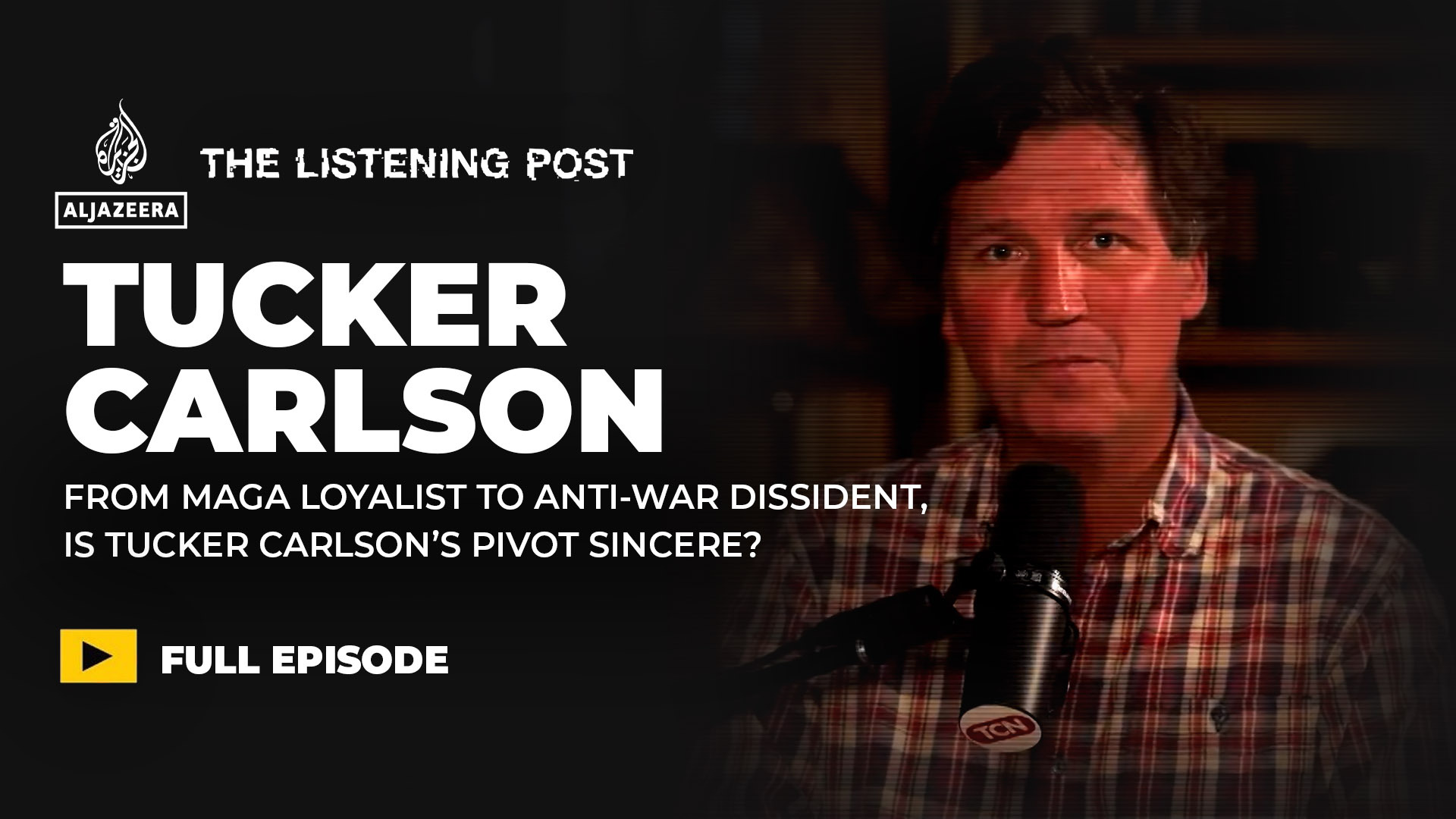

The strategic recalibration of Tucker Carlson’s media platform toward antiwar and anti-Israel narratives represents a calculated realignment with profound implications for cross-border capital flows in the Middle East and North Africa. As a figure whose influence transcends traditional political boundaries, his pivot could catalyze shifts in sovereign capital allocation, particularly in Gulf states where strategic patronage of media and think tanks often aligns with geopolitical hedging. For instance, Saudi Arabia’s Public Investment Fund or UAE’s sovereign wealth entities might reassess risk profiles for investments in regions perceived as politically volatile under this new narrative framework. Meanwhile, venture capitalists operating in MENA’s tech ecosystems—especially in Israel, Palestine, or the Levant—may face increased scrutiny over ESG metrics, as institutional investors increasingly tie philanthropic or strategic backing to우스 media personalities’ reputational risks. This underscores a growing convergence between soft power narratives and hard capital decisions in the region.
The business impact of Carlson’s evolution extends to regional infrastructure development, where stability often hinges on predictable policy landscapes. If his platform emboldens broader anti-Israel sentiment, it could amplify pressure on Western allies to recalibrate funding priorities for MENA infrastructure projects, such as energy pipelines or digital hubs. Countries relying on foreign direct investment may encounter delayed approbations or contingent terms tied to external geopolitical calculus. Furthermore, his advocacy for antiwar discourse might divert venture capital from conflict-dense areas like Sudan or Yemen toward tech-neutral platforms in UAE or Qatar, where regulatory environments remain more insulated. This could exacerbate regional economic disparities, as institutions with access to global narrative control disproportionately influence capital deployment in less visible markets.
The long-term implications for sovereign and venture capital ecosystems in MENA hinge on whether Carlson’s trajectory signals a genuine shift or a tactical adaptation to contemporary discourse. A sustained pivot could embolden local entrepreneurs and governments to diversify beyond Western-centric funding models, accelerating MENA’s push for sovereign-backed innovation hubs. Conversely, if perceived as opportunistic, it may erode trust in transatlantic investment channels, prompting regional fintechs and startups to seek alternative funding routes through Asian or Gulf intermediaries. Ultimately, the interplay between media influence and capital allocation in MENA will depend on how sovereign actors balance geopolitical signaling with economic pragmatism—a dichotomy that Carlson’s evolving role may soon crystallize.