
Klaviyo: A High-Growth SaaS Paradox in the MENA and Global Landscape
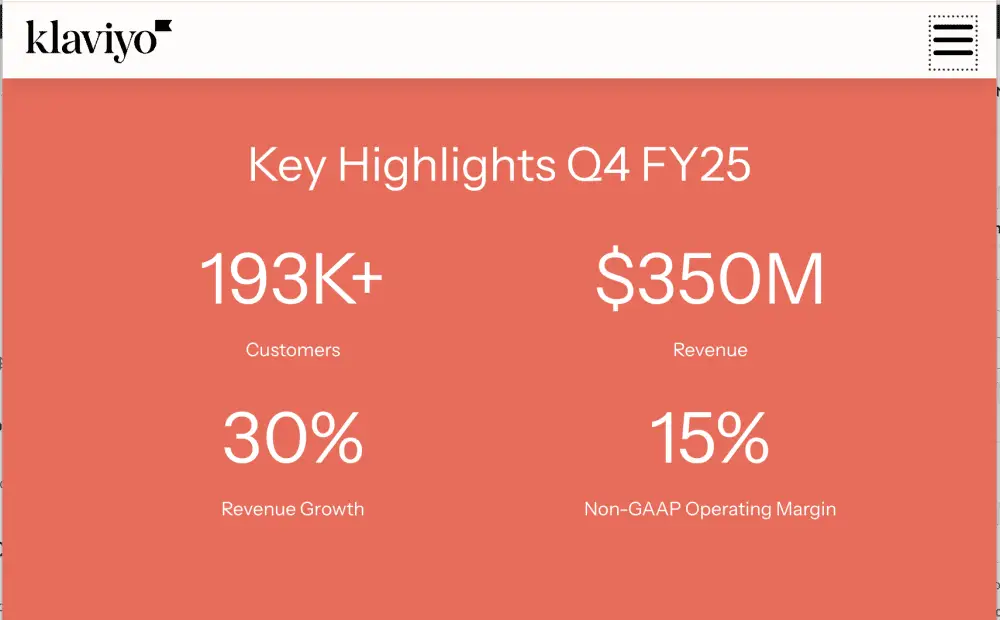
Klaviyo, a leading B2B marketing automation platform, presents a compelling yet perplexing investment case in the current financial environment, particularly within the context of the dynamic MENA region and broader global tech sector. While the company recently reported robust FY2025 results – $1.234 billion in revenue, a 32% year-over-year growth rate propelled by a 30% surge in Q4, and strong profitability – its market capitalization of approximately $5.4 billion suggests a valuation that many observers find materially below its underlying growth potential. This disconnect warrants a deep dive into the business implications, sovereign capital dynamics, venture capital flows, and regional infrastructure considerations that are shaping Klaviyo’s trajectory.
The core strength of Klaviyo lies in its impressive unit economics, underpinned by a consistently high Net Revenue Retention (NRR) of 110% in FY2025. This signifies not only customer retention but also the successful expansion of revenue from existing customer accounts, a critical indicator of a sustainable growth model. The company’s deliberate strategy of targeting the enterprise segment has yielded significant results, with the number of customers generating over $1 million in ARR doubling year-over-year. This expansion of the customer base, coupled with a growing emphasis on multi-channel marketing through SMS and WhatsApp, represents a significant shift away from a purely e-commerce-centric model, a trend increasingly relevant to the evolving digital landscape in the MENA region.
The company’s international expansion is another key driver of growth, with revenue from outside the Americas growing at a remarkable 42% in 2025 and now comprising over a third of its total revenue. Strategic investments in regional hubs such as Dublin and Singapore demonstrate a clear commitment to capturing the burgeoning digital economies of the Middle East and North Africa. This geographic diversification mitigates the risks associated with a concentrated market and positions Klaviyo to capitalize on the rapid digital adoption witnessed across the region. Furthermore, the company’s investment in AI-powered marketing tools, including the Marketing Agent and Customer Agent, is not merely a feature addition but a fundamental evolution of its platform offering, aligning with the broader trend of AI disruption in the SaaS space.
However, the inherent dependency on the Shopify ecosystem remains a significant factor influencing Klaviyo’s valuation. While the company has strategically diversified, 78% of its ARR is still tied to Shopify merchants. This dependence creates both opportunities and risks. The Shopify platform provides a substantial distribution channel for Klaviyo’s solutions, but it also exposes the company to the potential for platform-level shifts or competitive pressures from Shopify’s own expansion into marketing automation. While the current contractual runway until 2029 offers a degree of insulation, the long-term implications of this dependence are subject to ongoing market dynamics and the evolution of the digital commerce landscape, which is reshaping the MENA region significantly.
The market’s valuation of Klaviyo, at a 4.7x forward revenue multiple compared to Shopify’s 13x, highlights a disconnect that requires careful consideration. While Shopify benefits from a larger addressable market and potentially more robust platform economics, Klaviyo boasts superior NRR and profitability metrics with a higher growth rate. The irony lies in the fact that the very strength of Klaviyo’s growth, enabled in part by Shopify, is simultaneously a major driver of its lower valuation. Investors, perhaps recognizing the slower growth potential tied to the platform dependency, are pricing in a lower multiple, which could limit future upside.
In conclusion, Klaviyo represents a compelling case study of a high-growth SaaS company navigating the complexities of the MENA region and the global market. Its strong unit economics, international expansion, and AI-driven innovation position it for continued success. However, the enduring dependency on the Shopify ecosystem warrants careful monitoring and may constrain future valuation expansion. Balancing these factors, Klaviyo’s future success hinges on its ability to further diversify its revenue streams, enhance its enterprise independence, and effectively capitalize on the rapidly evolving digital landscape of the Middle East and North Africa.