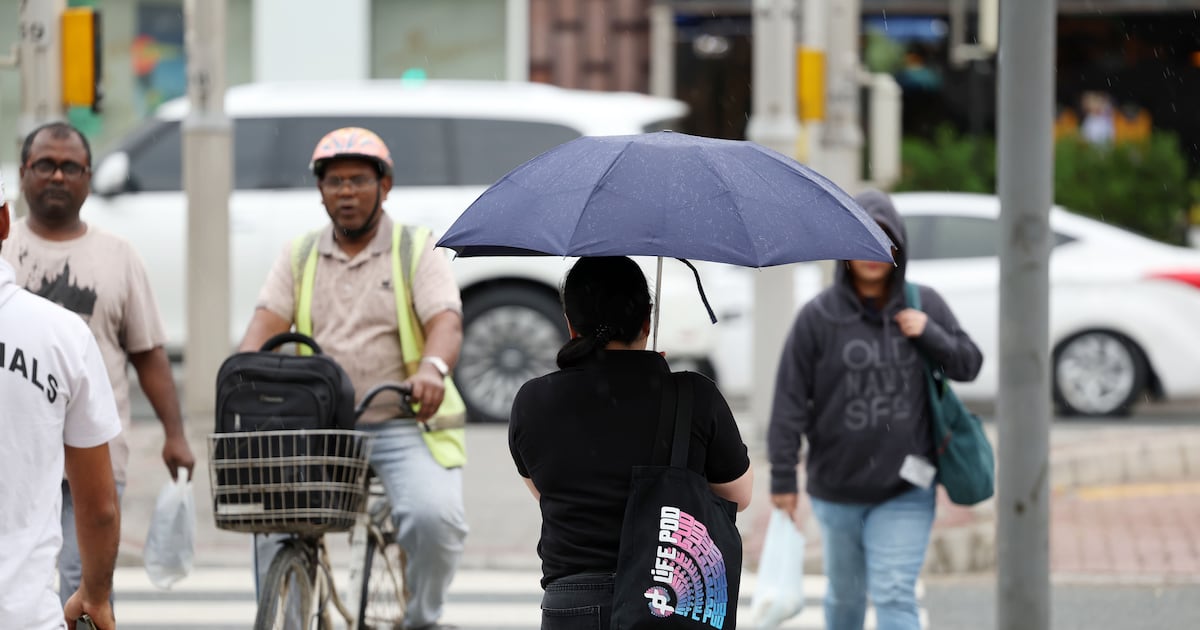

The UAE’s meteorological patterns are poised to impact the nation’s operational tempo, with the National Centre of Meteorology forecasting light rainfall across coastal and island territories beginning Tuesday. Winds surging to 40kph are anticipated to generate dust particulates, while maritime conditions in the Arabian Sea and Gulf of Oman are projected to deteriorate. The NCM’s five-day outlook indicates a parallel temperature decline along coastal regions, with meteorological instability extending into Wednesday and Thursday. Precedent from late March demonstrates the potential for significant infrastructural pressure, when record precipitation levels in Abu Dhabi and Ajman overwhelmed transport arteries and necessitated extensive municipal response efforts. These climatic dynamics carry implications for sovereign project continuity, particularly for outdoor construction ventures and renewable energy installations requiring grid stability.
Venture capital deployment patterns in the Gulf must account for seasonal weather volatility, which can disrupt logistics chains, outdoor construction timelines, and operational efficiency across critical sectors including logistics, energy, and real estate development. Infrastructure resilience has emerged as a priority for sovereign wealth strategies, with recent flooding incidents underscoring vulnerabilities in drainage systems and transportation networks. The frequency of such events, while cyclical, requires capital allocation toward adaptive urban planning measures, including permeable surfaces and improved water management systems. These considerations directly influence fund managers evaluating MENA exposure and technology adoption rates in climate-adaptive infrastructure.
Regional governments have historically prioritized megaproject pipelines and diversification into knowledge economies, but recurring atmospheric disruptions present both operational risks and strategic imperatives for capital deployment. Smart city initiatives, autonomous transport systems, and distributed energy networks—all critical to Vision 2030 and similar frameworks—demand weather resilience baked into design and viability models. From an institutional lens, this necessitates deeper integration of geospatial analytics, IoT-driven monitoring, and AI-based predictive capacity within sovereign portfolios. Investors will be scrutinizing governance frameworks and disaster response capabilities when calibrating risk premiums, particularly in areas with high first-time exposure to climate-induced infrastructure stress.
For the UAE, where economic narratives increasingly pivot on sustainability and technological sovereignty, atmospheric risk management is not merely environmental—it is fiscal. The convergence of physical climate events with macroeconomic positioning could inform the appetite for public-private partnerships, especially as sovereign capital seeks to underwrite next-generation infrastructure with built-in redundancy. As such, enduring climatic trends are reshaping not just the delivery but the very calculus of growth, influencing both capital inflows and technology enablers across the GCC’s most mature markets. Institutional players must therefore pair conservation ethics with infrastructural pragmatism, embedding adaptive resilience as a core metric in sovereign investment theses.