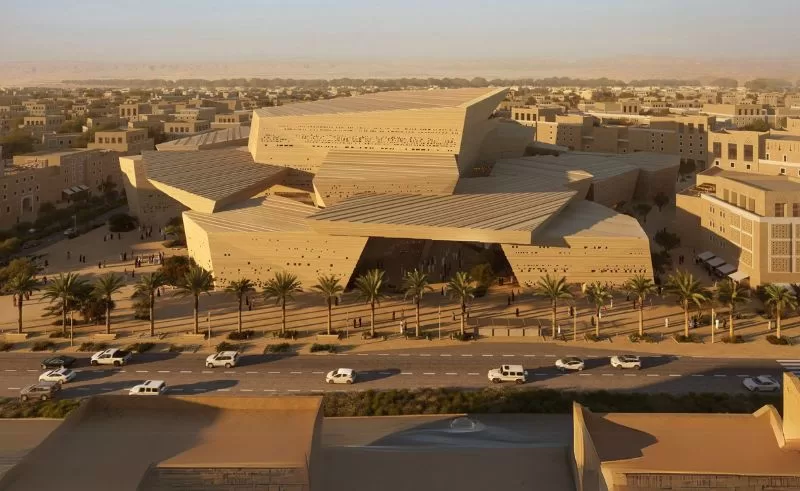

Saudi Arabia’s Public Investment Fund has sealed a US$1.4 billion construction contract for the Royal Diriyah Opera House, the flagship cultural venue of the Diriyam Gate Development Programme. The joint‑venture of El Seif Engineering, China State Construction and Midmac will deliver a 45,000 m² complex that includes a 2,000‑seat main auditorium, a 450‑seat studio theatre, a rooftop amphitheatre and a luxury hotel‑residential enclave. By anchoring the broader mixed‑use regeneration of Diriyah, the project is designed to generate tens of thousands of skilled jobs, stimulate hospitality revenue and underpin a projected SAR 70 billion addition to GDP once the precinct targets 50 million annual visitors.
From a sovereign capital perspective, the opera house is a tangible deployment of Vision 2030’s diversification mandate, shifting fiscal reliance from hydrocarbons to high‑value experience‑driven sectors. The involvement of the PIF provides not only capital underwriting but also a credit‑enhanced pipeline that is likely to attract private‑equity and venture‑capital partners seeking exposure to Saudi’s burgeoning creative‑industry ecosystem. The development’s integration with public‑transport links and heritage sites creates a fortified urban cluster that can leverage economies of scale for future infotainment and digital‑media ventures.
Regionally, the Diriyah opera house reinforces the Gulf’s race to embed world‑class cultural infrastructure into city‑branding strategies, joining Abu Dhabi’s Louvre and Doha’s Katara Cultural Village as catalysts for tourism‑linked economic growth. Its construction by a consortium that blends local expertise with Chinese and international firms signals a model for risk‑sharing that could be replicated in other sovereign‑backed projects, encouraging cross‑border venture participation and technology transfer in acoustics, sustainable building systems and hospitality services.
Strategically, the venue will serve as a magnet for global performing arts tours, fostering a talent pipeline that supports ancillary creative‑tech start‑ups and knowledge‑based industries. The anticipated influx of international acts and audiences is expected to spur demand for ancillary services—ticketing platforms, event‑logistics software and digital‑ticket resale markets—areas ripe for venture funding. In sum, the Royal Diriyah Opera House is positioned not merely as a cultural landmark but as a lever for sovereign wealth diversification, private‑capital mobilisation and the maturation of a regional creative‑technology infrastructure.