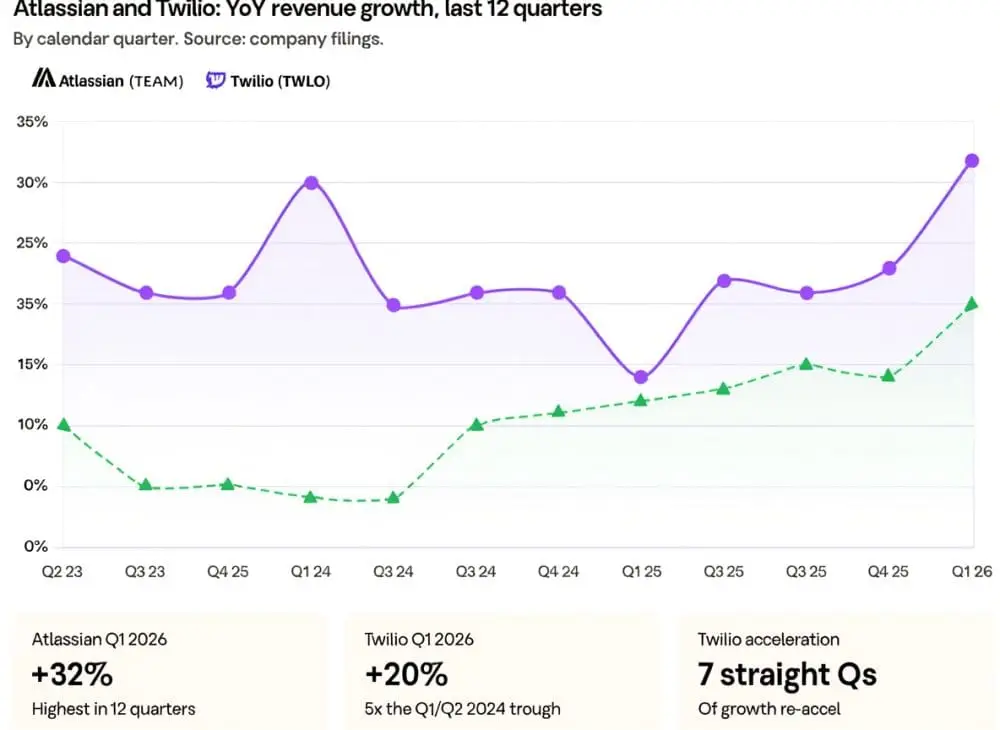

Recent earnings reports from Atlassian and Twilio signal a potential inflection point in the ongoing evolution of the business-to-business software landscape. While both companies demonstrated accelerated revenue growth, the implications for the Middle East and North Africa (MENA) region are significant, particularly concerning sovereign capital deployment, venture capital investment, and the broader regional technological infrastructure. The prevailing narrative of a “SaaS apocalypse” appears to be facing headwinds, although the long-term trajectory remains subject to considerable debate.
Atlassian’s 32% year-over-year growth, fueled by a rapidly expanding $7 billion annualized run rate, underscores the burgeoning demand for AI-powered productivity tools. This acceleration, driven in part by the introduction of its Rovo AI agent, demonstrates a shift away from traditional, seat-based models. The potential for sovereign capital in MENA to fund such initiatives is substantial, as governments increasingly recognize the transformative power of AI and software in driving economic diversification and digital transformation. Furthermore, venture capital firms operating in the region are increasingly allocating capital to AI-native SaaS companies, recognizing the long-term value proposition of these technologies.
Twilio’s 20% year-over-year growth, while slower than Atlassian’s, still represents a notable improvement. The company’s strategy of leveraging AI agents to enhance its existing communication infrastructure is proving effective. This aligns with the burgeoning demand for robust connectivity solutions in MENA, a region with significant mobile penetration and a growing digital economy. The expansion of regional infrastructure to support AI applications, including data centers, network connectivity, and cloud computing services, is a critical prerequisite for sustained growth in this sector. The success of companies like Twilio can serve as a catalyst for further investment in this foundational infrastructure.
However, it is crucial to acknowledge that these results are not definitive. The market’s reaction to Atlassian’s earnings was initially muted, with some analysts having significantly lowered their price targets. The challenge lies in demonstrating that AI integration can sustainably replace, rather than diminish, the core value proposition of existing SaaS models. While the data points are encouraging, the long-term implications for developer productivity and the ability of AI to unlock new revenue streams remain to be seen. The dynamic interplay between sovereign investment, venture capital deployment, and the development of regional technological infrastructure will ultimately determine whether the “SaaS apocalypse” is truly over or simply undergoing a significant recalibration. The attention of MENA investors and policymakers will remain keenly focused on this evolving landscape.