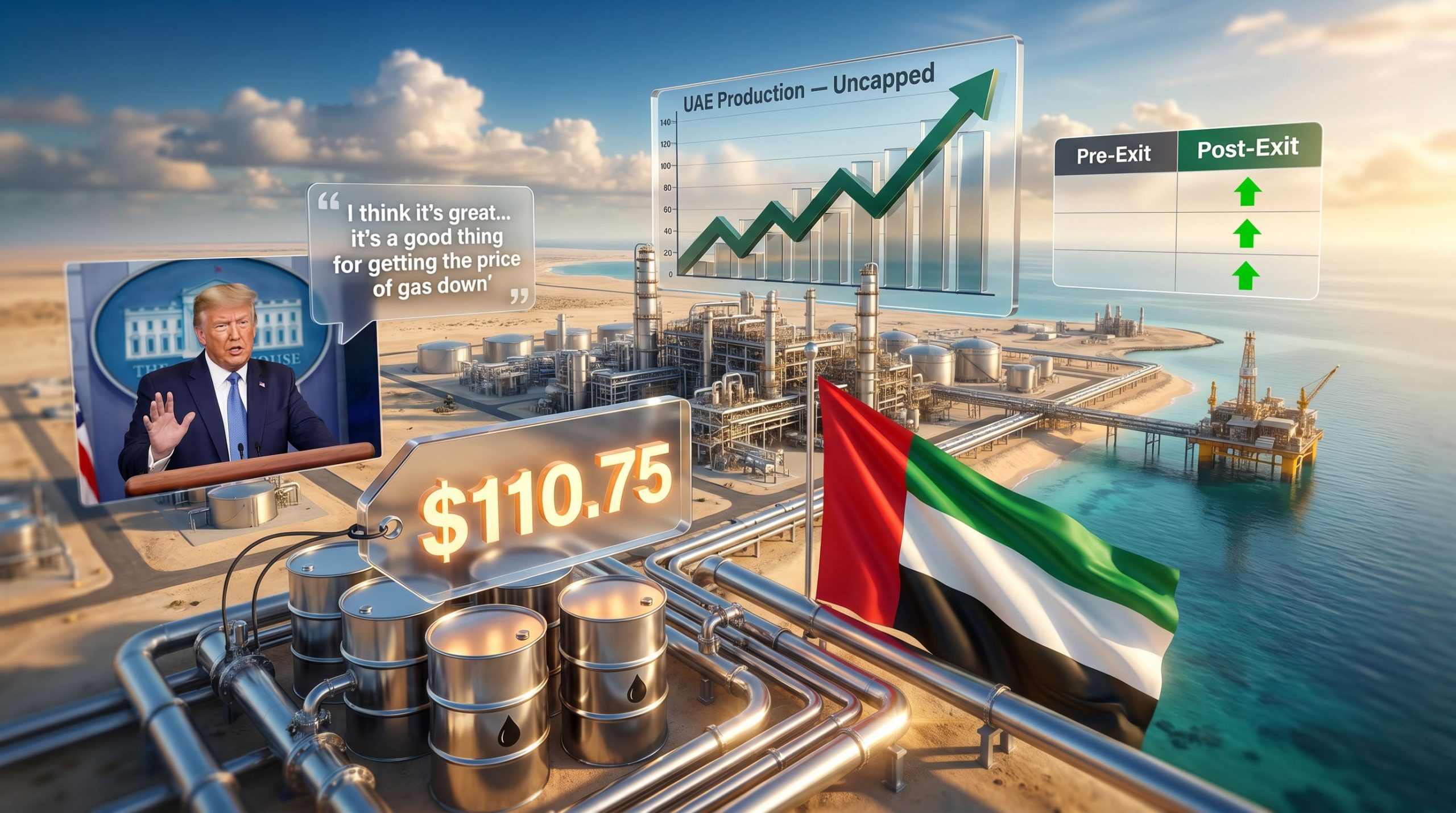

The UAE’s withdrawal from OPEC in April 2026 marks a seismicshift in global oil market dynamics, driven by the economic imperatives of ADNOC’s upstream expansion and the strategic pragmatism of U.S. energy policy. With UAE crude production capacity estimated at $8–$12 per barrel and Murban crude priced at $110.75/barrel for May 2026 delivery, the UAE’s quota restrictions under OPEC+ had become fiscally unsustainable, creating a direct conflict between cartel-enforced output ceilings and the profitability of high-margin, low-cost production. This divergence highlights the fragility of OPEC’s voluntary restraint model, as member states with robust upstream infrastructure prioritize fiscal returns over collective price management. The U.S. response, notably Trump’s endorsement of the exit as a vehicle for lower consumer prices, underscores Washington’s systemic preference for a fragmented OPEC that enables freer global supply—aligning with its strategic pivot toward domestic energy abundance and reduced reliance on geopolitically volatile suppliers. For MENA economies, this recalibration redefines the business calculus for state-owned enterprises like ADNOC, which now balances cartel membership against independent revenue maximization, while U.S.-Gulf energy partnerships gain geopolitical significance.
The UAE’s exit also amplifies vulnerabilities in OPEC+’s sovereign capital architecture, exposing the asymmetric fiscal tolerances among member states. UAE’s sovereign wealth funds, among the world’s largest, derive stability from disciplined production that supports energy revenues without overcommitting to volatile price cycles. By exiting quota constraints, Abu Dhabi gains fiscal flexibility to redirect surpluses toward strategic sovereign investments, from renewable infrastructure to global tech partnerships—a shift that could redefine the region’s investment landscape. Meanwhile, Gulf peers like Saudi Arabia and Iraq, with higher breakeven price thresholds ($70–$90/barrel), face intensified pressure to reassess their compliance with collective quotas, risking capital outflows if OPEC’s pricing power wanes. As Gulf stock markets absorb this uncertainty, evidenced by Emirates NBD’s $750 million AT1 bond issuance amid Iran war tensions, MENA sovereign capital strategies must pivot toward diversified portfolios resilient to fluctuating energy revenues.
Regionally, ADNOC’s aggressive pivot toward U.S. natural gas infrastructure exemplifies a broader MENA infrastructure realignment, as Gulf states leverage bilateral partnerships to bypass OPEC constraints. The $110/bbl Murban pricing premium and $25bn+ U.S. gas investment signal a strategic recalibration toward higher-value energy markets, attracting venture capital into cross-border energy-technology ecosystems. This trend could catalyze MENA’s transition from fossil fuel exporters to diversified energy hubs, with sovereign-backed venture capital targeting decarbonization and digital infrastructure. However, OPEC’s near-term cohesion—bolstered by Algeria’s public reaffirmation and Saudi Arabia’s managed output hikes—temper immediate volatility, though long-term fragmentation risks remain. As Gulf economies navigate this structural inflection, sultanates like Kuwait and Iraq will face existential questions about cartel membership, with sovereign wealth funds increasingly prioritizing agility over collective pricing power in an era of bifurcating energy markets.