
Here is the rewritten article:
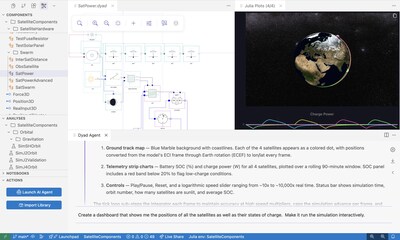
The Middle East and North Africa (MENA) region is on the cusp of a profound transformation in its industrial landscape, driven primarily by the strategic launch of Dyad 3.0 and a pivotal $65 million Series B funding round. As the region’s sovereign capital continues to vie for dominance in digital infrastructure, these developments underline a pivotal moment for investors and innovators aiming to harness cutting-edge technologies. The recent announcement of Dyad 3.0 marks the next generational leap in physical system design and testing, with a strong focus on integrating agentic AI platforms into complex engineering workflows. This advancement not only promises to compress R&D cycles from months to mere days but also reorients the fundamental business model of system development across a sector historically reliant on traditional, capital-intensive methods.
The implications for sovereign capital are substantial. With investments projected to reach $106 trillion by 2040 to meet infrastructure demands, the MENA region stands at the crossroads of necessity and opportunity. Sovereign investors and institutional investors are increasingly focused on catalyzing innovation that delivers measurable ROI while reducing the time-to-market for new solutions. Dyad’s Series B led by Dorilton Capital, supported by leading tech firms and venture-stage investors, signals a robust appetite for AI-driven engineering tools that bridge the gap between predictive modeling and physical reality. This round of funding will significantly accelerate Dyad’s trajectory, supporting its ambitious vision of embedding physics-first, agentic AI into nearly all levels of industrial product development.
The ripple effects extend far beyond the region. Venture capital and private equity firms are re-evaluating their portfolios as software-driven AI adoption accelerates at an unprecedented pace. For technology providers like Julia, this is a golden period to amplify their presence in the digital transformation wave sweeping the MENA and, eventually, the global economy. Companies operating at the intersection of science, engineering, and software are increasingly recognizing the need to harness the full potential of agentic AI platforms like Dyad to remain competitive.
For regional stakeholders, this evolution offers both a chance for collaboration and a strategic imperative to position themselves within the next technological era. As the world’s attention turns to agentic engineering, the MENA region’s ability to adapt and innovate will play a pivotal role in shaping the future of industrial software and physical systems.
Data underscores these trends. McKinsey estimates over $103 billion in investment would be needed by 2040 to sustain infrastructure growth, a figure that positions the region as a key beneficiary if it capitalizes on new opportunities in AI-augmented engineering. The partnerships announced with Synopsys and Cision further illustrate the growing synergy between regional players and global technology leaders, paving the way for deeper integration of SciML, Digital Twins, and real-time simulation in local industries.
Ultimately, as Daniel Freeman of George C. Mercer reminded us, the challenge of scaling complex system engineering has never been so relevant. Dyad’s advancements embody the convergence of fundamental science and industrial application, offering a rare blueprint for future-ready engineering. This evolution isn’t just about building smarter machines—it’s about building smarter systems on a global scale, with the MENA region firmly establishing itself as a vital participant in this transformative journey.