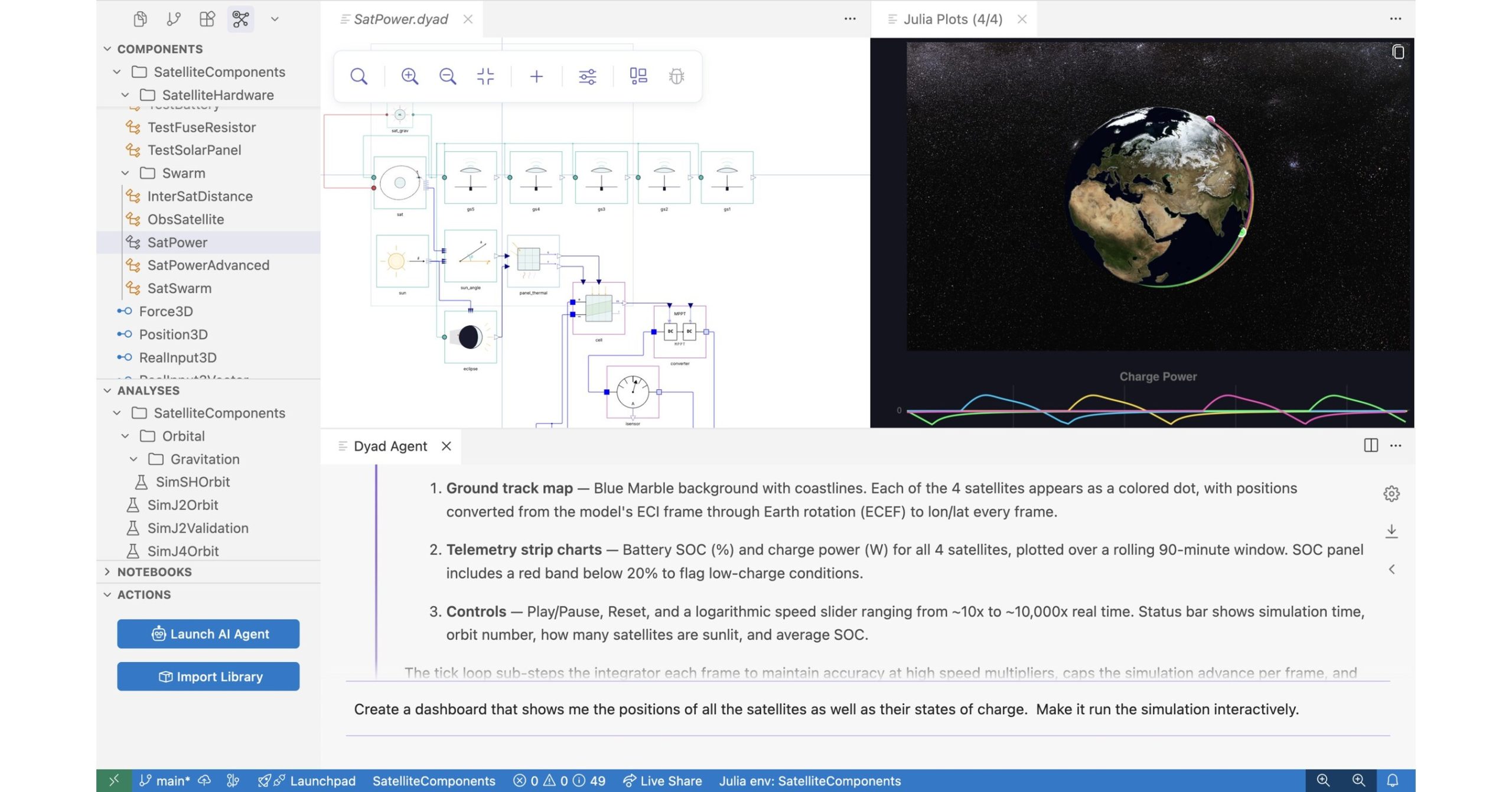

JuliaHub’s launch of Dyad 3.0, backed by a $65M Series B led by Dorilton Capital and joined by General Catalyst, AE Ventures, and former Snowflake CEO Bob Muglia, marks a pivotal moment for physical AI in industrial engineering. The platform’s ability to compress R&D cycles from months to days by integrating autonomous AI agents with physics-based simulations positions it as a strategic enabler for MENA’s transition toward technology-driven economic diversification. For businesses in the region, Dyad offers a competitive edge by reducing time-to-market for critical infrastructure projects, from energy grids to water management systems. This acceleration is particularly relevant in MENA, where sovereign and venture capital markets are increasingly prioritizing high-impact tech investments to address regional challenges. The platform’s applicability across aerospace, utilities, and transportation sectors aligns with MENA’s infrastructure priorities, suggesting a model where local enterprises can leverage AI-driven engineering to deliver cost-effective, scalable solutions. The Series B round itself underscores growing global appetite for physical AI – a trend that could catalyze cross-border investment flows into MENA, positioning the region as a hub for advanced hardware innovation within the global ecosystem.
The implications for sovereign capital in MENA are profound. Governments in the region face mounting pressure to modernize aging infrastructure while navigating fiscal constraints. Dyad’s capacity to enable rapid, precise digital twin development offers a pathway to optimize public spending through predictive modeling and risk mitigation. For instance, utilities firms in the Gulf or North African states could deploy Dyad to simulate and validate smart grid systems or desalination plants, ensuring long-term resilience against climate risks. Sovereign funds, traditionally focused on energy or real estate, may increasingly allocate capital to physical AI platforms like Dyad, which promise measurable returns through improved operational efficiency and reduced risk. Furthermore, the $65M Series B led by a U.S.-based firm highlights transnational investor confidence in MENA’s emerging tech ecosystem. This could prompt regional sovereign entities to partner with MENA-based or regional VC funds to source similar technologies, fostering a symbiotic relationship between public investment and private innovation. The adoption of Dyad 3.0 in public-sector projects could thus serve as a proof point for other sovereign-backed initiatives in sectors like renewable energy or transportation, which are central to MENA’s economic agendas.
Venture capital implications in MENA are equally significant, as the region’s VC landscape is accelerating its focus on infrastructure and industrial tech. The success of Dyad’s funding round—led by global firms with deep technical and financial expertise—signals a blueprint for attracting similar investments into MENA. Local VCs may emulate this model by backing startups that integrate physical AI into regional value chains, such as smart agriculture in arid zones or hydrogen infrastructure in the Gulf. Moreover, the platform’s open-source foundation and adaptability to local regulatory frameworks could lower barriers for regional entrepreneurs. A key differentiator for MENA is its ability to address hyperlocal challenges—like water scarcity or energy transition—with AI-native solutions. If MENA-based or pan-regional VCs replicate the Dyad investment model, it could catalyze a surge in startups targeting physical systems engineering, thereby creating a self-sustaining ecosystem. Additionally, the presence of institutional-grade investors like Dorilton Capital in this round may inspire sovereign-backed accelerators in MENA to incorporate physical AI into their portfolios, further strengthening the region’s position in the global tech stack for hard infrastructure.
Regionally, Dyad’s impact on infrastructure development could be transformative. MENA’s vast, heterogeneous landscapes require sophisticated systems for managing resources, from oil and gas facilities to urban transit networks. Dyad’s ability to generate compliant, physics-based digital twins without requiring specialized PhD-level engineering resources democratizes access to advanced modeling tools. For example, a government in the Levant could deploy Dyad to optimize retrofitted historical infrastructure or design resilient ports for modern trade demands. Similarly, in North Africa, the platform could accelerate the deployment of solar-powered desalination plants by simulating varying climatic and geological conditions in real time. The intersection of sovereign capital, VC funding, and physical AI thus creates a triad for MENA to leapfrog traditional engineering bottlenecks. However, realizing this potential requires concerted efforts: regulatory bodies must align frameworks to support AI-driven infrastructure projects, while VCs and sovereign funds must prioritize physical AI as a growth vector. If achieved, Dyad could serve as a catalyst—not merely for technological adoption, but for redefining how MENA approaches its most urgent developmental challenges through scalable, intelligent engineering solutions.