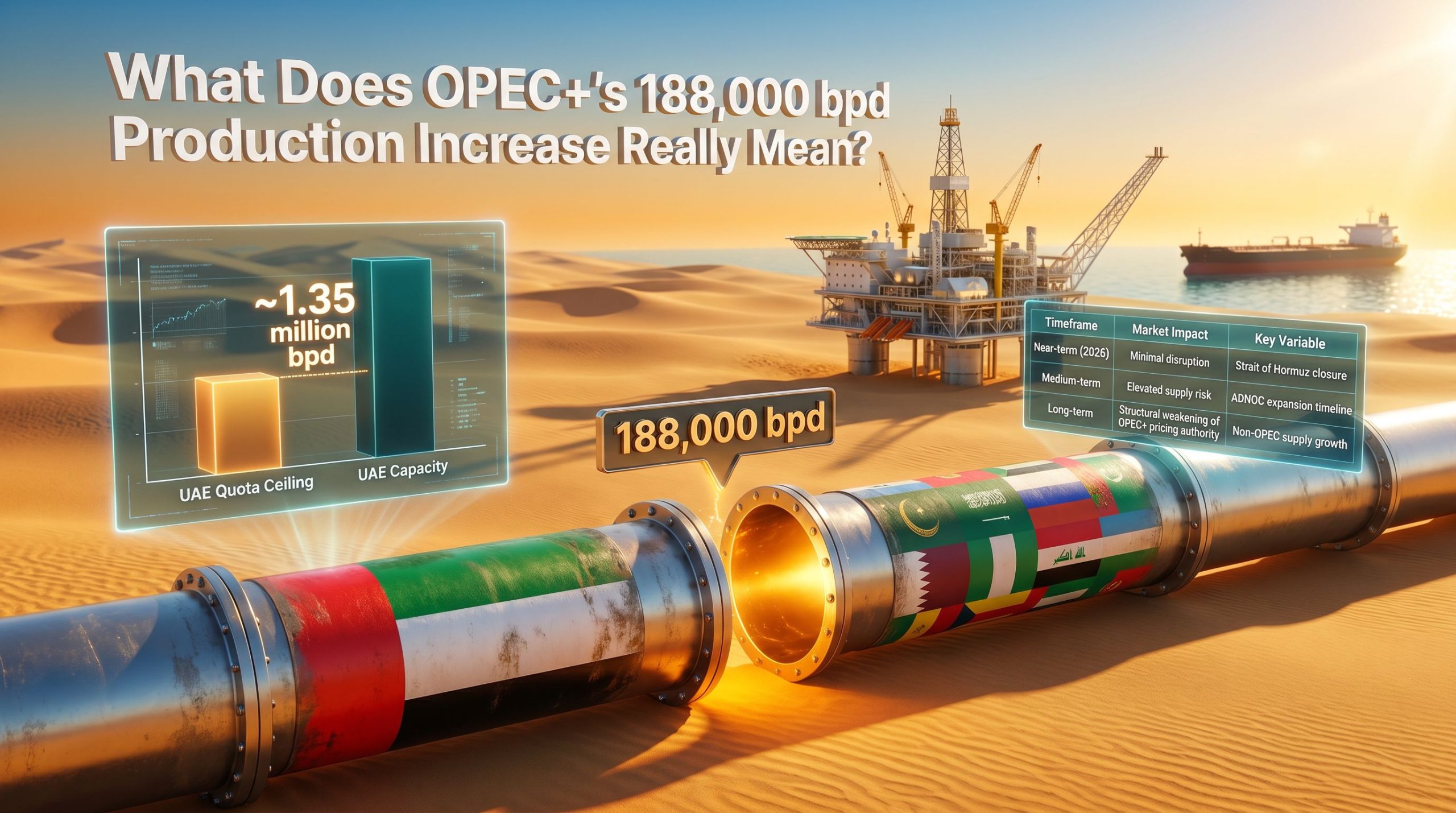

With Abu Dhabi’s formal exit from OPEC+ on 1 May 2026, the Gulf’s most prolific oil producer shed the collective quota mechanism that had governed its output for decades. By the time of the withdrawal the UAE’s National Oil Company, ADNOC, had already fielded approximately 4.85 million barrels per day (bpd) of capacity, against an OPEC+ ceiling of roughly 3.5 million bpd. The resulting 1.35‑million‑bpd “sacrifice” had represented more than a third of the country’s production capability and had been sustained by a national economy finely tuned to export‑generated revenue. Removing the UAE from the cartel clears this 1.35‑million‑bpd corridor from the OPEC+ quota grid, instantly enlarging the pool of uncoordinated supply available to the sovereign and opening a channel for accelerated output that the alliance can no longer constrain.
The June 2026 production adjustment—an 188,000 bpd increase announced by Saudi Arabia, Russia and five other members—was largely a procedural carry‑over that OPEC+ treated as routine business. However, the shift gains a different character once the UAE is excluded: the cartel’s effective share of global production drops noticeably, while a state‑backed, privately funded 55‑billion‑dirham ($55 billion) expansion programme announced by ADNOC is positioned to bear down on market supply once the Strait of Hormuz reopens. For sovereign capital markets, this translates into an immediate erosion of OPEC+ price‑setting power and a new risk premium for producers that could deviate from the quota logic that has historically tempered volatility.
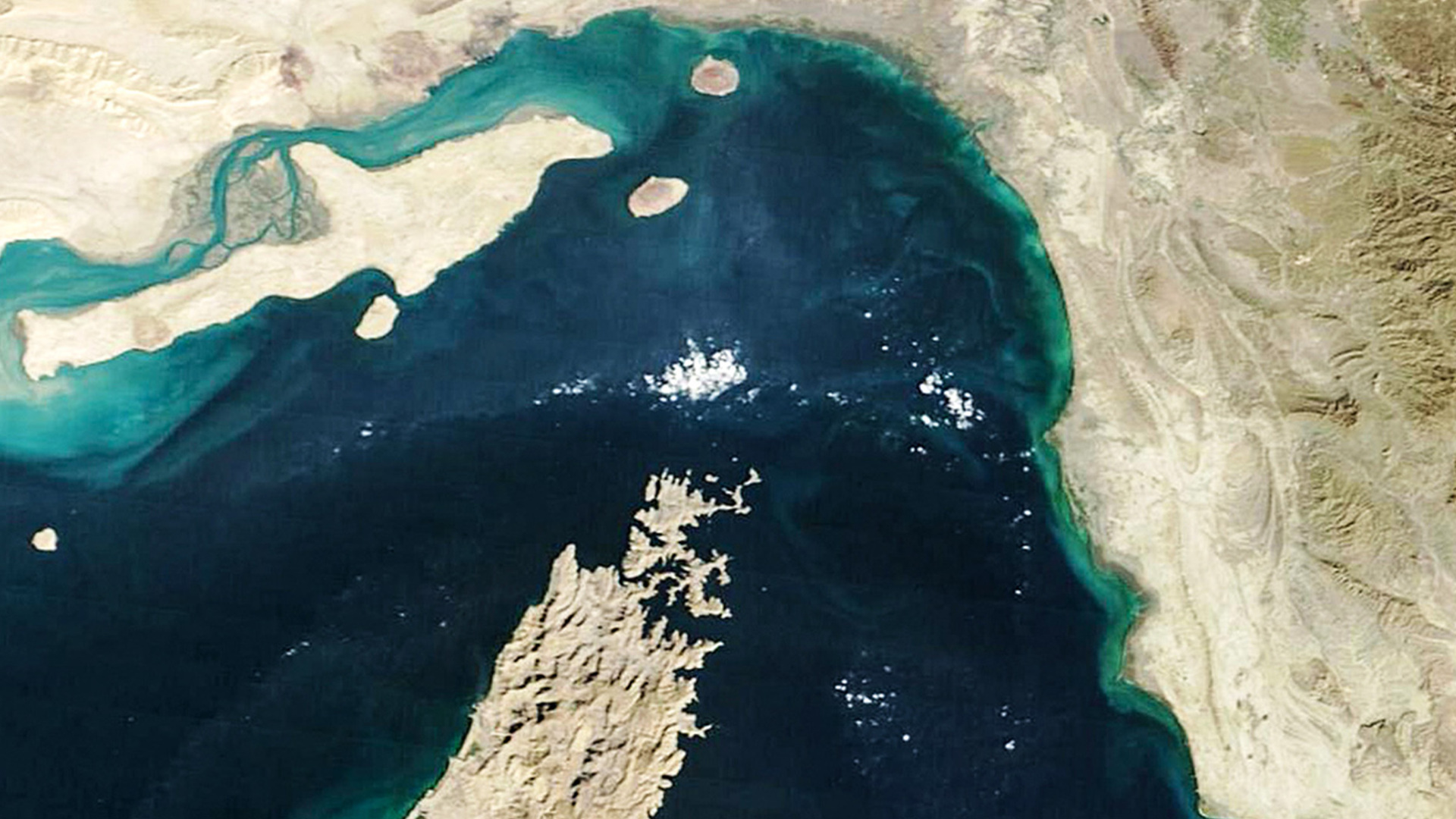
From an infrastructure perspective, the region faces a dual convergence of capital investment and geopolitical constraint. ADNOC’s push to fill a 1.35‑million‑bpd capacity gap hinges on the reopening of the Hormuz waterway, a channel whose blockage has already forced producers to treat quota increases as theoretical. When navigable again, the UAE will be uniquely positioned to deliver high‑volume crude without Oview to OPEC+ oversight, compelling other non‑OPEC players—US shale, Brazil and Kazakhstan—to reassess their own supply‑management strategies. Venture capital flowing into downstream and midstream assets across the Gulf will increasingly be calibrated against this new supply window, as investors seek to capture upside from a region that is both expanding its output and decoupling from collective price governance.
In sum, the UAE’s departure marks a structural pivot in Middle East—and by extension, MENA—energy economics. Sovereign revenue streams are no longer tethered to an alliance quota; venture capital flows are reshaped by the prospect of unsupervised supply expansion; and regional infrastructure projects must now be aligned with a new reality where Gulf output can surge without coordinated restraint. The next weeks will reveal whether the remaining OPEC+ members can maintain a cohesive narrative, but the business case for a more fragmented, faster‑moving oil market in the Gulf is already in motion.