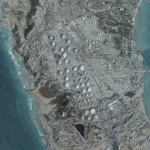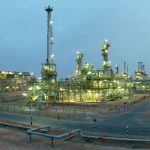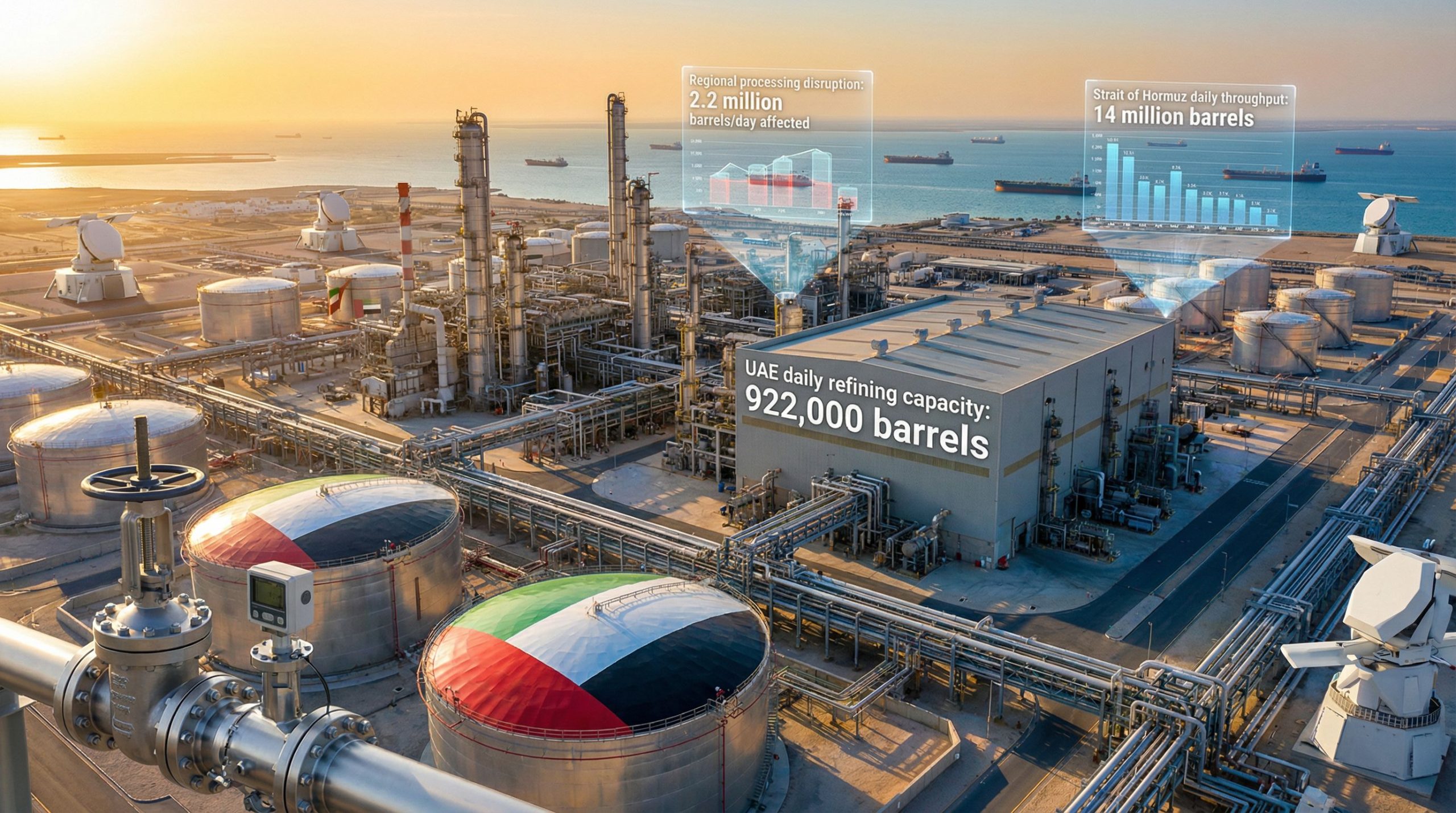

The recent drone strike on ADNOC’s Ruwais refinery has crystallized a profound reassessment of energy infrastructure vulnerability across the Gulf, exposing how concentrated downstream assets face asymmetric threats from proliferating autonomous systems. The facility’s 922,000 bpd capacity—representing roughly 15% of UAE refining output and integrated with petrochemical and fertilizer production—triggered immediate regional cascading effects, including force majeure declarations at Bahrain’s Bapco complex and production adjustments in Kuwait. This incident underscores a critical shift: modern refining economics, which prioritize geographic integration for operational efficiency, now create single-point failure risks where disruption to core units like crude distillation necessitates full-site shutdowns, amplifying economic impact far beyond physical damage estimates. Market response was swift, with Brent crude spiking 2.3% intraday as traders priced in potential prolonged outages, testing the efficacy of strategic reserve mechanisms designed for traditional supply shocks rather than precision infrastructure attacks.
Sovereign capital is already mobilizing to address this new risk paradigm, with Gulf states accelerating investments in layered defense systems and geographic diversification strategies. Abu Dhabi’s ADQ has earmarked $1.8 billion for refinery hardening across its portfolio, focusing on AI-driven threat detection, decentralized utility networks, and hardened control architectures—direct responses to the Ruwais incident’s demonstration of how shared infrastructure (cooling water, power grids) propagates failure. Simultaneously, Saudi Arabia’s PIF is fast-tracking $5 billion in investments to expand alternative export corridors like the Petroline pipeline and develop inland refining clusters in Ras Al-Khair, reducing Hormuz Strait dependency. These moves reflect a broader sovereign wealth fund reallocation toward assets with demonstrable resilience to asymmetric threats, altering project finance terms as lenders impose higher risk premiums on coastal refining projects lacking distributed defensive capabilities.
Venture capital and private capital flows are concurrently shifting toward defensive technologies and decentralized energy solutions, creating new investment corridors within MENA’s tech ecosystem. Early-stage funding for counter-drone systems—particularly RF jamming, AI-powered surveillance, and kinetic interceptors—has surged 40% YoY across UAE and Saudi accelerators, with sovereign-backed funds like Hub71 and Wa’ed taking strategic stakes. Concurrently, infrastructure investors are reassessing bluefield integrated complexes; greenfield modular refining projects in Oman’s Duqm and Egypt’s Suez Canal Zone are attracting premium valuations due to their inherent geographic dispersion. This capital migration is reshaping regional energy security economics, as the cost of defending concentrated assets now competes with the capex of building distributed capacity—a calculation that favors the latter when factoring in business interruption insurance premiums, which have risen 25-35% for Gulf refining operators post-strike. The Ruwais event thus marks not an isolated incident but a catalyst for structural change in how MENA energy infrastructure is conceived, financed, and protected.