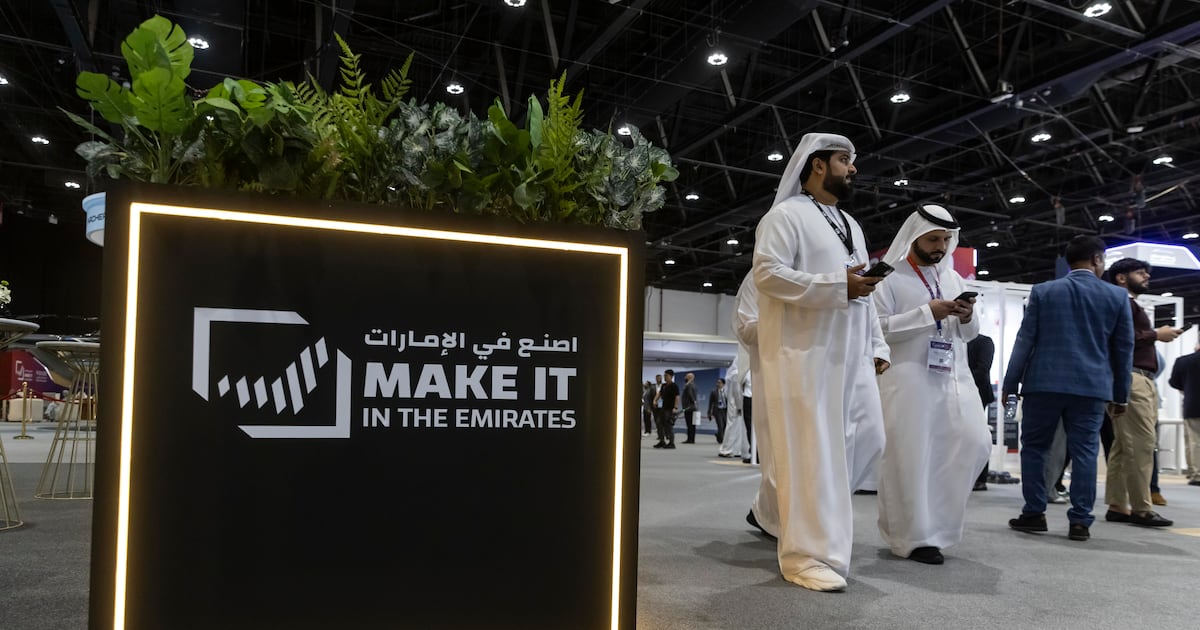

The recalibration of industrial and sovereign resilience now defines the MENA risk-adjusted growth matrix, with Abu Dhabi’s Make it in the Emirates summit functioning as the decisive interface between capital and security. Against a backdrop of structural geopolitical fragmentation, the UAE is institutionalizing self-insurance across critical input chains—food, medical, metals, chemicals and advanced technology—by ring-fencing domestic productive capacity with explicit sovereign mandates. The Dh1 billion National Industrial Resilience Fund is not marginal liquidity; it is contingent capital deployed to harden priority nodes of the non-oil economy and lower the option cost of import substitution. In a region where supply-side shocks redistribute fiscal and current account risk rapidly, this pivot converts industrial policy into balance-sheet protection, anchoring sovereign credit buffers while compressing external vulnerability premia across GCC corporates and state-linked issuers.
Venture and growth capital are being re-channeled into de-risked, strategic verticals underwritten by state balance sheets and long-term offtake visibility. The Emirates Development Bank’s pipeline toward Dh9 billion in annual approvals—amplified by a dedicated Dh1 billion growth mandate for SMEs—signals a co-investment model in which policy risk is absorbed to crowd in institutional liquidity. With offtake agreements at the summit projected to exceed $45 billion and SME participation rising 42 percent year-over-year, the cap table for MENA tech and industrial platforms is shifting from consumer-facing speculation to hard-asset productivity. Capital allocation now hinges on ICV-weighted returns: procurement mandates that redirect government spend into the national economy create contracted revenue floors that lower funding costs, extend runway visibility and unlock cross-border mezzanine and export-finance facilities for regional champions.
Infrastructure strategy is converging with sovereign capital deployment to lock in logistics, energy and digital corridors that compound MENA’s comparative advantage. Mandatory ICV coverage for federal and state-linked entities insulates domestic capacity from external demand volatility while monetizing industrial clusters through captive demand, effectively turning fiscal spend into a funded basis for network expansion and inventory rationalization. The multiplier effect extends across the region: neighboring markets will face pressure to replicate sovereign-funded industrial buffers and preferential procurement architectures or cede value-added activity to subsidized UAE hubs. Over the 2026–2031 cycle, this re-ordering implies a structural reallocation of FDI and project finance toward automation, robotics and critical-input localization, compressing Capex cycles and embedding the Gulf as the MENA reference price-setter for resilient, capital-intensive supply chains.