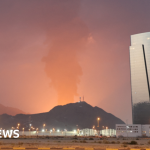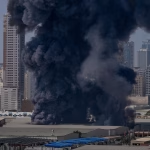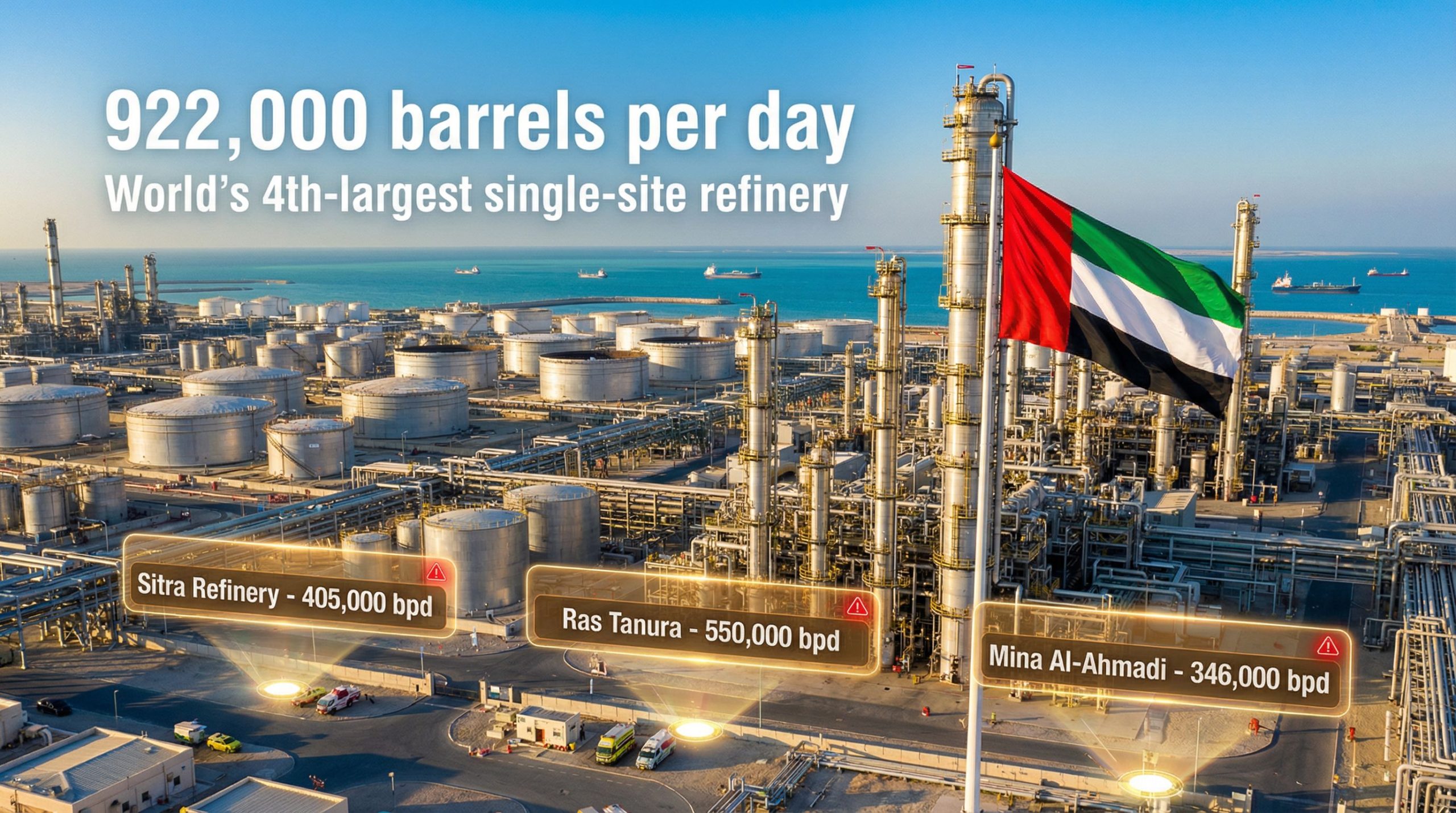

The drone strike on ADNOC’s Ruwais complex, which knocked out roughly 817,000 b/d of refining capacity and contributed to a broader OPEC+ supply curtailment of 6.2‑6.9 million b/d, has underscored the fragility of the MENA energy chokepoint system. The incident forced precautionary shutdowns of the Ruwais West refinery and highlighted the integrated nature of modern Gulf assets, where refining, petrochemicals and fertilizer production are tightly coupled. Market participants reacted swiftly, with ICE Brent swinging from $120 /bbl to below $90 /bbl in single sessions, reflecting both the immediate supply shock and the difficulty of pricing a scenario where traditional export routes via the Strait of Hormuz are intermittently blocked.
Sovereign wealth funds across the region are already recalibrating capital allocations in response. Entities such as ADQ, Mubadala and Saudi Arabia’s PIF are earmarking billions for hardened infrastructure—upgrading the East‑West pipeline’s throughput, expanding strategic storage at Yanbu and Ruwais, and investing in redundant offshore loading points. Simultaneously, venture‑capital activity is spiking around defensive technologies: AI‑driven threat detection, autonomous intercept systems and hardened SCADA architectures are attracting seed and Series A funds that see a structural demand surge as national oil companies seek to harden critical nodes against saturation attacks.
Infrastructure bottlenecks remain the most pressing constraint. Yanbu’s effective loading capacity hovers around 4.0 million b/d, well below the 7.0 million b/d design capacity of the East‑West pipeline, while the Sumed pipeline’s 2.3 million b/d ceiling limits the Red Sea‑to‑Mediterranean alternative. The Iraq‑Turkey line continues to operate at a fraction of its nameplate capacity due to security and political frictions, and the Adcop pipeline is already running above its 1.5 million b/d nameplate rating. These limits are prompting a strategic pivot toward distributed refining capacity closer to consumption centers and the development of new marine export corridors that bypass the Hormuz strait altogether.
Looking ahead, market stability will hinge on the speed with which sovereign and private capital can close these infrastructure gaps. Investors should expect a persistent risk premium on Gulf crude until redundant export pathways and advanced defensive layers are demonstrably operational. The crisis is accelerating a reallocation of capital from pure efficiency plays to resilience‑focused projects—spanning storage expansion, pipeline upgrades, and next‑gen security systems—thereby reshaping the MENA energy landscape for the next decade and establishing a new benchmark for infrastructure investment in volatile geopolitical environments.