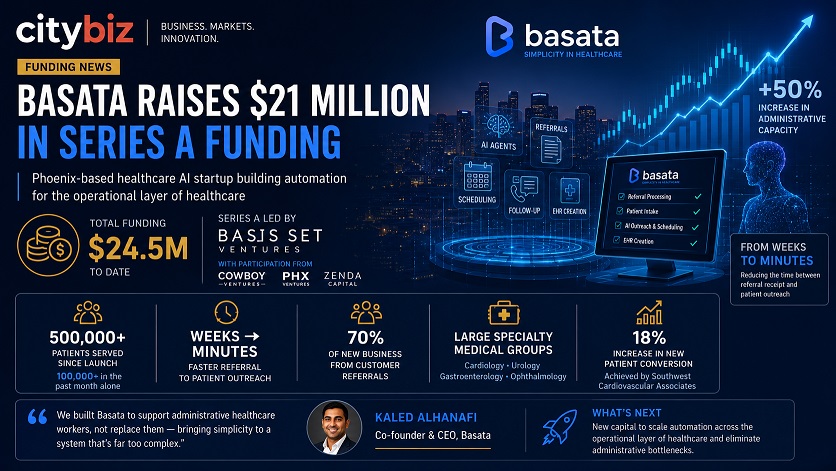

Basata, an Arizona‑based AI specialist that digitises referral and scheduling workflows for U.S. specialty clinics, has closed a $21 million Series A round, taking its cumulative financing to $24.5 million. While the capital originates from North American venture houses – Basis Set Ventures, Cowboy Ventures, PHX Ventures, Zenda Capital and individual angel Victoria Treyger – the deal signals a widening appetite among sovereign wealth funds and regional investors for health‑tech platforms that can be redeployed across the MENA health ecosystem, where legacy administrative processes remain entrenched and labour costs are escalating.
For Gulf Cooperation Council (GCC) sovereign investors, Basata’s technology offers a template for tackling the chronic bottlenecks that plague public‑private hospital networks in Saudi Arabia, the UAE and Qatar. The AI‑driven engine, which converts faxed referrals into electronic health‑record entries, contacts patients via voice bots and auto‑schedules appointments, can be integrated with national health information exchanges that are being rolled out under Vision‑2030‑type programmes. Leveraging the new funding, Basata plans to scale its platform across the “operational layer” of healthcare – a segment that remains fragmented in the region and represents a multi‑billion‑dollar opportunity for efficiency‑driven reform.
From a venture‑capital perspective, the round underscores the maturation of the health‑administration niche, which has attracted $1.3 billion of global VC money in 2023 alone. Basata’s reported 50 % lift in administrative capacity and a reduction of referral‑to‑patient contact time from weeks to minutes positions it as a flagship export for MENA incubators seeking to replicate U.S.‑scale AI solutions locally. Regional funds such as Saudi Arabia’s PIF and Abu Dhabi’s ADQ are likely to view Basata as a strategic acquisition target or a co‑investment partner for building domestic AI‑health platforms that align with sovereign digital‑health agendas.
Infrastructure implications are equally pronounced. Deploying Basata’s cloud‑native stack will demand robust data‑centre capacity, compliance with emerging health‑data sovereignty laws, and interoperable API standards with existing electronic medical‑record systems in the Middle East. The influx of venture capital into such firms accelerates the development of a regional health‑tech supply chain, from AI talent pipelines to secure networking fabric, thereby strengthening the overall digital‑health architecture that underpins future public‑sector reforms.